
EM Hedge Funds: Extracting Alpha from Inefficient Markets?
Theoretically, yes; practically, no.
February 2026. Reading Time: 10 Minutes. Author: Nicolas Rabener.
SUMMARY
- Theoretically, EM hedge funds should have compelling alpha opportunities
- Practically, they just offer diluted exposure to the MSCI EM Index
- It is questionable why there was no more value creation in EM
INTRODUCTION
MSCI, the global index provider, is reportedly considering downgrading the Indonesian stock market from emerging to frontier status, citing opaque share ownership and coordinated trading behaviour, which are indicative of insider trading. With roughly $1.3 trillion in assets tracking the MSCI Emerging Markets Index, the announcement had an immediate negative impact on Indonesian equities.
While the downgrade may be unwelcome for Indonesia, it also creates potential opportunities: investors can acquire beaten-down stocks at attractive valuations or profit from the selling pressure through short positions. Emerging-market hedge funds, in particular, are well positioned to capitalize on such situations, owing to the diversity and inefficiencies inherent in these markets.
Yet, long-biased emerging-market funds have struggled to consistently outperform their benchmarks, despite apparent higher levels of market inefficiency relative to developed markets (read Less Efficient Markets = Higher Alpha?). In this article, we investigate whether emerging markets hedge funds have been more successful at extracting alpha.
PERFORMANCE ANALYSIS
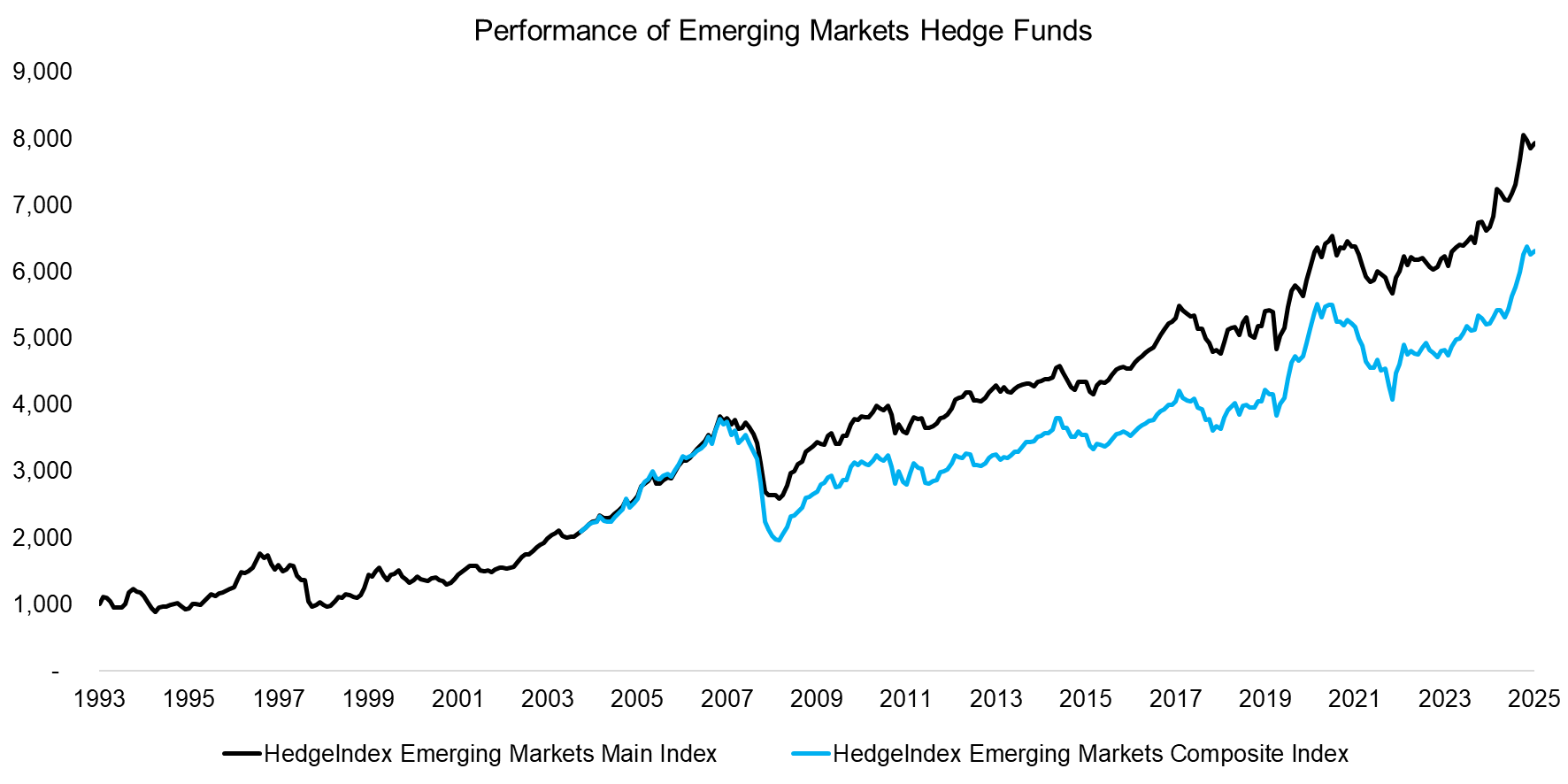
We analyze the performance of the HedgeIndex Equity Market Emerging Markets Main Index and the HedgeIndex Equity Market Emerging Markets Composite Index. The Main Index has a track record dating back to 1994, while the Composite Index, which includes only funds open to new investments, was launched in 2004. Originally developed by Credit Suisse, the index is now marketed by Mast Investments. Both indices track funds focused on emerging markets using a variety of strategies, including long-short equity, equity market neutral, event-driven, arbitrage, and fixed income.
Since 2004, the Main Index has delivered higher returns, with a CAGR of 9.0% and a Sharpe ratio of 0.72, compared to 5.3% and 0.47 for the Composite Index. Despite differences in absolute performance, the two indices exhibit similar overall trends as demonstrated by their 0.91 correlation.
Source: Mast Investments, Finominal
FACTOR EXPOSURE ANALYSIS
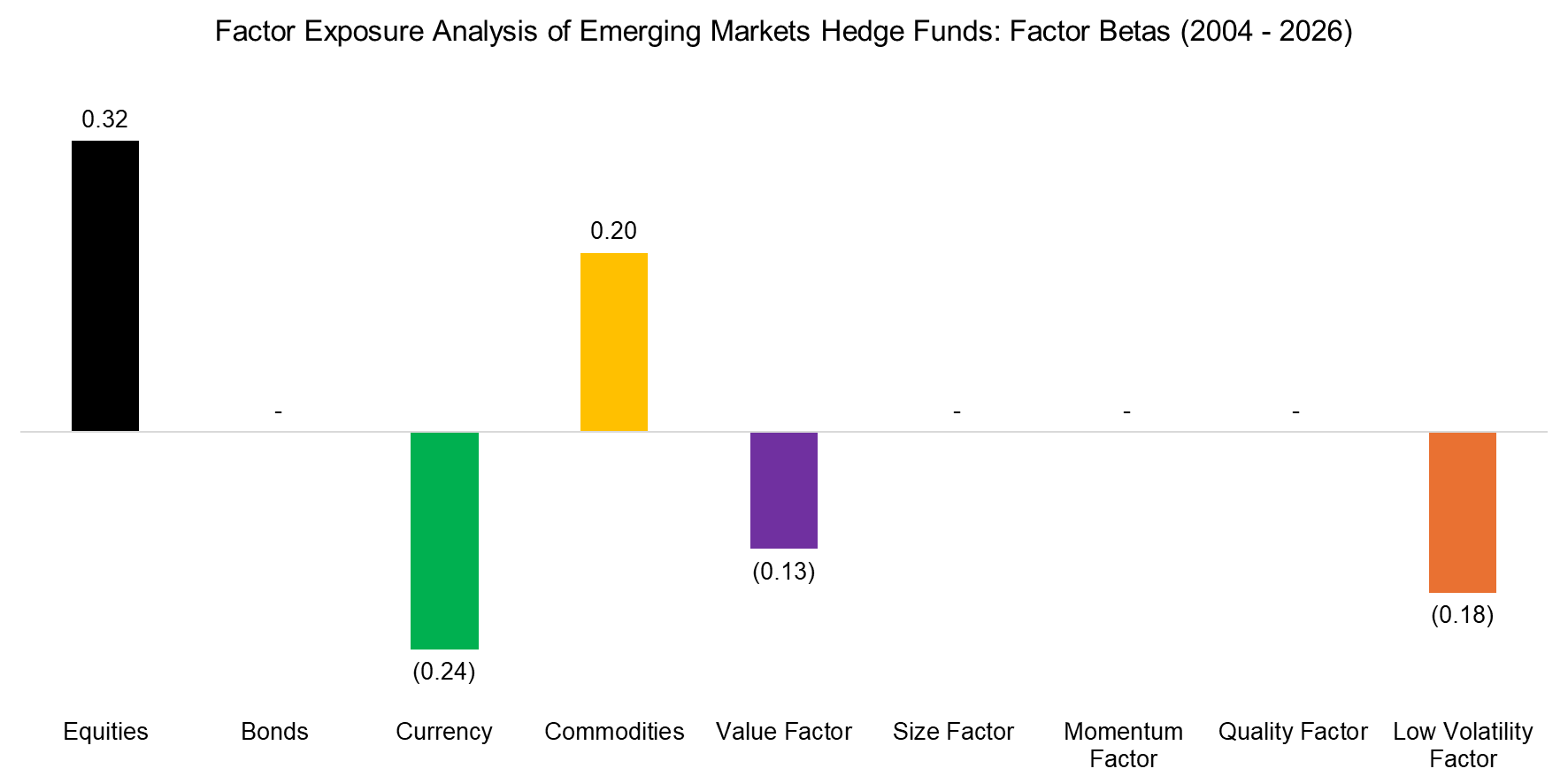
To better understand the drivers of emerging markets hedge fund performance, we conducted a returns-based factor exposure analysis using a Lasso regression. The results indicate a positive beta to equities and commodities, and negative betas to currencies relative to the U.S. dollar, as well as to value and low-volatility factors between 2004 and 2026. This suggests that these funds take directional risk, as reflected in the positive equity beta, which naturally limits diversification benefits. However, the regression achieved an R-squared of only 0.66, indicating that the model explains the returns only partially.
Source: Finominal
QUANTIFYING DIVERSIFICATION BENEFITS
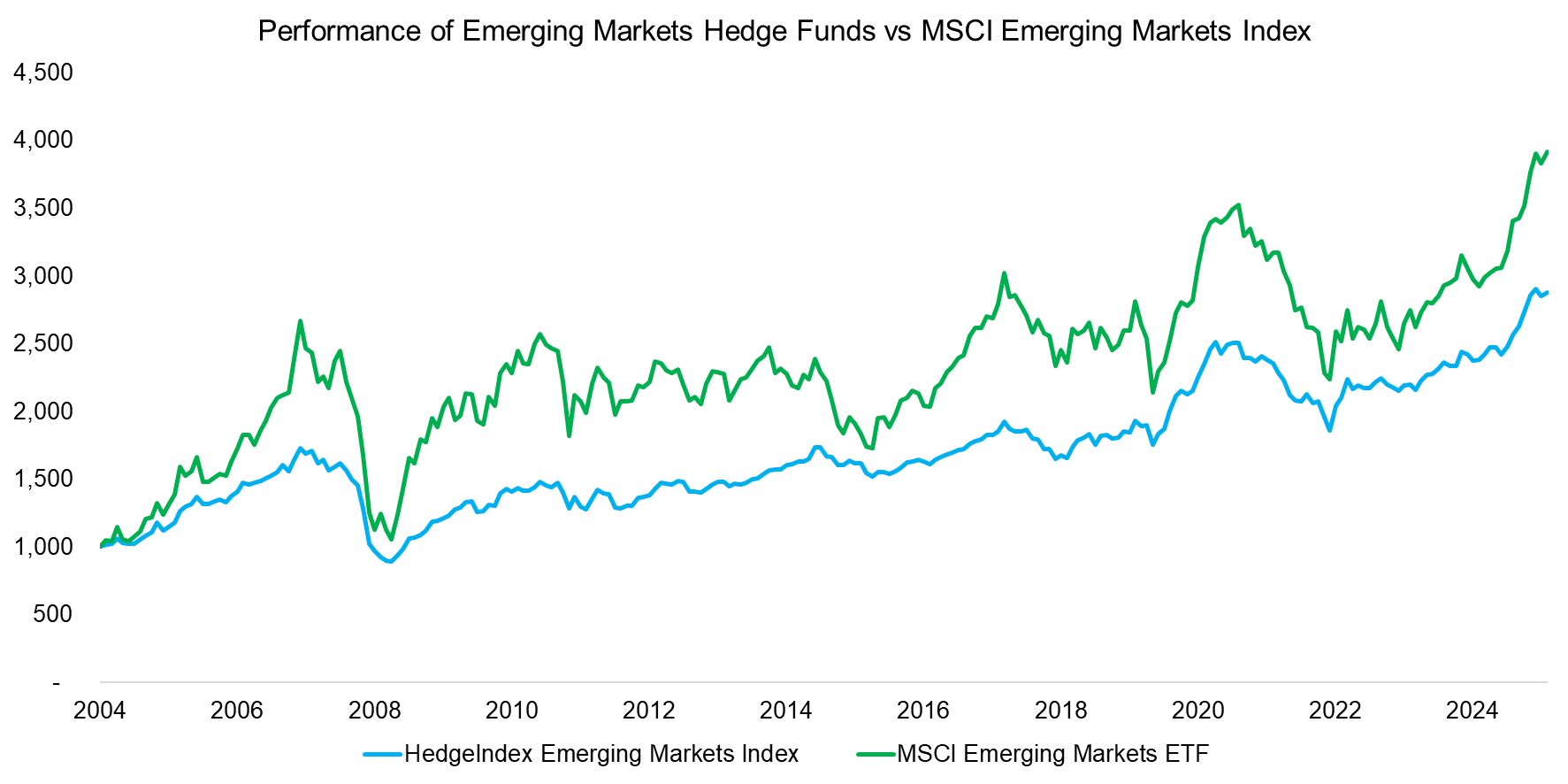
Given equity-like performance trends in emerging markets hedge funds and their positive equity beta, we compare them with the MSCI Emerging Markets Index. Between 2004 and 2025, we observe similar performance patterns and a high correlation of 0.82.
Source: Finominal
REPLICATING EM HEDGE FUNDS
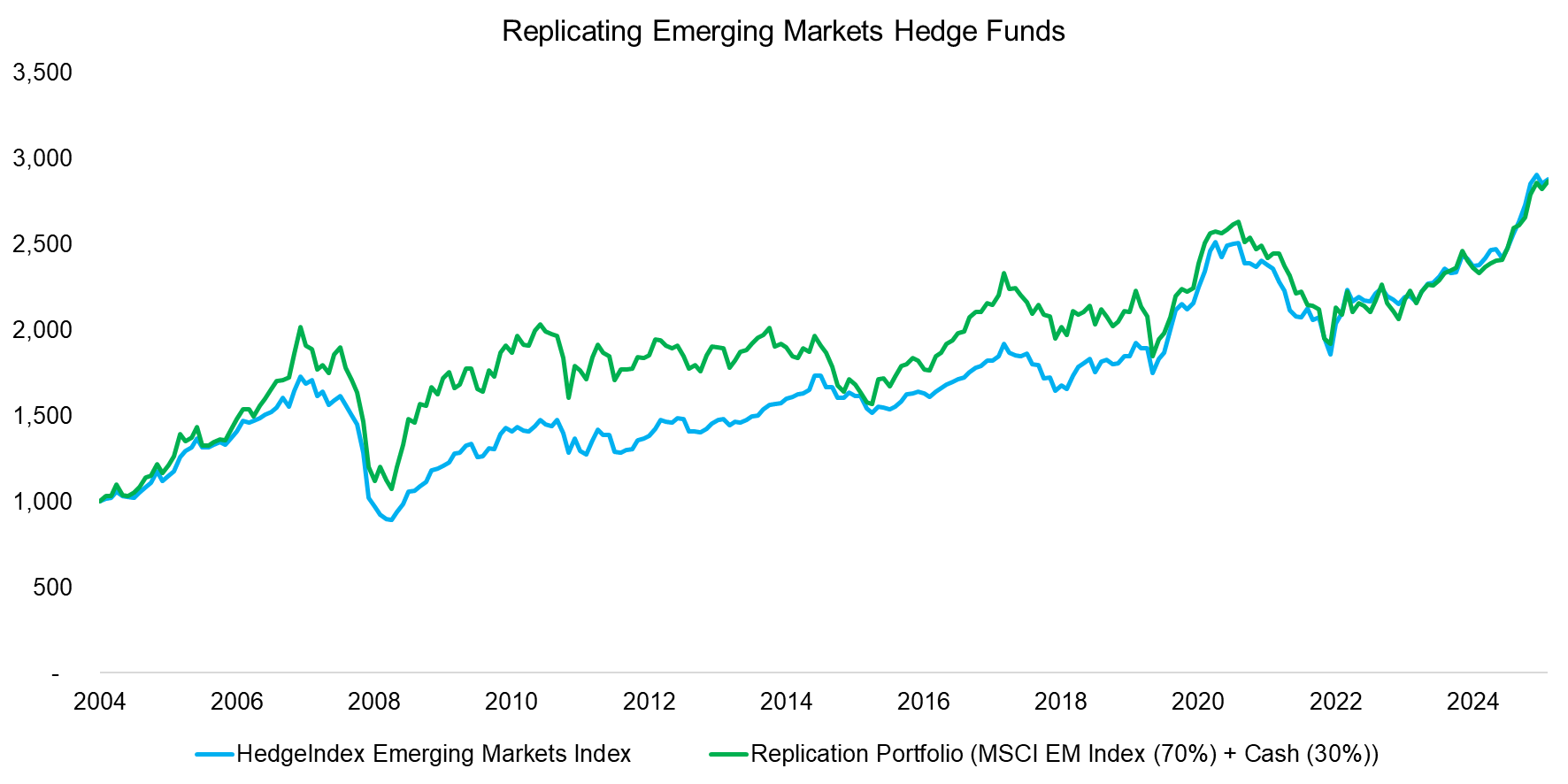
Given the high correlation, we construct a simple replication portfolio consisting of 70% in the MSCI Emerging Markets Index and 30% in non-interest-bearing cash. The replication portfolio mirrors the performance trends of the emerging markets hedge funds and has produced the same cumulative return since 2004.
Source: Finominal
FURTHER THOUGHTS
This analysis largely confirms the findings of our previous research on hedge fund strategies: most funds provide only diluted equity exposure and do not create meaningful value. The reality is that generating alpha is difficult, and attempting to do so through a truly equity market neutral approach is often career-ending for fund managers. Incorporating some market exposure helps ensure survival, provided the market performs well.
However, it is therefore disappointing to see that even in emerging markets, where inefficiencies might be expected, the results are no different from those in developed markets. Perhaps they do, and fees are simply too high.
RELATED RESEARCH
Less Efficient Markets = Higher Alpha?
Emerging Market Funds: Same, Same, but Different?
Momentum in Emerging Markets
The Case Against EM Equities
Factor Investing in Emerging Markets
EM Equities vs Debt: Same, Same, but Different?
Market Neutral Hedge Funds: Powered by Beta?
Multi-Strategy Hedge Funds: Equity in a Different Shade?
Global Macro: Masters of the Universe?
Merger Arbitrage: Arbitraged Away?
ABOUT THE AUTHOR
Nicolas Rabener is the CEO & Founder of Finominal, which empowers professional investors with data, technology, and research insights to improve their investment outcomes. Previously he created Jackdaw Capital, an award-winning quantitative hedge fund. Before that Nicolas worked at GIC and Citigroup in London and New York. Nicolas holds a Master of Finance from HHL Leipzig Graduate School of Management, is a CAIA charter holder, and enjoys endurance sports (Ironman & 100km Ultramarathon).
Connect with me on LinkedIn or X.