
Multi-Factor Investing in Emerging Markets
More attractive than in developed markets?
March 2026. Reading Time: 10 Minutes. Author: Nicolas Rabener.
SUMMARY
- Factor investing produced higher returns in EM than in developed markets
- Factor premia were large even over the most recent decade
- However, long-only products were unable to harvest these premia effectively
INTRODUCTION
The largest multi-factor ETF in the U.S. is Goldman Sachs’ ActiveBeta U.S. Large Cap Equity ETF (GSLC). It selects stocks based on four well-known factors: value, momentum, low volatility, and quality. The construction is largely textbook, fees are very low at 0.09% per annum, and the sponsor is widely regarded as having top-tier talent and a strong technology platform. Yet, since its launch in September 2015, GSLC has underperformed the S&P 500 by roughly 0.85% per year.
Unfortunately, similar underperformance has been observed across most U.S. multi-factor ETFs over the past decade. One explanation is that the U.S. equity market has become overcrowded, with smart-beta strategies now representing approximately $1 trillion in assets under management.
What about multi-factor investing in less crowded places like emerging markets? Let’s explore.
FACTOR INVESTING IN EMERGING VS DEVELOPED MARKETS
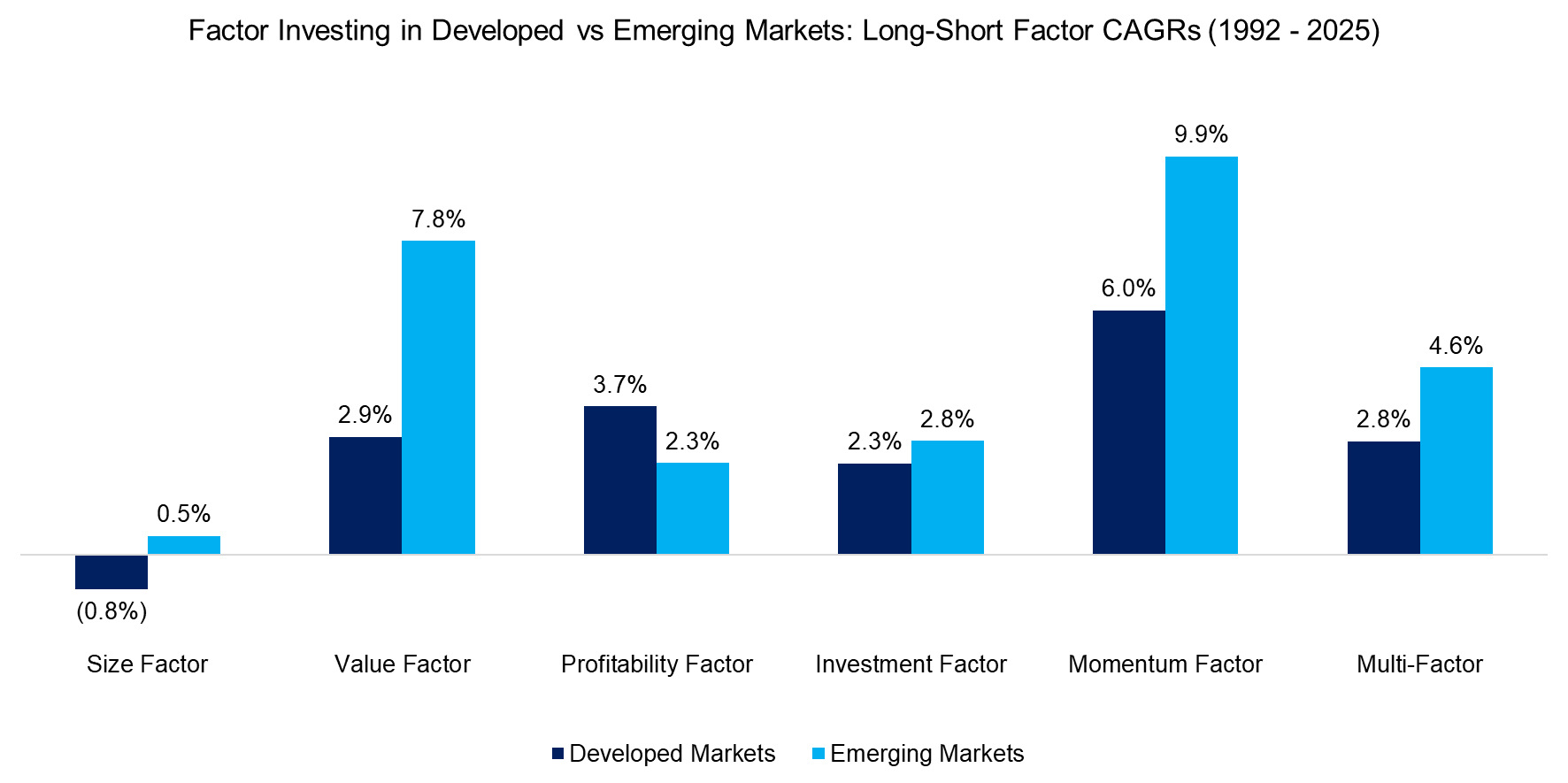
We compare the excess returns of the established long–short equity factors from the Fama–French framework across developed and emerging markets. Between 1992 and 2025, we find that excess returns were higher in emerging markets than in developed markets for all factors except profitability. An equal-weighted multi-factor portfolio would have generated an annualized excess return of 4.6% in emerging markets, compared with only 2.8% in developed markets.
It is worth noting that these results exclude transaction costs and include stocks with very small market capitalizations. That said, the magnitude of the excess returns suggests they would likely remain positive even after accounting for realistic trading costs.
Source: Kenneth R. French Data Library, Finominal
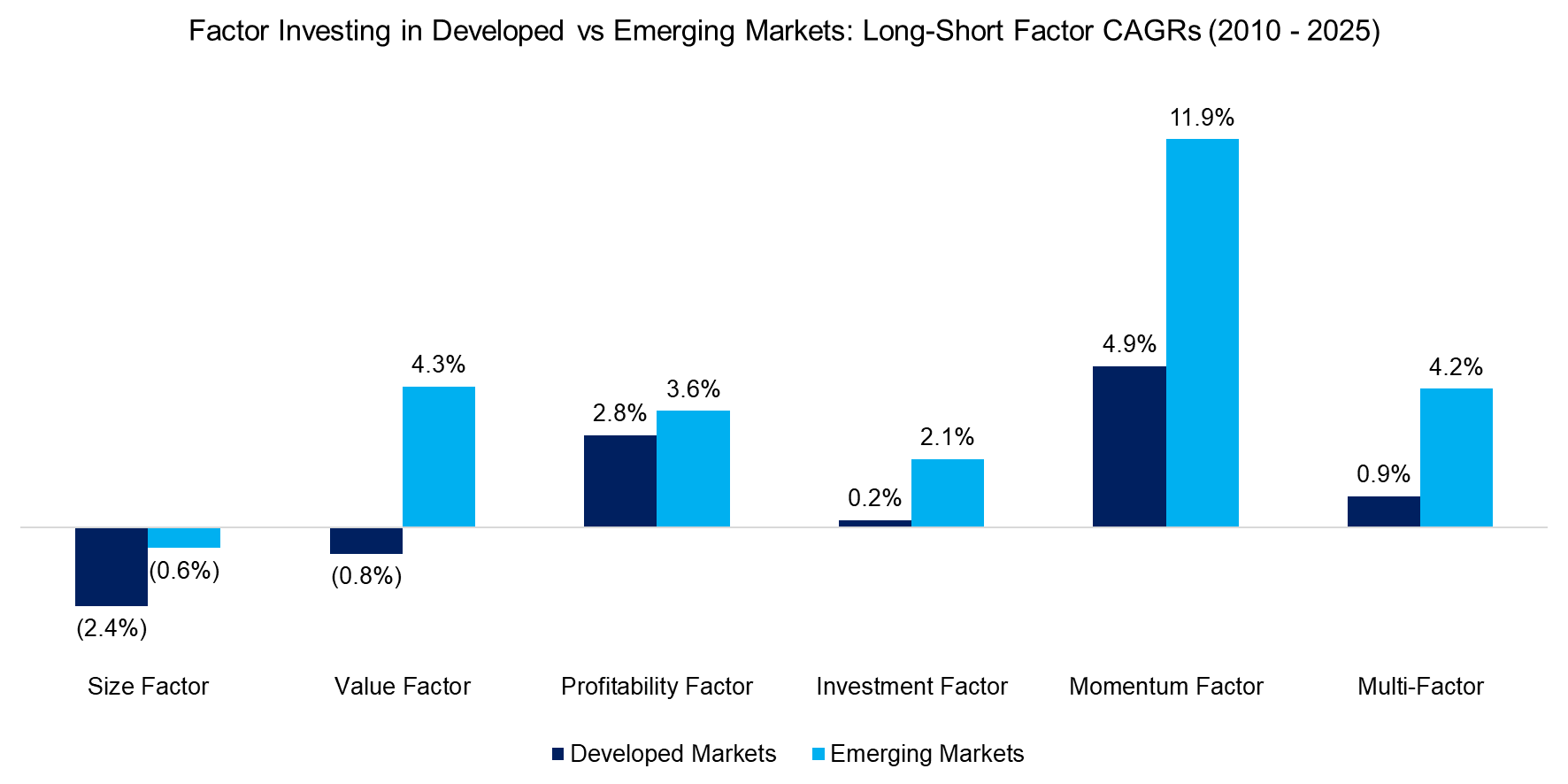
Long-term returns for factor investing have been attractive in both developed and emerging markets, yet we know that over the past decade, realized returns from multi-factor products in the U.S. and other developed markets were disappointing. To examine this, we calculate the excess returns of the long–short factors over the 15 years following the global financial crisis. In developed markets, the equal-weighted multi-factor portfolio delivered an annualized excess return of just 0.9%, which would fall close to zero after accounting for transaction costs and management fees.
In contrast, emerging markets still show a robust annualized return of 4.2%, only slightly below the long-term return of 4.6% per annum observed since 1992.
Source: Kenneth R. French Data Library, Finominal
PERFORMANCE OF MULTI-FACTOR ETFS
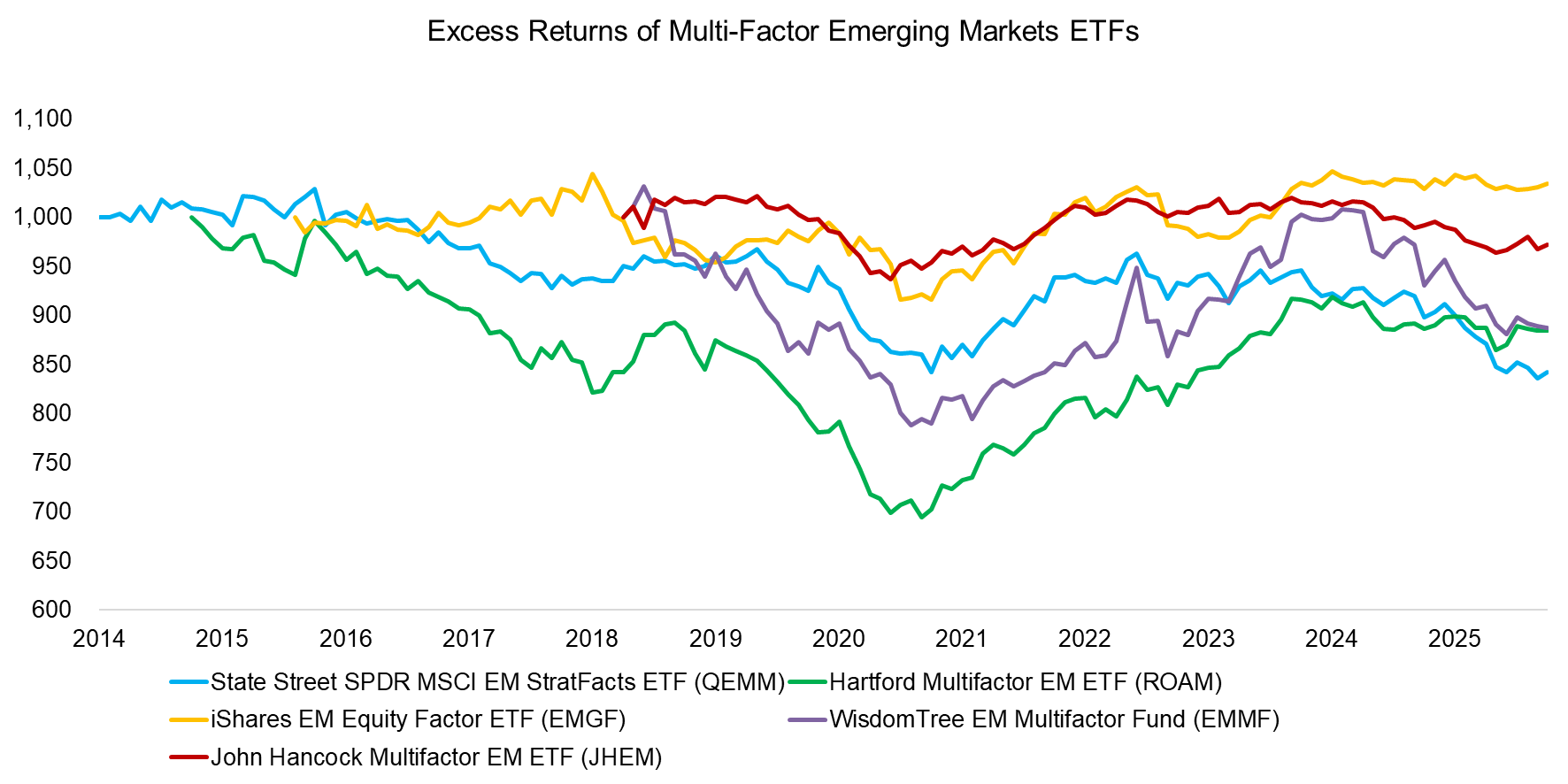
Given strong academic support for factor investing in emerging markets, we examine the largest U.S.-listed multi-factor ETFs: State Street SPDR MSCI EM StrategicFactors ETF (QEMM), Hartford Multifactor Emerging Markets ETF (ROAM), iShares Emerging Markets Equity Factor ETF (EMGF), WisdomTree Emerging Markets Multifactor Fund (EMMF), and John Hancock Multifactor Emerging Markets ETF (JHEM). These funds charge fees ranging from 0.26% (EMGF) to 0.49% (JHEM) and collectively manage $2.5 billion in assets, compared with $138 billion for the iShares Core MSCI Emerging Markets ETF (IEMG). The limited assets under management in these ETFs indicate they have generated little value for investors.
We calculate excess returns for each ETF since inception relative to the MSCI Emerging Markets Index. Despite the academic evidence, only EMGF delivered a positive excess return, while all other funds underperformed the benchmark, some significantly.
Source: Finominal
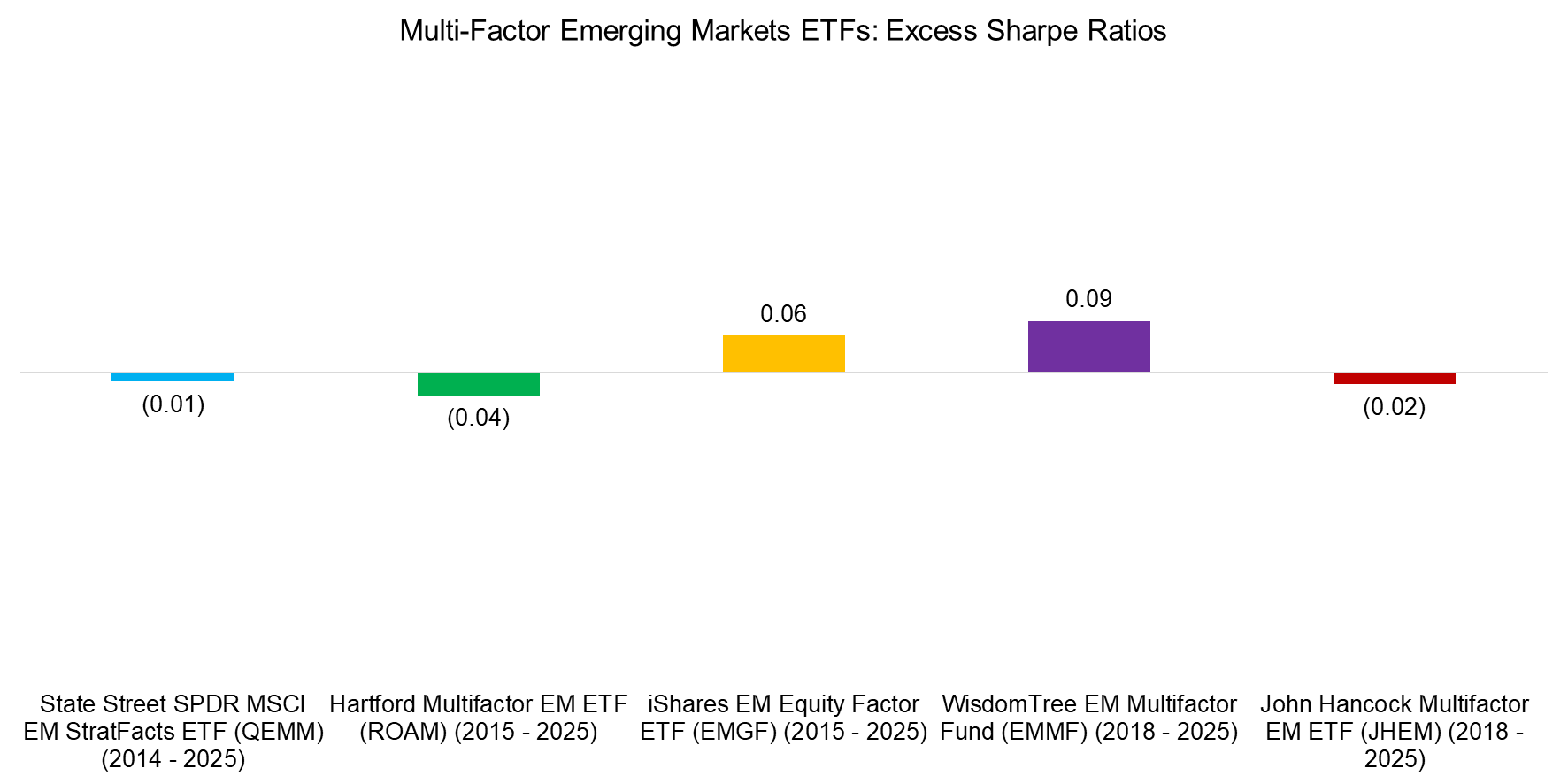
We shift the analysis from relative performance to risk-adjusted returns by calculating excess Sharpe ratios versus the MSCI Emerging Markets Index. This yields a somewhat more favorable view, as two ETFs achieved higher Sharpe ratios than the benchmark. EMGF benefited from both higher returns and lower volatility, whereas EMMF outperformed on a risk-adjusted basis due to significantly lower volatility, which is notable given a portfolio of approximately 200 stocks versus nearly 3,000 for the benchmark index.
Source: Finominal
FURTHER THOUGHTS
What explains the weak performance of multi-factor ETFs in emerging markets over the past decade, which seems to contradict academic findings? A key distinction is that the academic evidence is based on long–short portfolios, whereas the ETFs are long-only. Other contributing factors may include the absence of transaction costs in academic studies, the inclusion of less-liquid stocks, and the stock selection process in portfolio construction.
However, it is worth noting that long–short factor investing is alive and well, as illustrated by products such as AQR’s Equity Market Neutral Fund (QMNIX), which applies this approach to global equities and is trading at all-time highs. The challenge lies in translating the effectiveness of long–short strategies into a long-only format, which is the preferred approach for most investors.
RELATED RESEARCH
EM Hedge Funds: Extracting Alpha from Inefficient Markets?
Emerging Market Funds: Same, Same, but Different?
Momentum in Emerging Markets
The Case Against EM Equities
Factor Investing in Emerging Markets
EM Equities vs Debt: Same, Same, but Different?
EM Debt: To Hold or Not to Hold?
Multi-Factor Smart Beta ETFs
Factor Olympics 2025
Factor Optimization via ETFs
Smart Beta ETF vs Customized Factor Portfolios
Improving Smart Beta Attribution Analysis II
The Illusion of the Small-Cap Premium
Shorting Lousy Stocks = Lousy Returns?
Higher Volatility, Higher Alpha?
Outperformance Ain’t Alpha
Improving the Odds of Value Investing
The Value Factor’s Pain: Are Intangibles to Blame?
Smart Beta vs Alpha + Beta
How Painful Can Factor Investing Get?
GARP Investing: Golden or Garbage? II
Are Low-Risk Stocks Really Low-Risk?
ABOUT THE AUTHOR
Nicolas Rabener is the CEO & Founder of Finominal, which empowers professional investors with data, technology, and research insights to improve their investment outcomes. Previously he created Jackdaw Capital, an award-winning quantitative hedge fund. Before that Nicolas worked at GIC and Citigroup in London and New York. Nicolas holds a Master of Finance from HHL Leipzig Graduate School of Management, is a CAIA charter holder, and enjoys endurance sports (Ironman & 100km Ultramarathon).
Connect with me on LinkedIn or X.