
Quality Stocks in Emerging Markets
Superior returns from betting on good business models?
March 2026. Reading Time: 10 Minutes. Author: Nicolas Rabener.
SUMMARY
- There is a clear rationale for high-quality stocks in emerging markets
- However, these stocks gave up most of their long-term outperformance recently
- The lack of funds in this space is surprising
INTRODUCTION
In our most recent research article (read Multi-Factor Investing in Emerging Markets), we noted that multi-factor ETFs have underperformed in emerging markets, even though academic data from the Kenneth R. French database indicates they should have delivered strong excess returns.
There are several reasons for this underperformance, one of which is suboptimal portfolio construction. While combining uncorrelated factors can provide diversification benefits, we often see asset managers pairing factors, such as value and momentum, that are negatively correlated. Depending on the stock selection process, this can result in factors offsetting each other, effectively producing a portfolio that mirrors the broad market. When coupled with high fees, this setup is almost destined to underperform.
If your goal is to avoid these pitfalls and select a single factor for emerging markets equities, which one should it be?
Setting aside the data for a moment, value may appear unattractive because many emerging market stocks are cheap – but often for a reason, e.g. Russian equities. Momentum can lead to participation in cyclical booms and busts across markets, introducing undesirable volatility. The low volatility factor is appealing, yet it carries the risk of overexposure to low-risk but highly leveraged businesses, which can be sensitive to interest rates and dependent on sound monetary policy – something not always present in emerging markets (hello Argentina!).
By contrast, focusing on quality, particularly profitability, is intuitive: it is a bet on companies with robust business models.
In this article, we evaluate quality stocks in emerging markets.
PROFITABILITY FACTOR IN EMERGING MARKETS
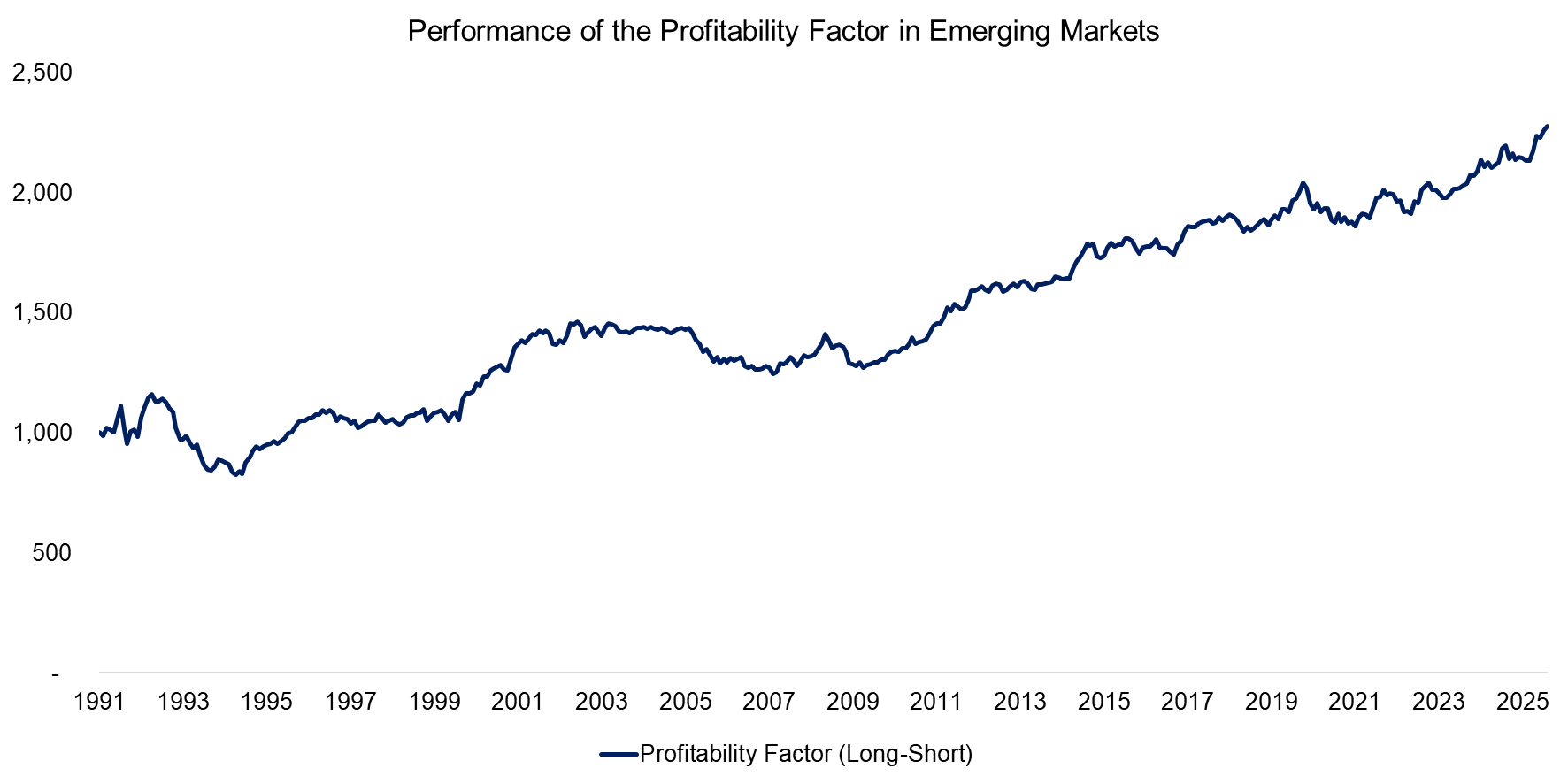
Quality stocks are generally defined as companies exhibiting high profitability and low leverage – that is, businesses with sustainable and resilient business models. While long-term data for a broad “quality factor” in emerging markets is limited, the Kenneth R. French database provides a profitability factor for these markets. In this framework, stocks in the long portfolio are selected for high operating profitability, while those in the short portfolio have low operating profitability.
Using this measure, the profitability factor in emerging markets would have delivered an excess return of 2.4% per year between 1991 and 2025. Performance has been particularly consistent since 2009. It is important to note that these results exclude transaction costs and include stocks with very small market capitalizations.
Source: Kenneth R. French Data Library, Finominal
QUALITY STOCKS IN EMERGING MARKETS
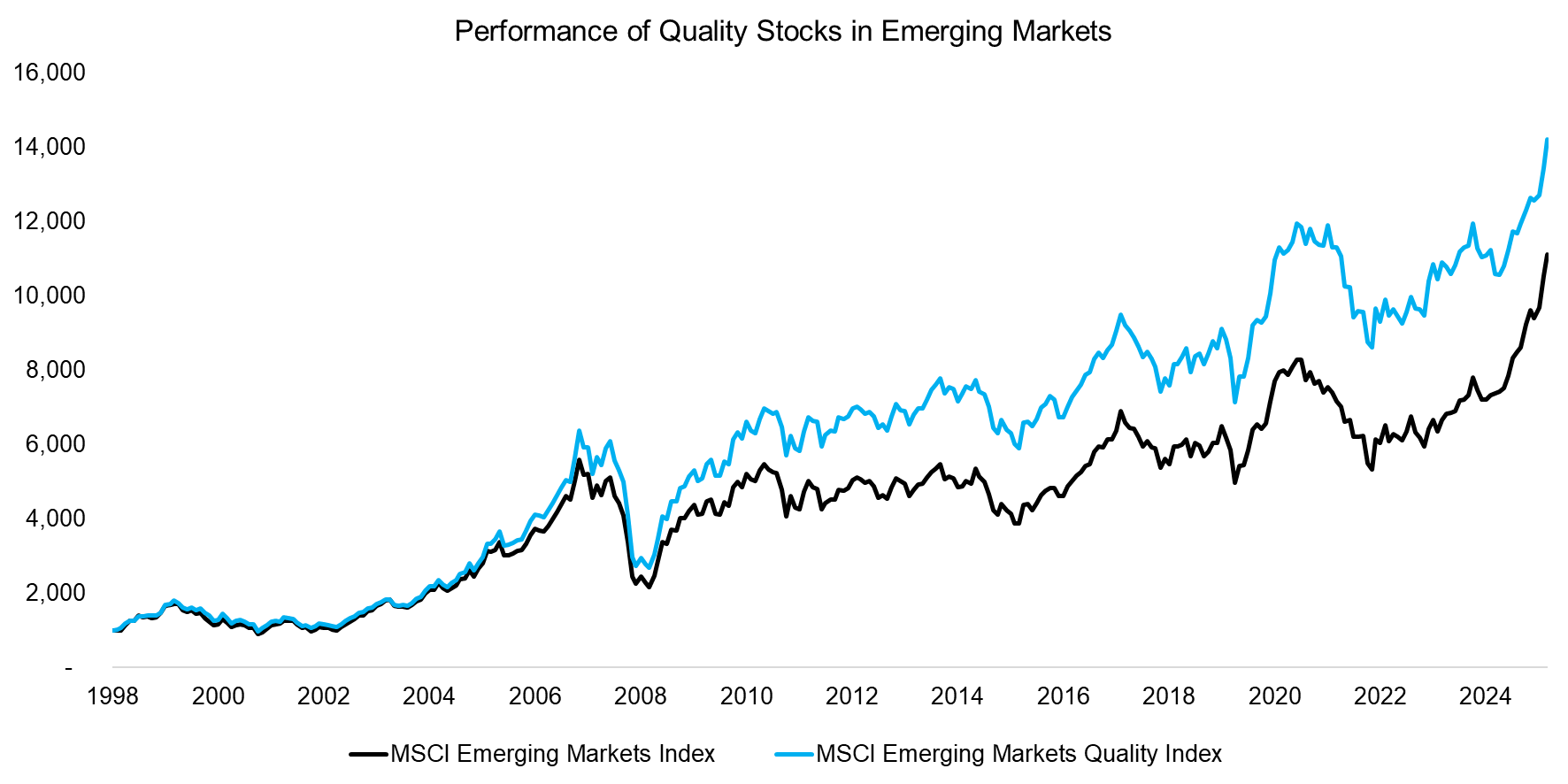
Next, we shift our focus from long-short strategies to long-only indices by examining the MSCI Emerging Markets Quality Index, which selects stocks based on high profitability, strong earnings growth, and low leverage. Between 1998 and 2008, the performance of quality stocks closely tracked the broader MSCI Emerging Markets Index, but they have outperformed consistently since then.
Source: Finominal
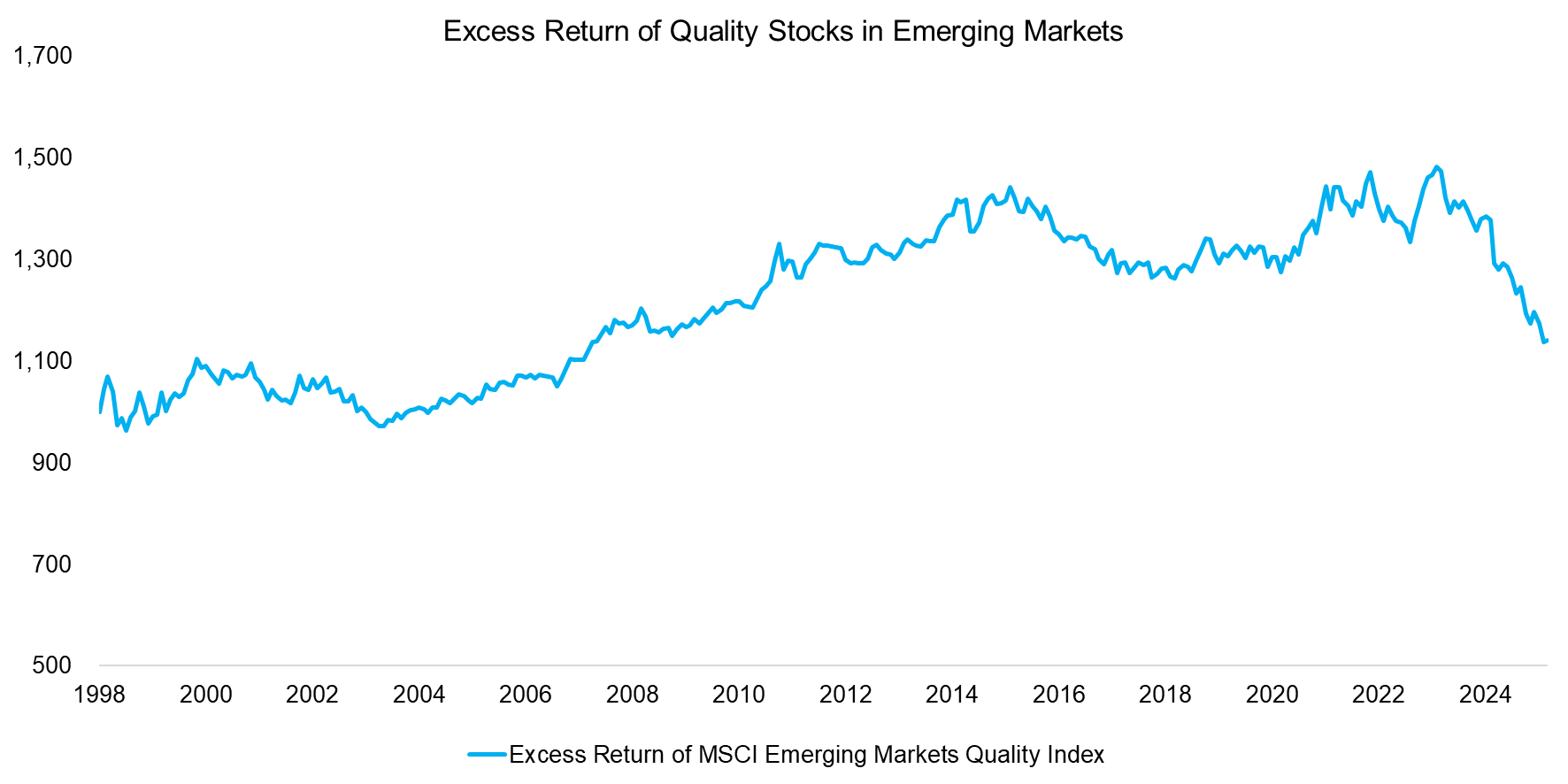
However, when we shift the visualization to show the excess returns of the MSCI Emerging Markets Quality Index, it becomes clear that most of the cumulative outperformance since 1998 was eroded over the past two years, as quality stocks experienced significant underperformance. As a result, the excess return has declined to just 0.5% per year. After management fees, this would be close to zero.
Source: Finominal
QUALITY-FOCUSED EMERGING MARKETS FUNDS
Although the recent poor performance of quality stocks in emerging markets is concerning, one would expect an abundance of mutual funds and ETFs given the long-term track record. However, despite this and the qualitative argument for investing in quality stocks in emerging markets, there are hardly any products available. BlackRock’s iShares only launched the iShares MSCI Emerging Markets Quality Factor ETF (EQLT) in 2024.
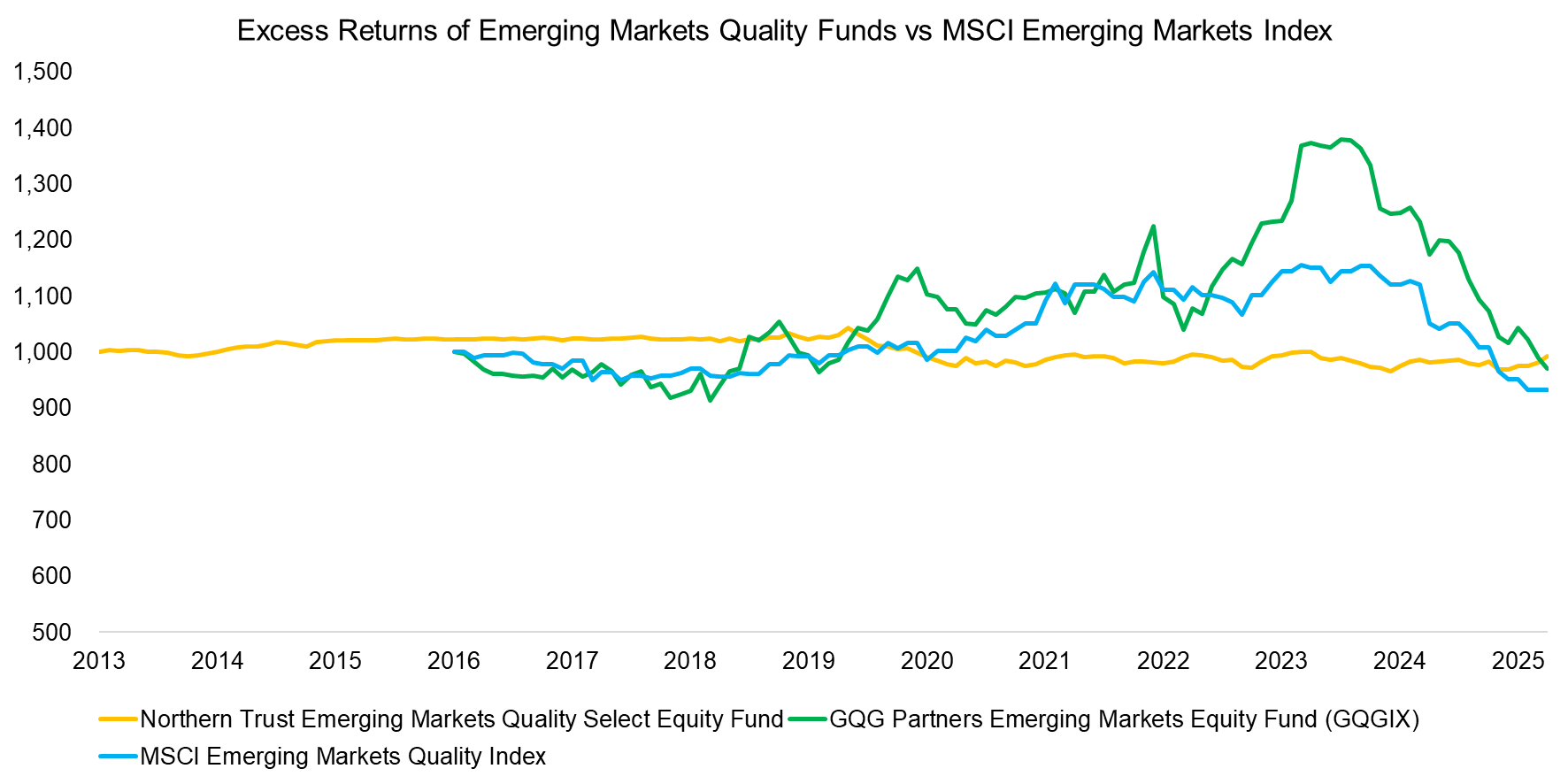
There are only two mutual funds with long track records and a clear emphasis on selecting quality stocks: the GQG Partners Emerging Markets Equity Fund (GQGIX) in the U.S. and Northern Trust’s NT Emerging Markets Quality Select Equity Fund in Europe. These funds manage approximately $21.6 billion and $1.3 billion in assets, respectively. GQGIX outperformed the broad MSCI Emerging Markets Index from 2016 to 2023, but subsequently gave up all of its outperformance, consistent with the broader underperformance of quality stocks in emerging markets. In contrast, Northern Trust’s fund has closely tracked the broad emerging markets index and, despite its name, does not appear to hold quality stocks.
Source: Finominal
FURTHER THOUGHTS
Although the recent underperformance of quality stocks in emerging markets is concerning, it may simply reflect a temporary drawdown that could be followed by a swift recovery. Only time will tell.
At the same time, many emerging markets – such as China – face record levels of debt and declining populations, which makes the case for allocating to profitable, well-managed businesses increasingly compelling. A meaningful portion of listed companies in these markets are still run with the state’s interests in mind rather than those of shareholders. It would seem that asset managers have a clear opportunity to develop emerging market products that prioritize quality, with a particular focus on profitable companies.
RELATED RESEARCH
Multi-Factor Investing in Emerging Markets
EM Hedge Funds: Extracting Alpha from Inefficient Markets?
Emerging Market Funds: Same, Same, but Different?
Momentum in Emerging Markets
The Case Against EM Equities
Factor Investing in Emerging Markets
EM Equities vs Debt: Same, Same, but Different?
EM Debt: To Hold or Not to Hold?
Quality vs Growth Factors
Quality in Small versus Large-Cap Stocks
U.S. versus International Quality Stocks
Quality versus Low Volatility ETFs
Oh, Quality, Where Art Thou?
Picking Profitable Companies Can Be Unprofitable
Quality Factor: Zero Alpha for Most Investors
Building a Stock Portfolio for a Debt-Averse World
The Odd Factors: Profitability & Investment
ABOUT THE AUTHOR
Nicolas Rabener is the CEO & Founder of Finominal, which empowers professional investors with data, technology, and research insights to improve their investment outcomes. Previously he created Jackdaw Capital, an award-winning quantitative hedge fund. Before that Nicolas worked at GIC and Citigroup in London and New York. Nicolas holds a Master of Finance from HHL Leipzig Graduate School of Management, is a CAIA charter holder, and enjoys endurance sports (Ironman & 100km Ultramarathon).
Connect with me on LinkedIn or X.