
Inflation-Protection ETFs – III
As complicated as inflation
March 2026. Reading Time: 10 Minutes. Author: Nicolas Rabener.
SUMMARY
- Fixed-income funds dominate the inflation-protection fund universe
- TIPS, gold, equity and real return funds have not protected well against inflation
- Oil, commodities, and managed futures were better hedges
INTRODUCTION
Since the COVID-19 pandemic, politicians worldwide have grown acutely aware that inflation can end careers – few things mobilise voters more than the erosion of their purchasing power. Central banks responded decisively, and inflation retreated. For a time, the threat appeared contained.
It no longer does. The escalating conflict between the U.S., Israel, and Iran is putting renewed upward pressure on prices. Partial closure of the Strait of Hormuz and strikes on energy infrastructure across several Gulf states are disrupting oil and gas supply, with predictable consequences for inflation expectations. This is weighing on the minds of politicians and investors alike.
We reviewed inflation-focused ETFs in 2024, shortly after the post-COVID inflation surge, but many of those products had limited track records at the time (read Inflation-Protection ETFs – II). With a longer return history now available, this article revisits those ETFs to reassess how effectively they deliver inflation protection in practice.
We focus on U.S.-listed ETFs designed to provide inflation protection, a universe that spans a range of approaches. Some hold Treasury Inflation-Protected Securities (TIPS) – U.S. government bonds whose principal adjusts with inflation. Others take an equity approach, selecting stocks expected to benefit from a rising price environment. A third group allocates across inflation-sensitive asset classes such as REITs, commodities, and real assets, aiming to generate a positive real return over time. In total, investors can choose from more than 50 funds.
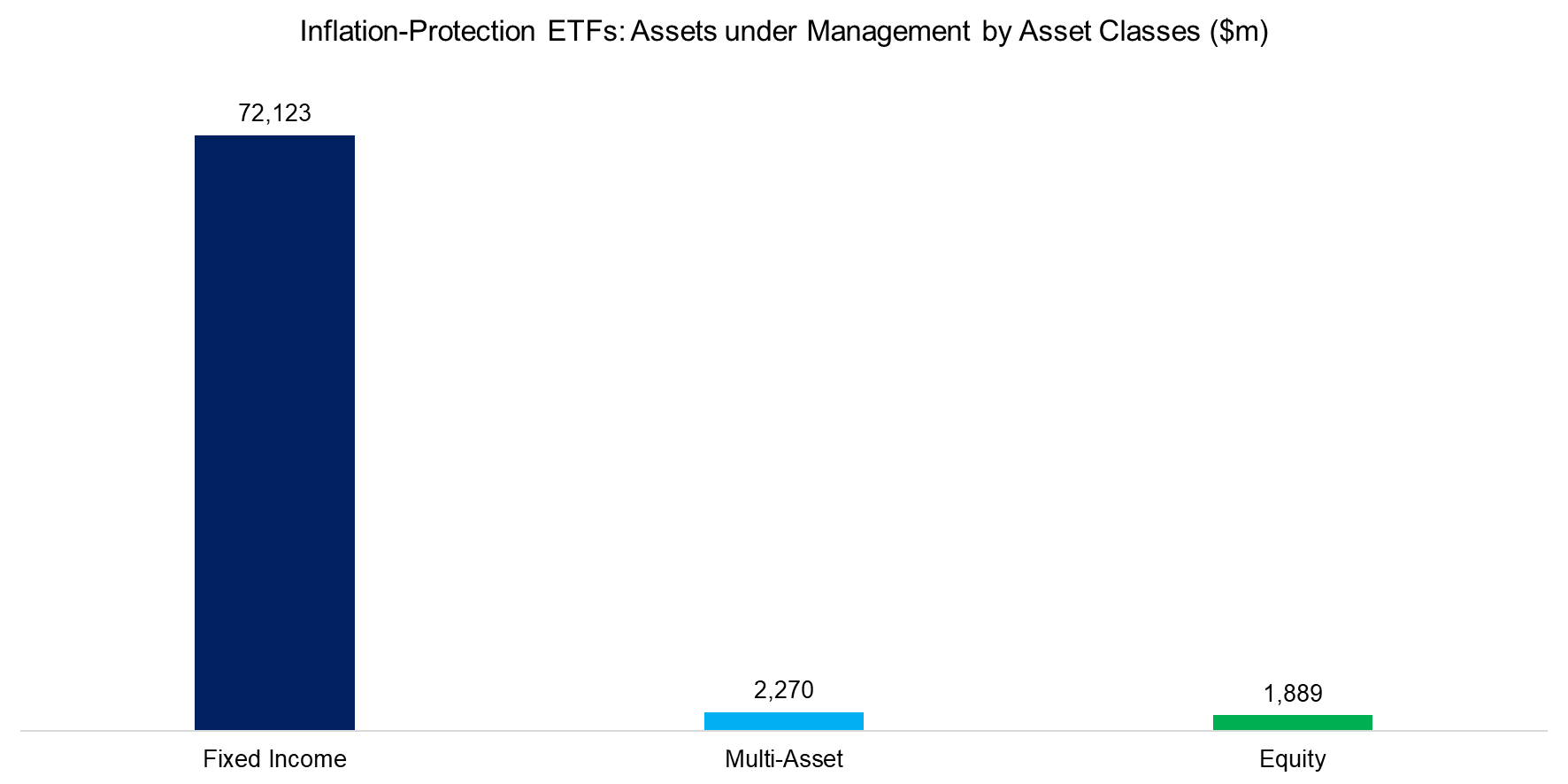
Yet the diversity of approaches masks a striking concentration of capital. Total assets under management across the universe stand at $76 billion, of which 95% is allocated to fixed income – overwhelmingly TIPS ETFs. Multi-asset and equity-focused strategies have attracted negligible inflows. As we will show, this is not without reason: for investors seeking broad portfolio protection against inflation, these strategies have delivered little.
Source: Finominal
PERFORMANCE OF TIPS ETFS
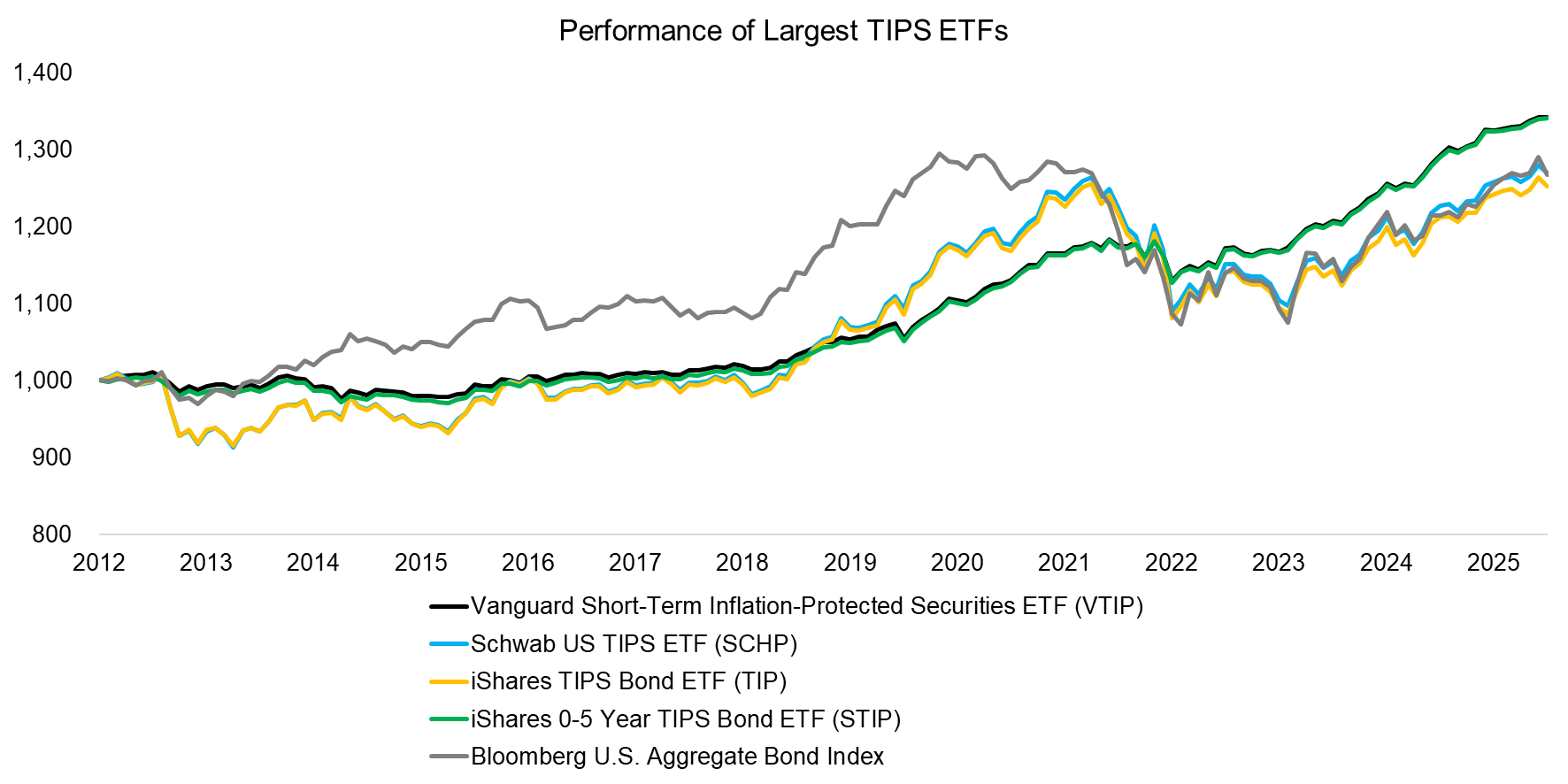
The four largest inflation-protection ETFs all provide exposure to TIPS, collectively managing approximately $60 billion – around 80% of total assets in this space.
Comparing their performance between 2012 and 2026, a clear pattern emerges along duration lines. Longer-duration funds such as Schwab’s US TIPS ETF (SCHP) and iShares’ TIPS Bond ETF (TIP) behaved more like the broad Bloomberg U.S. Aggregate Bond Index, with returns driven as much by interest rate sensitivity as by inflation linkage. Shorter-duration strategies – Vanguard’s Short-Term Inflation-Protected Securities ETF (VTIP) and iShares’ 0-5 Year TIPS Bond ETF (STIP) – were considerably less volatile, as one would expect.
Perhaps the most telling episode was 2022, when U.S. inflation peaked at 9.1% in June. All four ETFs declined. Maximum drawdowns ranged from -4.6% to -13.9%, which compared favourably to the -17.1% suffered by the broad bond index – but this is a low bar. Investors who had been led to believe that TIPS protect against inflation would have been surprised, if not alarmed, to find their inflation-protection holdings falling precisely when inflation was at its most severe. The funds did less badly than conventional bonds; they did not do what many investors expected them to do (read Inflation-Linked Bonds for Inflationary Periods?).
Source: Finominal
PERFORMANCE OF EQUITY & MULTI-ASSET INFLATION-PROTECTION ETFS
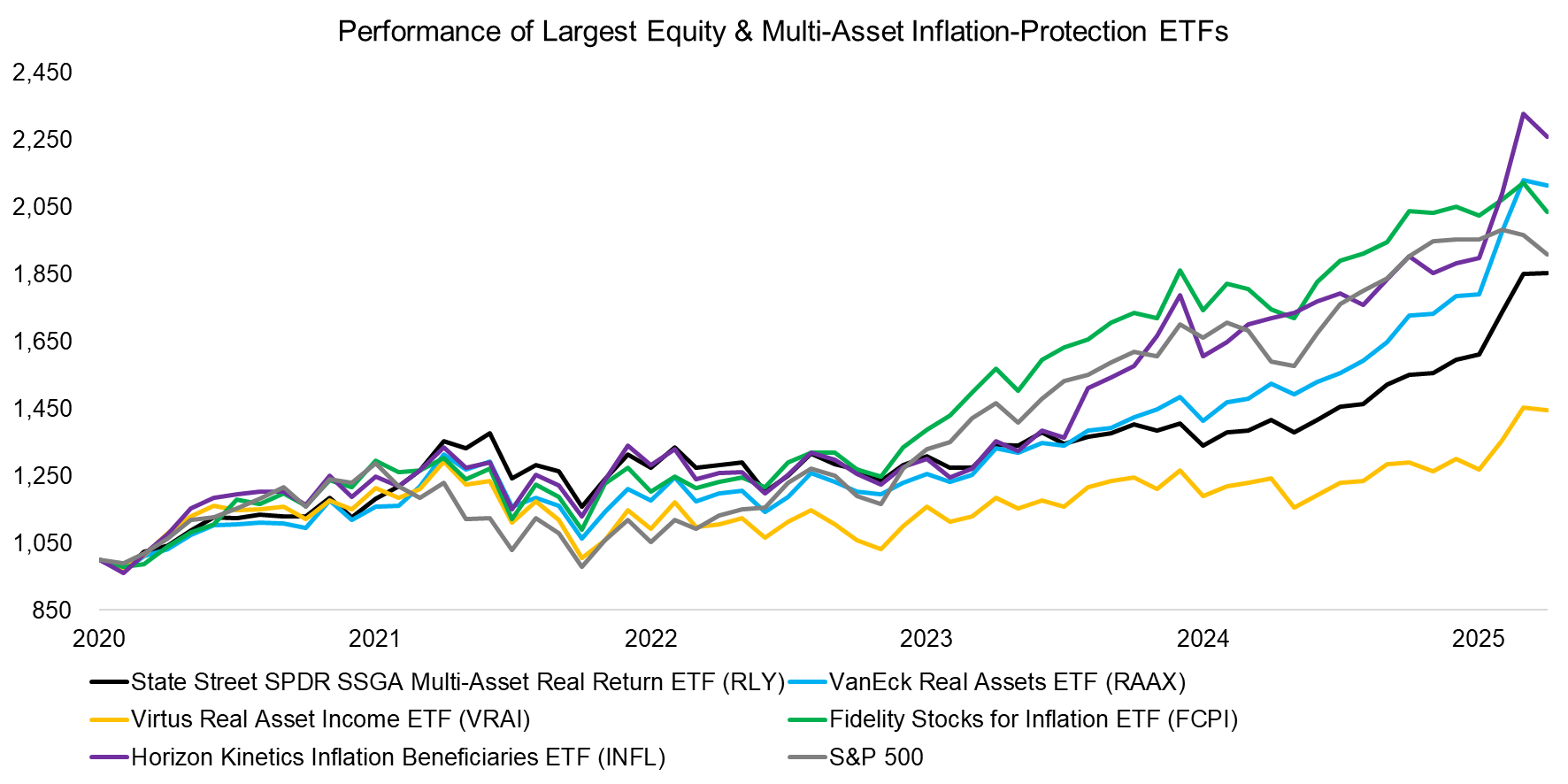
We next examine the largest equity and multi-asset inflation-protection ETFs with track records of more than 5 years.
Total returns between 2020 and 2026 were divergent across the group, though three of the five outperformed the S&P 500 over the period. The two laggards were both multi-asset ETFs – an unsurprising result given that broader diversification naturally dampens upside participation in strong equity markets.
Two observations stand out. First, all five ETFs surged in early 2026 as rising oil and gas prices, driven by the Iran-Israel-U.S. conflict, fed through into energy-heavy holdings – a reminder that these strategies can respond to the right kind of inflationary shock. Second, and more damaging to the inflation-protection narrative, all five declined in 2022 when inflation was at its peak. Their behaviour broadly mirrored the S&P 500, offering little in the way of differentiated protection precisely when investors needed it most.
Source: Finominal
CORRELATION TO INFLATION
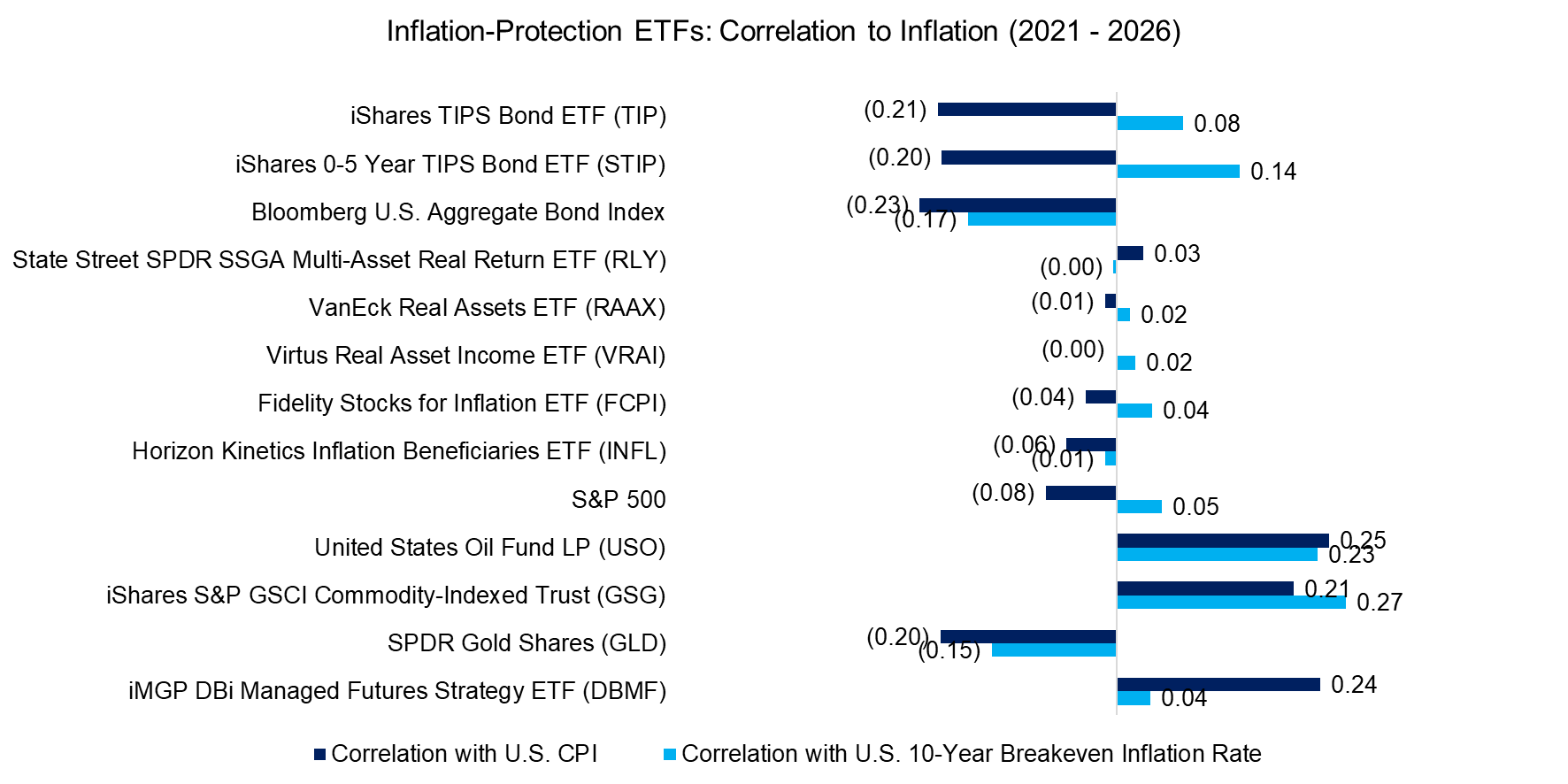
Finally, we measure the correlation of long and short-duration TIPS, equity and multi-asset, oil, and commodity ETFs between 2020 and 2026 to two inflation benchmarks: realised U.S. CPI and the U.S. 10-Year Breakeven Inflation Rate, which measures expected inflation. We also include a managed futures ETF – the iMGP DBi Managed Futures Strategy ETF (DBMF) – which goes long and short across asset classes to theoretically capture trends in assets that benefit from inflation while shorting those that do not, making it a natural candidate for inflation protection.
The results for TIPS ETFs are divergent: they are negatively correlated with realised CPI, perhaps due to the lagging nature of coupon adjustments, but positively correlated with the breakeven inflation rate. Conventional bonds, as represented by the Bloomberg U.S. Aggregate Bond Index, are negatively correlated to both inflation measures – declining when inflation rises, as expected.
The correlations of equity and multi-asset ETFs are similarly divergent, small in magnitude, and not materially different from those of the S&P 500. Stated differently, these equity-heavy products offer little protection against inflation.
In contrast, oil, commodities, and managed futures exhibit significantly higher, consistently positive correlations with both inflation measures, making them the more credible inflation-protection tools among the strategies reviewed. To the surprise of likely many investors, gold was negatively correlated with inflation.
Source: Finominal
It is also worth considering how inflation-protection ETFs fit within a broader asset allocation framework.
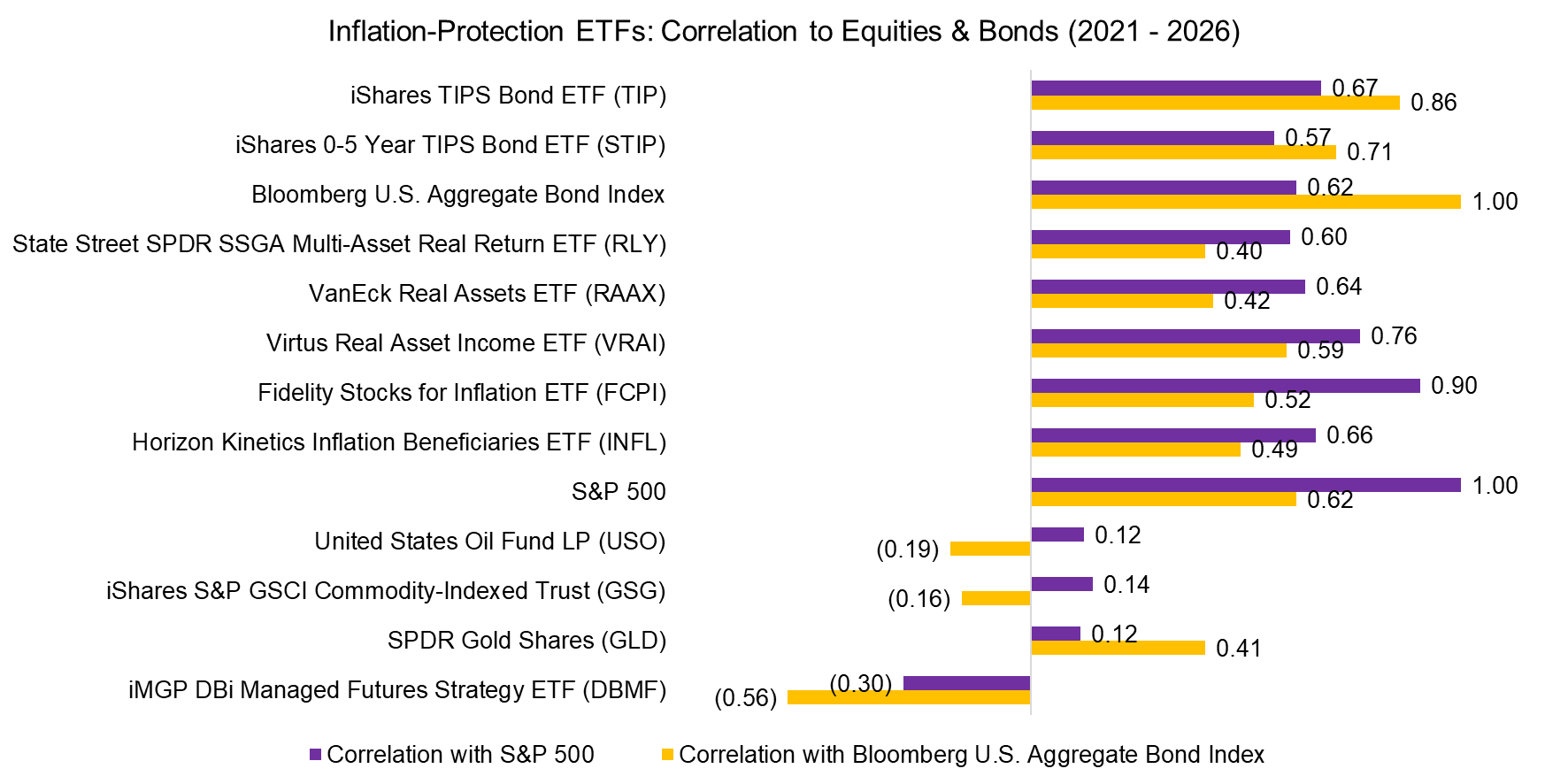
TIPS ETFs feature correlations of 0.71 to 0.86 to U.S. investment-grade bonds between 2020 and 2026, which suggests they are best understood as a bond replacement rather than a standalone inflation hedge – a reasonable swap for investors anticipating a rising inflation environment but who wish to maintain fixed income exposure.
Equity and multi-asset inflation-protection ETFs present correlations of 0.60 to 0.99 to the S&P 500. This degree of overlap with the broader equity market means they offer insufficient differentiation to justify a dedicated allocation – investors would be paying for inflation protection they are not meaningfully receiving. The market appears to have reached the same conclusion: the negligible assets under management in these strategies suggest investors have largely voted with their feet.
Oil, commodity, and managed futures ETFs tell a different story. Their correlations with both equities and bonds are low to negative, meaning they not only provide the most credible inflation protection in our analysis but also offer the greatest diversification benefits within a multi-asset portfolio. For investors genuinely seeking to hedge inflation risk, these are the strategies that earn their place in an allocation.
Source: Finominal
FURTHER THOUGHTS
Almost all financial analysis software and tools – including Finominal’s – display performance in nominal terms, before accounting for inflation. Yet nominal returns overstate what investors are actually earning. In practice, only real returns matter.
The difference can be stark. iShares’ TIPS Bond ETF (TIP) recorded a nominal loss of -12.3% in 2022, but with annual inflation running at 6.3%, the real return was -18.6% – a significantly worse outcome than the headline figure suggests. An ETF explicitly designed to protect against inflation was quietly destroying real wealth while the nominal return made the damage look manageable.
This matters beyond a single fund or a single year. Many fixed-income and alternative strategies persistently fail to keep pace with inflation, but because investors are not shown real returns, capital continues to flow into strategies that are quietly eroding purchasing power. The misallocation is invisible by design.
The backdrop makes this more urgent, not less. As public debt continues to rise across major economies, governments have a structural incentive to allow inflation to run – it erodes the real value of debt over time. Investors who rely on nominal returns to assess their portfolios are, in effect, reading a map that flatters the terrain. The industry’s default should shift to real returns, and the fact that it has not is itself worth examining.
RELATED RESEARCH
Inflation-Protection ETFs – II
Inflation-Protection ETFs
Myth-Busting: Equities are an Inflation-Hedge
Myth-Busting: Money Printing Must Create Inflation
Equity Factors & Inflation
Inflation-Linked Bonds for Inflationary Periods?
Building an Inflation Portfolio Using Stocks
Building an Inflation Portfolio Using Asset Classes
ABOUT THE AUTHOR
Nicolas Rabener is the CEO & Founder of Finominal, which empowers professional investors with data, technology, and research insights to improve their investment outcomes. Previously he created Jackdaw Capital, an award-winning quantitative hedge fund. Before that Nicolas worked at GIC and Citigroup in London and New York. Nicolas holds a Master of Finance from HHL Leipzig Graduate School of Management, is a CAIA charter holder, and enjoys endurance sports (Ironman & 100km Ultramarathon).
Connect with me on LinkedIn or X.