
Benchmark Illusions: The Case Against Narrow Equity Benchmarks
What should equity funds be measured against?
May 2026. Reading Time: 10 Minutes. Author: Nicolas Rabener.
SUMMARY
- Most equity products should be benchmarked against the global stock market
- If the strategy underperforms, then it does not deserve an allocation
- The only exception is diversifying equity strategies
INTRODUCTION
The Global Luxury Goods Fund (USLUX) offers investors exposure to iconic luxury companies such as LVMH, Hermes, and Ferrari – brands whose products are often out of reach for most consumers. A small Birkin bag from Hermes, for example, can cost well over $10,000. Even for those who can afford it, purchasing one is not straightforward: Hermes sells these bags selectively, often requiring years-long waiting periods. On the secondary market, prices frequently double or even triple.
From this perspective, USLUX presents an elegant way to gain access to the economics of luxury goods and participate in the high-margin business behind these brands. The minimum fund investment is relatively accessible at $5,000. However, the fund charges a steep annual management fee of 1.75%, meaning it must generate strong returns to justify the cost.
USLUX also serves as a useful case study in the complexity – and limitations – of selecting appropriate benchmarks for funds, a topic we examine in this research article.
PERFORMANCE OF THE GLOBAL LUXURY GOODS FUND (USLUX)
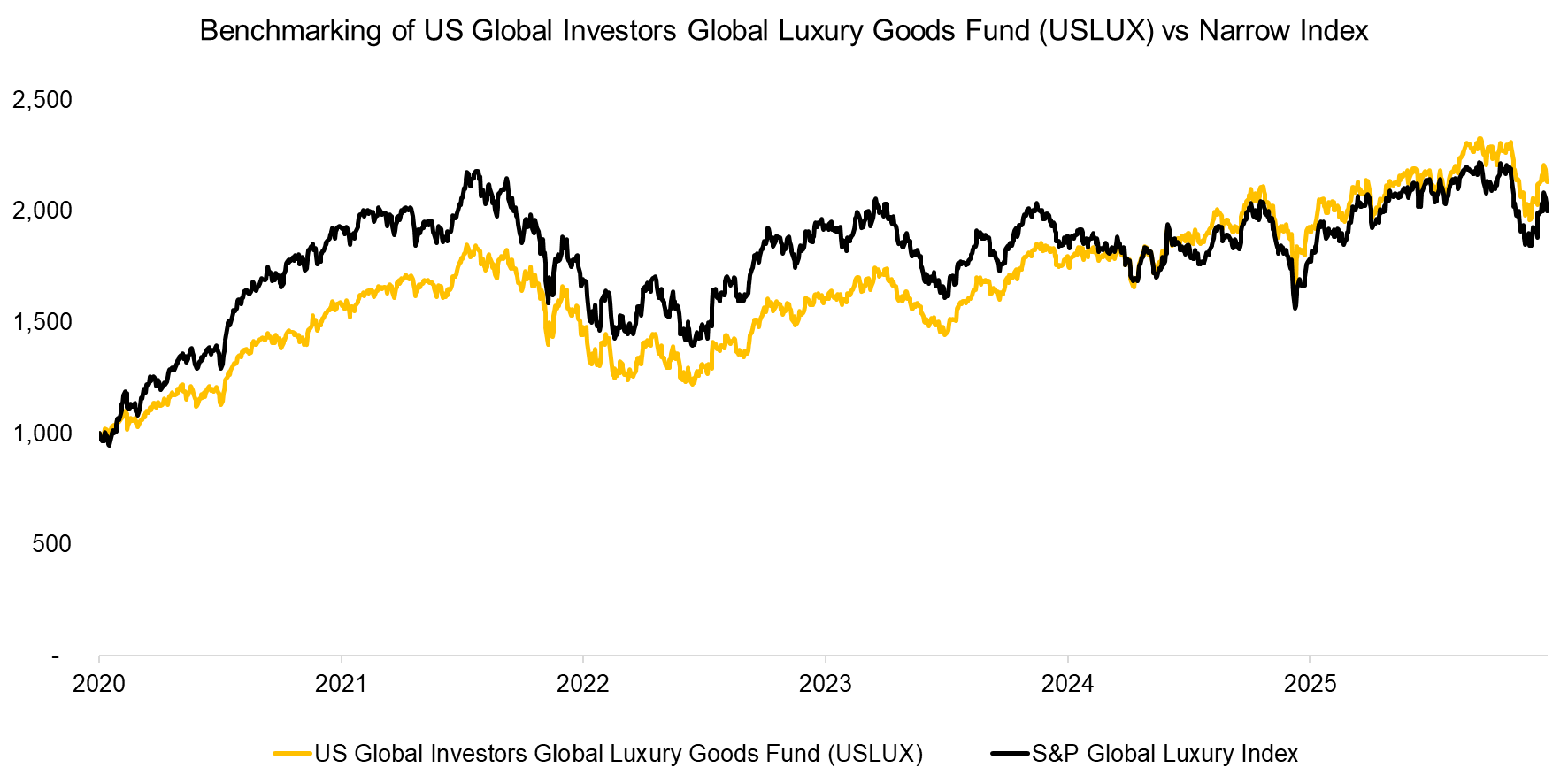
USLUX is managed by U.S. Global Investors and has a track record dating back to 1994. On the fund’s website, the benchmark is listed as the S&P 1500 Composite, while the factsheet references the S&P Global Luxury Index. Both sources note that prior to May 2020, the fund operated as the Holmes Trends Fund (MEGAX), which followed a different investment strategy altogether.
Despite this, the factsheet presents a 10-year performance comparison against the S&P Global Luxury Index – even though roughly half of that period reflects a portfolio that was not focused on luxury stocks. This communication creates a misleading impression for investors.
A fairer comparison would begin only from May 2020, when the fund adopted its current luxury-focused strategy. From May 2020 through mid-2024, the fund underperformed the S&P Global Luxury Index, and it has only performed roughly in line with the benchmark since then. Given the 1.75% annual management fee, investors would reasonably expect consistent and meaningful outperformance to justify the cost.
Source: Finominal
BENCHMARK SELECTION
Fund managers typically select benchmarks that closely resemble their portfolios, using criteria such as investment strategy, sector exposure, factor tilts, or geographic focus. For a fund like USLUX, which is concentrated in luxury stocks, the S&P Global Luxury Index appears to be a reasonable benchmark. In this framework, the manager’s role is reduced to one single purpose: outperform the benchmark.
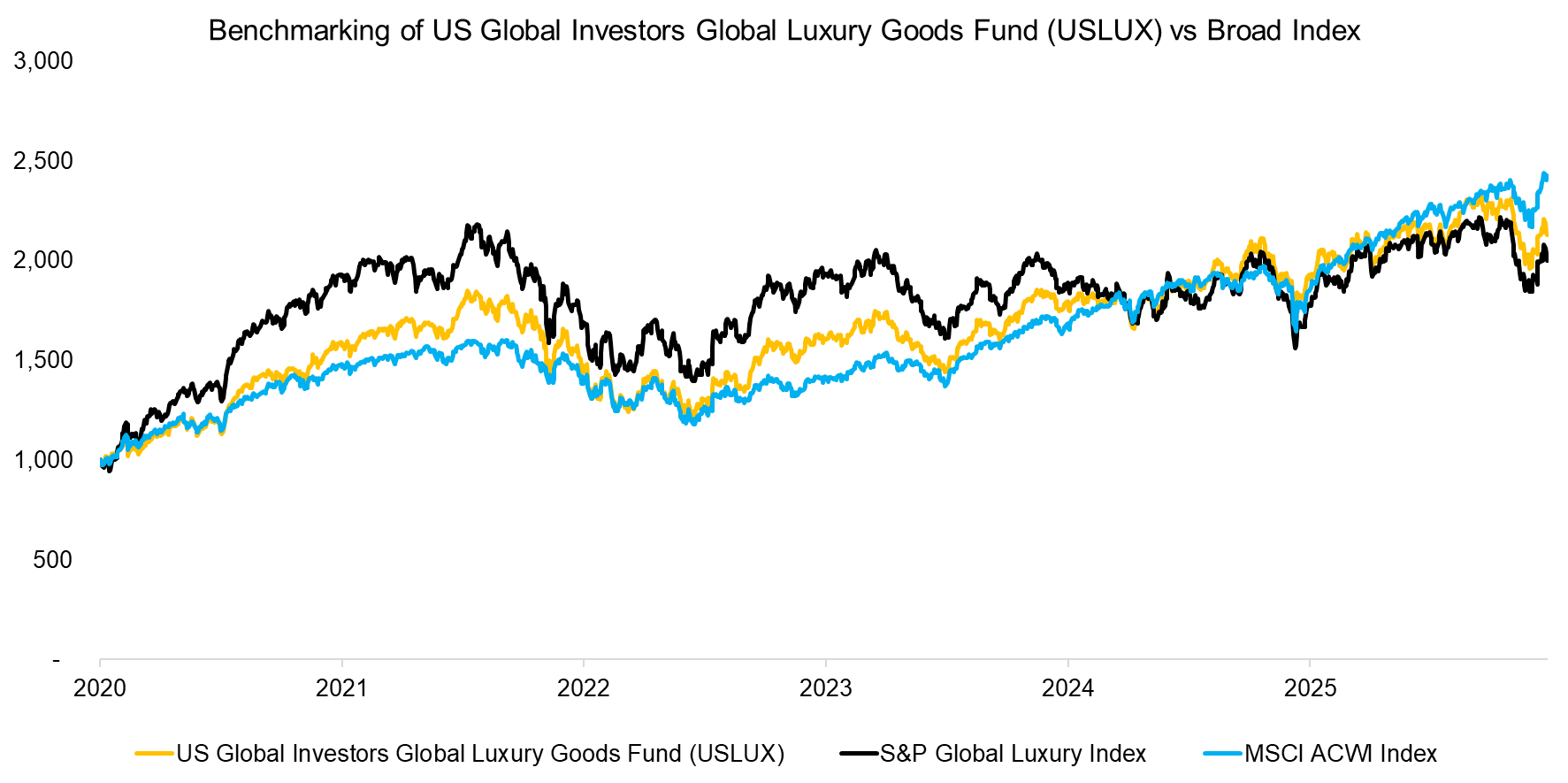
However, one could argue that this approach misses the broader objective of most investors: to maximize the return on investment of the equity allocation. From that perspective, a broader benchmark such as the MSCI ACWI Index is more appropriate. Against this standard, USLUX has failed to outperform since May 2020.
Source: Finominal
USLUX’s fund manager would likely dispute the idea that the MSCI ACWI is the most appropriate benchmark. However, investors allocate to luxury stocks precisely because they expect them to outperform the broader global equity market.
The same logic applies to most equity strategies. Investors allocate to value funds because they believe value stocks will outperform over the medium to long term. Likewise, few investors would choose technology or emerging markets equities if they expected those segments to lag the market. From this perspective, the most rational benchmark for equity funds is the global equity market itself, rather than a narrowly defined subset of stocks.
That said, this view assumes that these equity strategies are highly correlated with the broader market and provide largely similar economic exposures. USLUX features a correlation of 0.89 to the MSCI ACWI Index since May 2020.
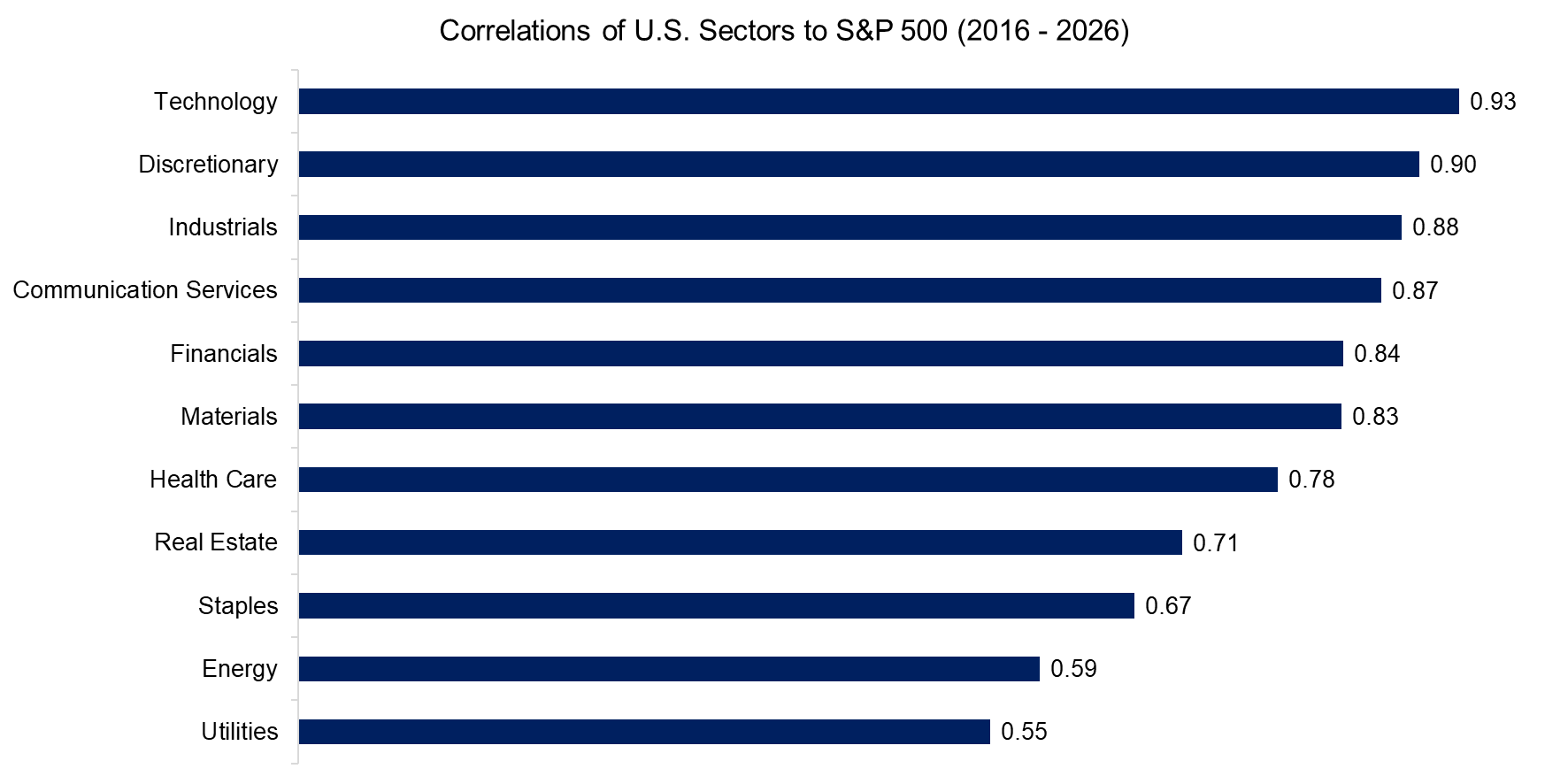
In practice, most U.S. sectors are indeed strongly correlated with the overall equity market. However, some sectors – such as utilities and energy – show meaningfully lower correlations, with 10-year correlations of 0.55 and 0.59, respectively. For managers focused on such areas, it would be appropriate to present performance relative to both a sector-specific index and global equities.
Source: Finominal
The objective of a fund can ultimately be reduced to two goals: delivering higher returns or lowering portfolio risk. However, when a fund’s holdings are highly correlated with the global stock market, achieving meaningful risk reduction becomes extremely difficult. In such cases, the most appropriate benchmark – regardless of the specific strategy – is the broader global equity market. If such a fund cannot outperform an index such as the MSCI ACWI, it becomes difficult to justify allocating capital to it. Outperforming a more narrow benchmark simply represents a misallocation of capital.
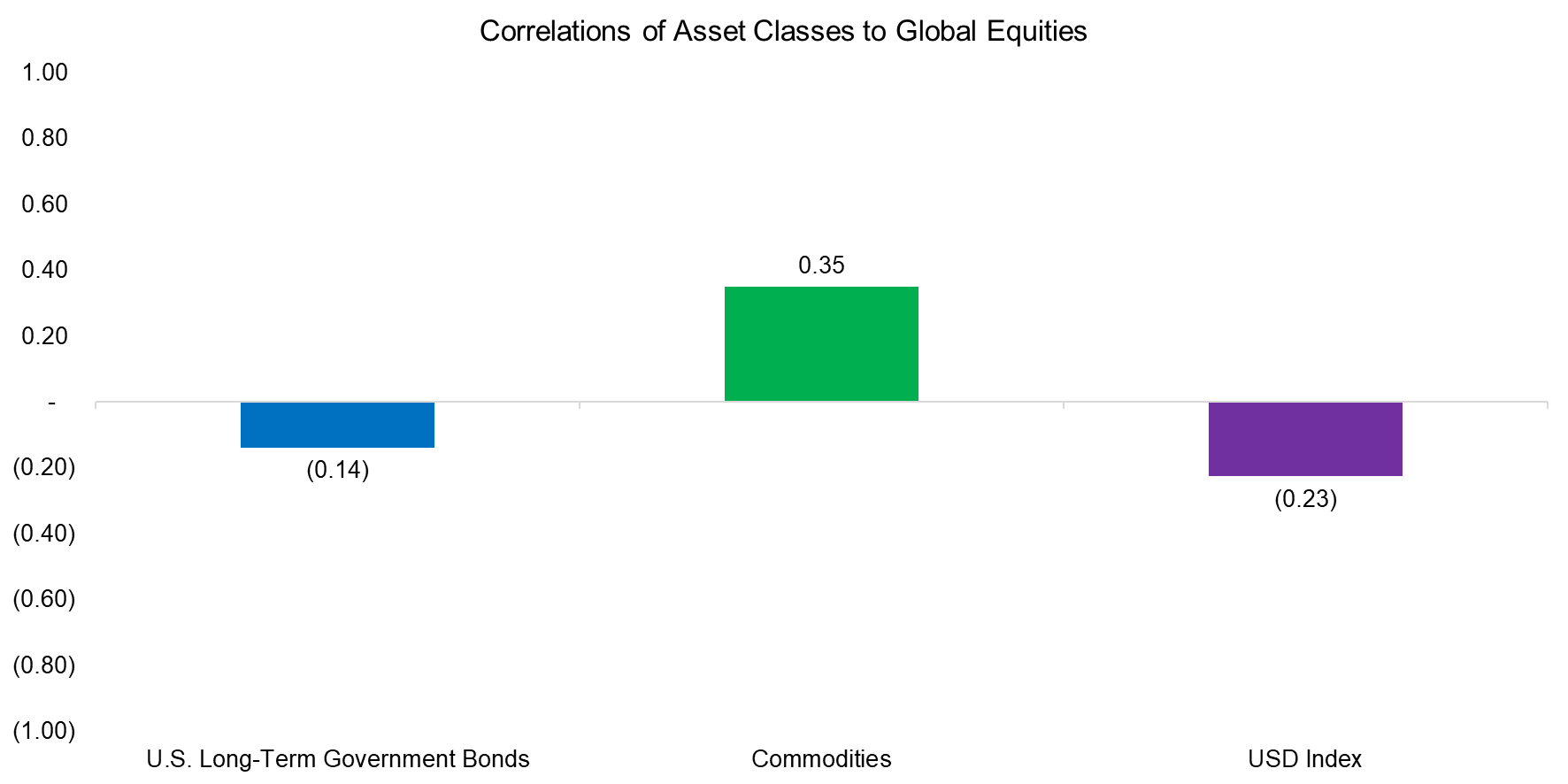
By contrast, if a strategy genuinely reduces risk – reflected, for example, in lower correlations to global equities – and provides diversification benefits, then a different benchmark may be more suitable. In practice, this is often more easily achieved by allocating to other asset classes such as bonds, commodities, or currencies, rather than by selecting a narrower subset of equities.
Source: Finominal
FURTHER THOUGHTS
What about the S&P 500? Should it also be evaluated against a global equity benchmark?
The answer is yes. In practice, this is exactly how most investors behave. Capital tends to flow toward the markets that deliver the strongest returns, and over the past decade, the U.S. equity market has outperformed most international and emerging markets. As a result, most U.S. investors have avoided allocating to international and emerging market stocks, which have persistently lagged.
From an asset allocation perspective, the global equity market remains the ultimate reference point. Investors are not choosing between benchmarks; they are choosing where to allocate capital based on expected returns and risk.
As Tolkien wrote in The Lord of the Rings: “One ring to rule them all.”
RELATED RESEARCH
Determining the Optimal Benchmark for Funds
Sector vs Factor-based Benchmark Selection
Mirror, Mirror, on the Wall, which is the Fairest Benchmark of All?
Benchmarking Smart Beta ETFs
The Juggernaut Index
Indexing: Out with Tradition?
What´s Better than the S&P 500?
Outperformance via Leverage
Chasing Mutual Fund Performance
Thematic versus Momentum Investing
Cap-Weighted Benchmarks: Good Momentum Bets?
ABOUT THE AUTHOR
Nicolas Rabener is the CEO & Founder of Finominal, which empowers professional investors with data, technology, and research insights to improve their investment outcomes. Previously he created Jackdaw Capital, an award-winning quantitative hedge fund. Before that Nicolas worked at GIC and Citigroup in London and New York. Nicolas holds a Master of Finance from HHL Leipzig Graduate School of Management, is a CAIA charter holder, and enjoys endurance sports (Ironman & 100km Ultramarathon).
Connect with me on LinkedIn or X.