
Buy-the-Dip: Viable Strategy or Fallacy?
Does fortune favor the bold?
June 2026. Reading Time: 10 Minutes. Author: Nicolas Rabener.
SUMMARY
- Buying the dip has worked since the GFC
- However, it represents a poor investment strategy
- Max drawdowns of -70% were reached historically
INTRODUCTION
The period following the Global Financial Crisis can be characterized as one in which central banks and governments became significantly more active in managing financial markets. Each time equity markets declined meaningfully, policymakers appeared to intervene – through quantitative easing, emergency rate cuts, or fiscal stimulus – to arrest the fall and restore confidence (read Have Stock Markets Changed?).
The current U.S. president, Donald Trump, appears particularly conscious of the stock market as a barometer of his administration’s success, frequently citing the S&P 500 as a measure of policy effectiveness. Unconventional measures such as sweeping tariffs have at times been swiftly reversed when markets reacted negatively – suggesting that equity performance carries significant political weight.
Against this backdrop, it is perhaps unsurprising that an entire generation of investors has come to believe that buying stocks during market declines is not merely a viable strategy, but an almost risk-free one. Subversive Capital sought to capitalize on this conviction by launching the Buy-the-Dip ETF (BTFD) in January 2022 – offering investors a packaged, rules-based vehicle for this popular approach. However, the ETF was liquidated within months of its launch.
In this research article, we evaluate the buy-the-dip strategy on its merits – examining whether the popular conviction holds up under systematic scrutiny.
QUANTIFYING DIPS
There is no universally accepted definition of what constitutes a dip in the stock market. Some measure it simply by the magnitude of a decline – but what threshold is meaningful? A fall of 10%, 20%, or 30% each tells a different story, and any fixed threshold risks being arbitrary.
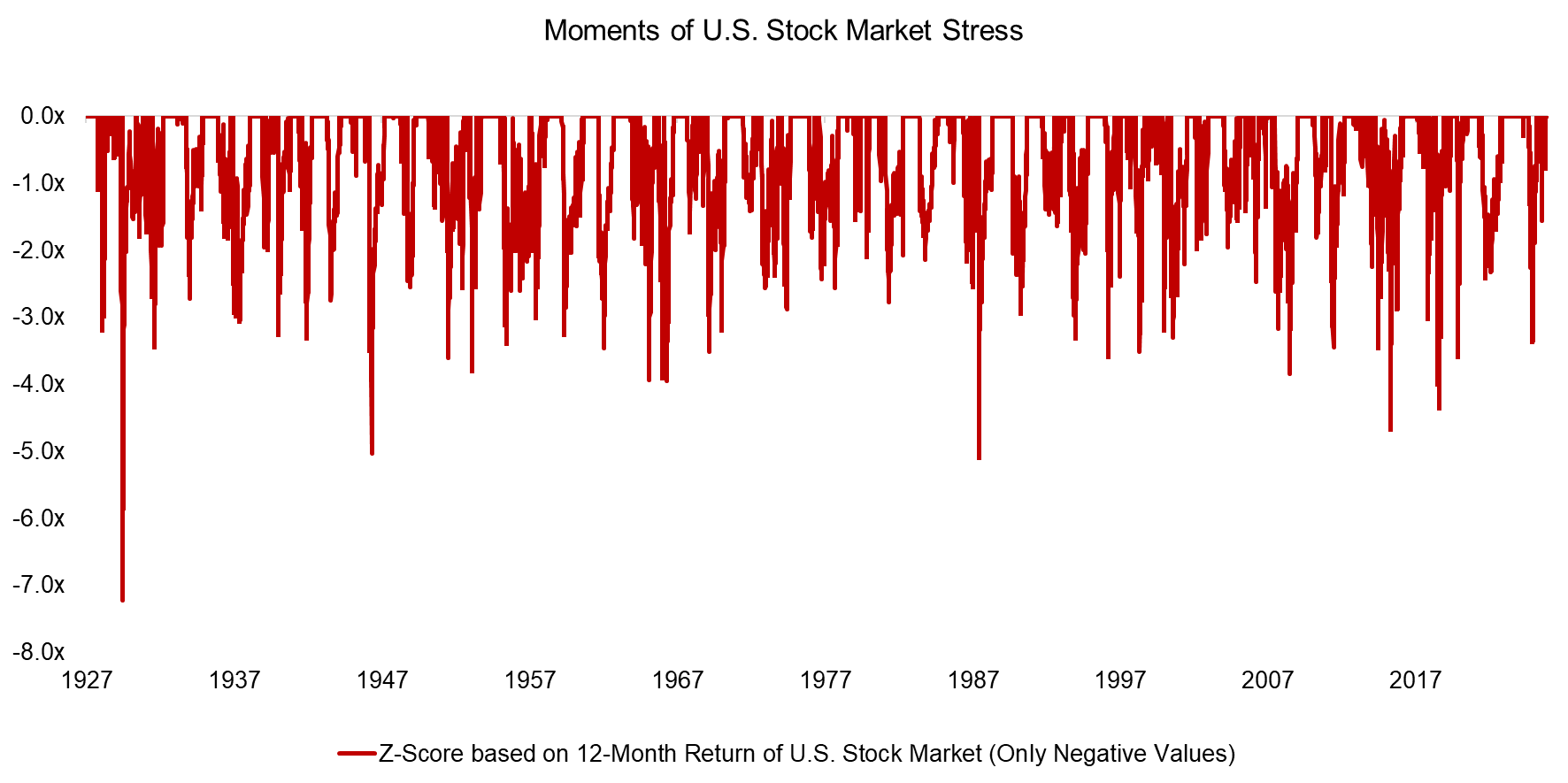
A more rigorous approach is to use z-scores, which express a market move in terms of standard deviations from its historical mean – automatically adjusting for the prevailing volatility regime. This is the methodology we adopt. Specifically, we compute the z-score of U.S. equity market returns using rolling 12-month returns, drawing on long-run data from AQR Capital Management.
Visualizing the negative z-score values reveals the most severe dislocations in modern U.S. market history. The most extreme reading was -7.2x, recorded during the Great Depression in 1929 – a reminder of how unprecedented that episode was relative to any other period. Other notable troughs include the aftermath of World War II in 1946 and the Black Monday crash of October 1987, when the Dow Jones Industrial Average fell by over 22% in a single session.
Source: AQR, Finominal
BUY-THE-DIP STRATEGY IN THE U.S.
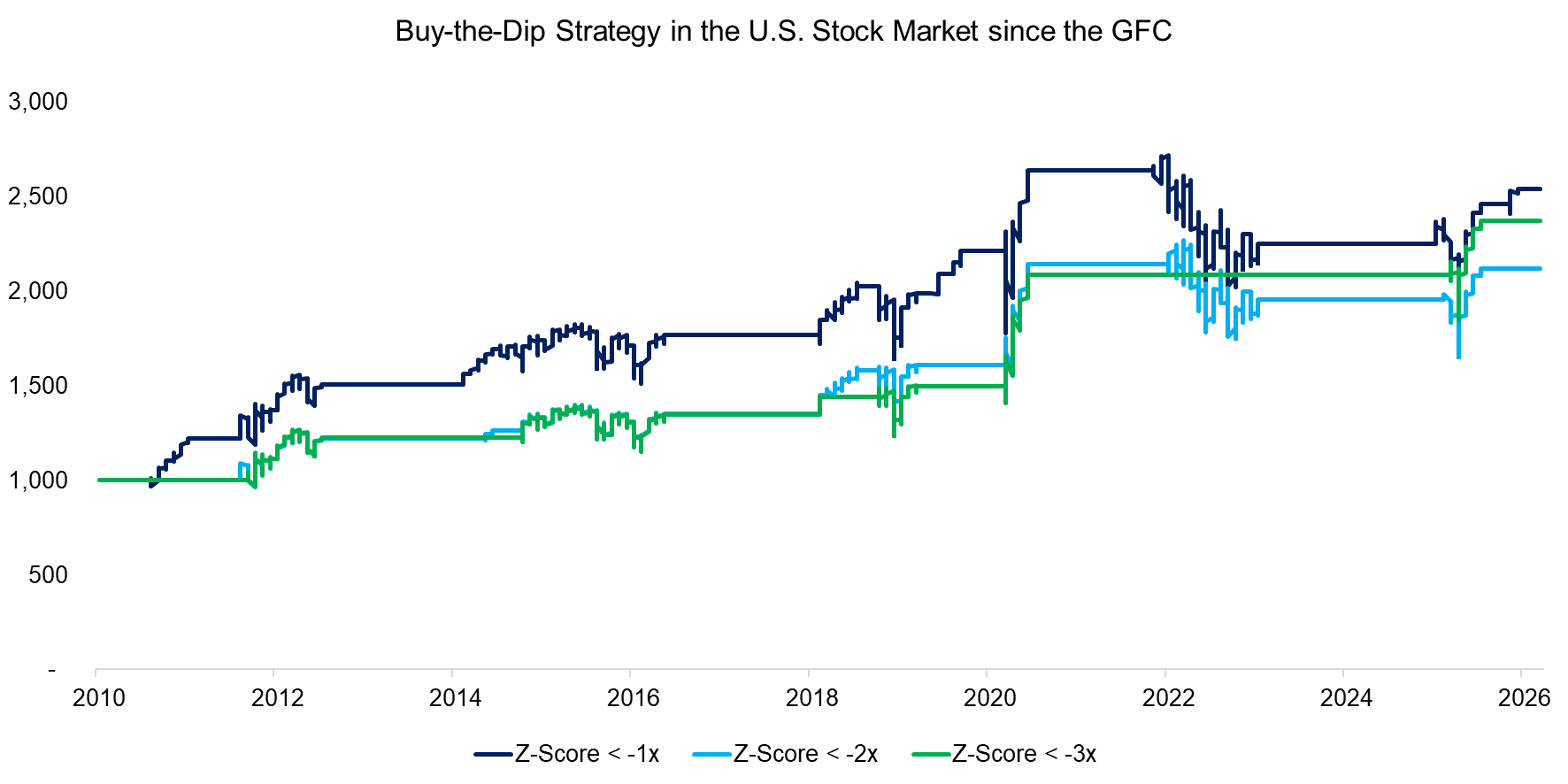
We evaluate the performance of the buy-the-dip strategy using entry z-score thresholds of -1.0x, -2.0x, and -3.0x, holding each position until the z-score reverts to zero. All three strategies generated positive performance over the period since the Global Financial Crisis in 2009 – lending credence to the view that U.S. equity markets exhibit strong mean-reverting behavior, and that buying during periods of elevated stress has historically been rewarded.
Source: AQR, Finominal
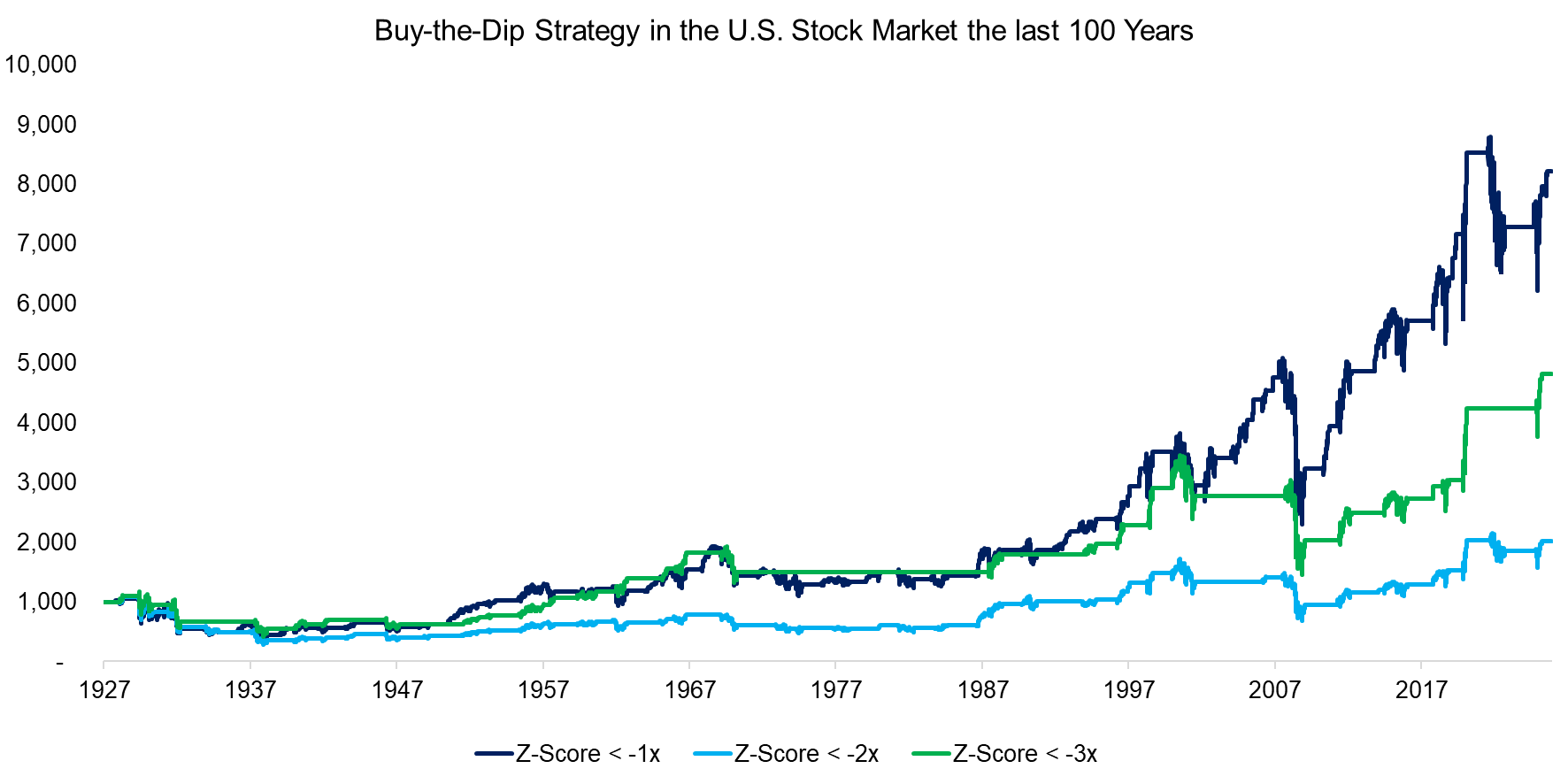
We next extend the analysis to the full available history, dating back to 1927. Across all three entry thresholds – z-scores of -1.0x, -2.0x, and -3.0x – the buy-the-dip strategy generated positive returns over this approximately 100-year period, underscoring the long-run resilience of mean reversion in U.S. equity markets.
The -1.0x entry threshold produced the highest cumulative return, which is intuitive: a lower entry barrier results in greater market exposure over time, and U.S. equities have been in a broadly bullish trend throughout the period. More surprisingly, the -2.0x strategy underperformed the -3.0x strategy, despite trading more frequently. This counterintuitive result warrants further investigation and may reflect the composition and severity of drawdowns at each threshold.
Source: AQR, Finominal
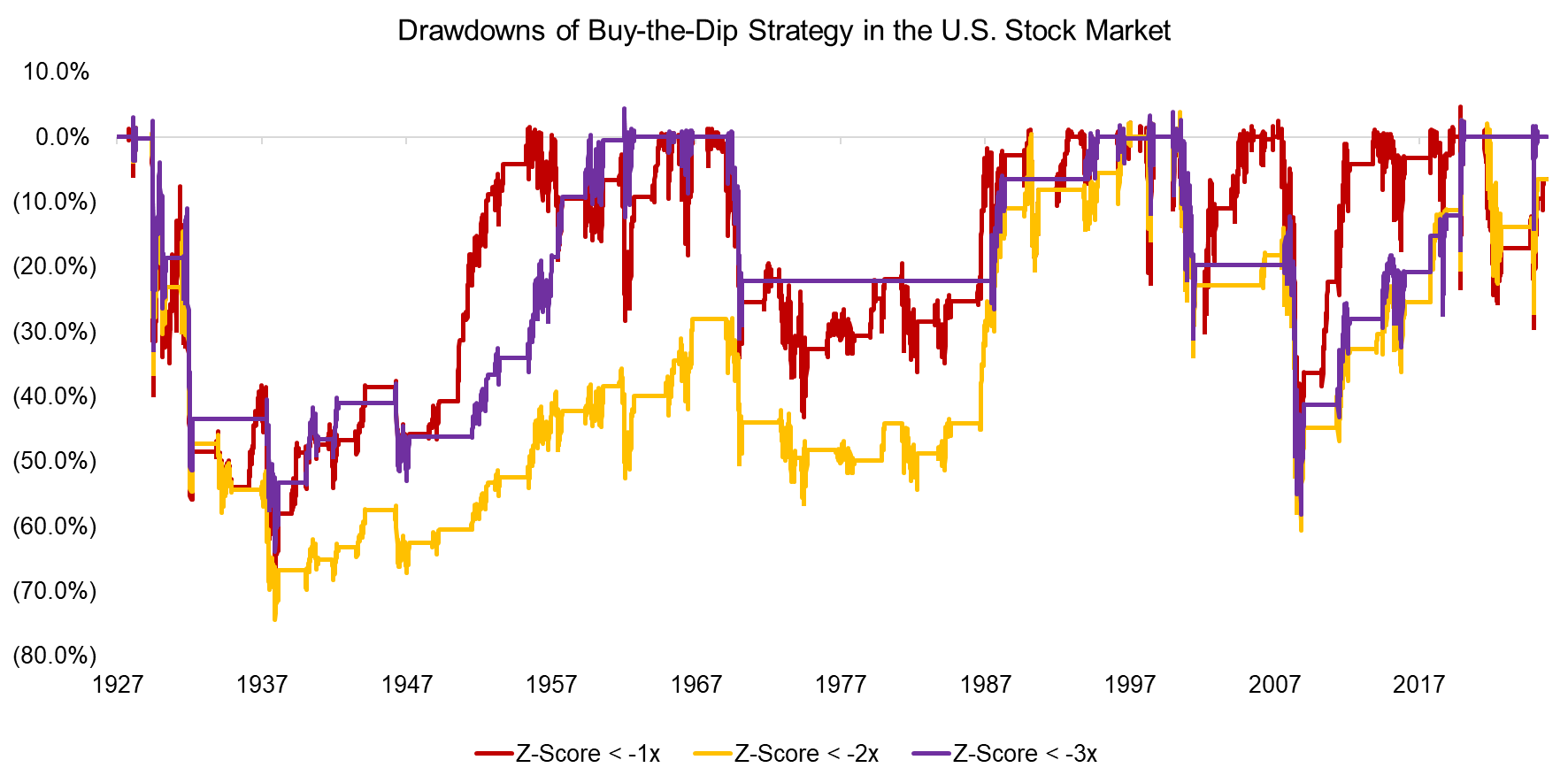
The relatively poor performance of the -2.0x entry strategy can be partly explained by examining its drawdown profile. The analysis reveals a peak drawdown of -75% in the aftermath of the Great Depression in the 1930s – an extreme episode that significantly weighs on long-run performance.
More concerning for proponents of the buy-the-dip strategy, comparable drawdown levels were also reached during the stagflationary environment of the 1970s and again during the Global Financial Crisis – suggesting that catastrophic losses at this threshold are not a once-in-a-century anomaly, but have recurred across fundamentally different market regimes.
Source: AQR, Finominal
BUY-THE-DIP STRATEGY IN JAPAN
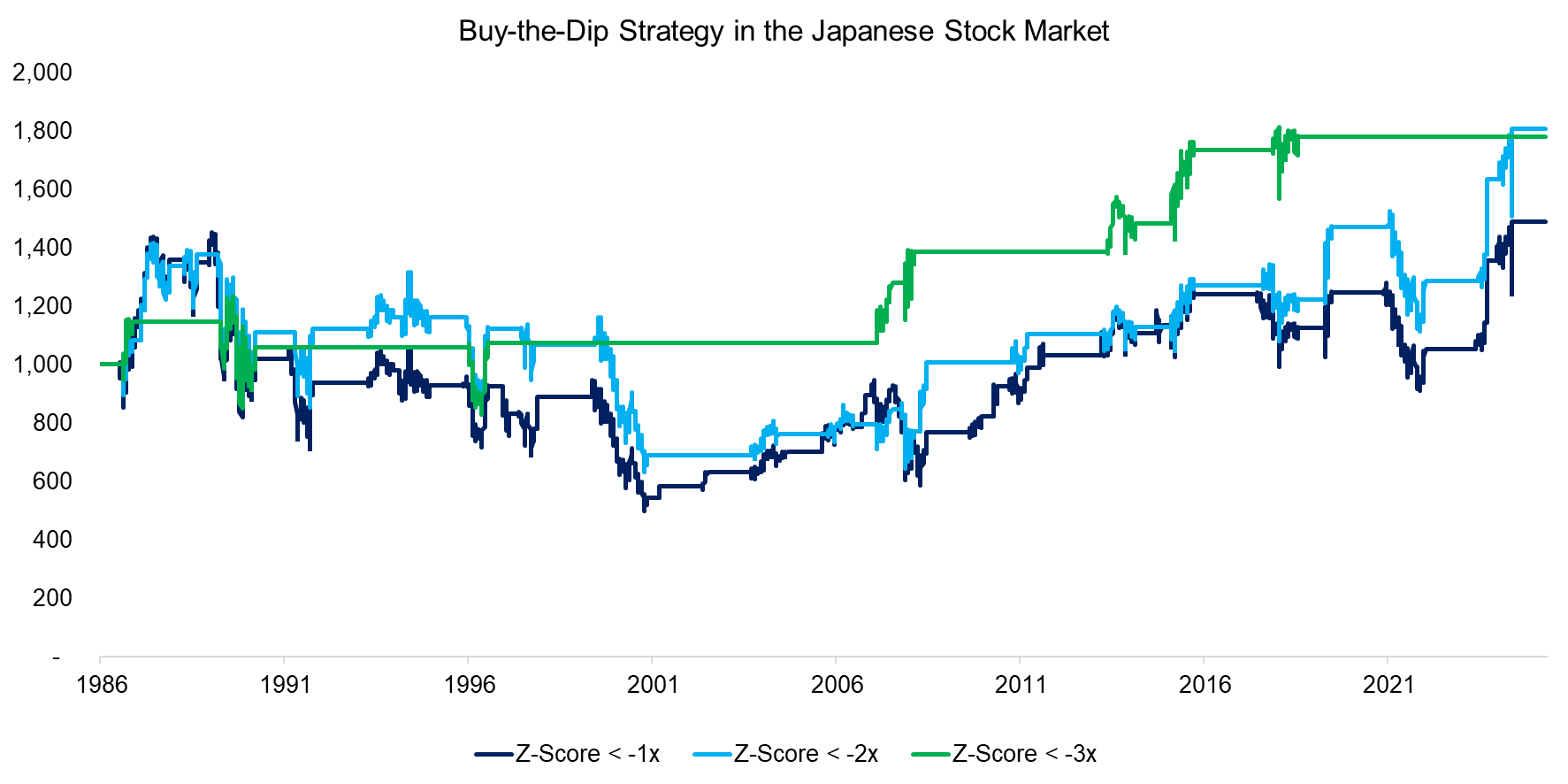
Evaluating the buy-the-dip strategy in the U.S. can be criticized on the grounds that the U.S. stock market was one of the best-performing markets globally over the last century. To address this, we replicate the analysis in Japan, which experienced a far less stellar performance.
We start the analysis in 1986, when the Japanese stock market and economy were booming. This was followed by a severe collapse, and the stock market traded sideways and downward for the next 30 years. We observe that a buy-the-dip strategy would have been profitable there as well, but with frequent and recurring drawdowns throughout the period.
Source: AQR, Finominal
FURTHER THOUGHTS
It is an unfortunate reality that almost every new generation of investors appears destined to repeat the mistakes of its predecessors. The latest generation has grown up with trading available 24/7 from their smartphones, at near-zero cost, and with the most powerful central bankers and politicians appearing to backstop their speculations.
However, markets cannot be controlled. Bear markets and crashes are not anomalies – they are natural and recurring components of market cycles. Although the buy-the-dip strategy has generated positive returns over the past 15 years, our analysis suggests it has been a poor long-term investment strategy.
RELATED RESEARCH
The Fallacy of Betting on the Best Stock Market
Have Stock Markets Changed?
Risk versus Momentum-based Equity Allocations
Mean-Reversion Across Markets
Mean-Reversion on Equity Index Level
Death, Taxes and Mean-Reversion
ABOUT THE AUTHOR
Nicolas Rabener is the CEO & Founder of Finominal, which empowers professional investors with data, technology, and research insights to improve their investment outcomes. Previously he created Jackdaw Capital, an award-winning quantitative hedge fund. Before that Nicolas worked at GIC and Citigroup in London and New York. Nicolas holds a Master of Finance from HHL Leipzig Graduate School of Management, is a CAIA charter holder, and enjoys endurance sports (Ironman & 100km Ultramarathon).
Connect with me on LinkedIn or X.