
Factor Exposure Analysis 119: Fixed Income Factors III
What is driving bond funds?
June 2026. Reading Time: 10 Minutes. Author: Nicolas Rabener.
SUMMARY
- There are different approaches to fixed income factor exposure analysis
- None of these seems statistically superior in explaining bond returns
- However, some are more intuitive than others
INTRODUCTION
We published our initial research on factor exposure analysis of fixed income ETFs in 2022, followed by two further articles in 2023, in which we highlighted a persistent divide in how practitioners approach the subject. The fixed income perspective tends to use the language of bond markets – analyzing funds through the lens of duration, yield, and credit quality. The quantitative perspective borrows from the equity factor toolkit, applying concepts such as value, quality, momentum, and low volatility to fixed income portfolios (read Factor Exposure Analysis 108: Fixed Income Factors II and Factor Exposure Analysis 107: Fixed Income Factors).
Our earlier research showed that neither approach was clearly superior in explaining the drivers of risk and return in bond funds – each captures something the other misses. In this article, we make another attempt at building a more intuitive and comprehensive framework for fixed income factor exposure analysis.
FIXED INCOME FACTORS
Investors seeking higher returns than short-term government bonds offer have essentially two choices: lend money to the government for longer periods or lend to riskier borrowers, such as corporates or foreign governments. The first source of additional return is measured by the duration of a bond – expressed in years – and the second by the credit spread. We use base interest rates, duration, and credit spreads as our core fixed income factors, but extend them with spreads on inflation via Treasury Inflation-Protected Securities (TIPS), mortgage-backed securities (MBS), and emerging markets (EM).
The duration factor is defined as the difference in total returns between long and short-term government bonds. All other factors are defined as the difference in total returns between the relevant index and duration-matched government bonds, ensuring that interest rate risk is stripped out and only the spread is captured.
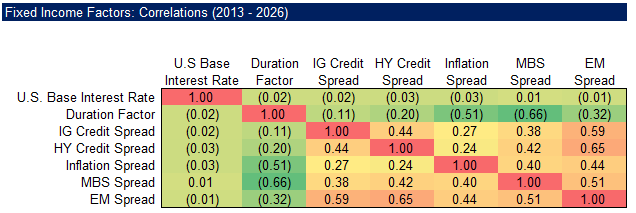
For a regression-based factor exposure analysis, it is important that the independent variables are not highly correlated with one another. We compute the pairwise correlations between these factors over the period from 2013 to 2026 and observe that most are weakly correlated, with some exceptions, including a moderately positive correlation between HY credit and EM spreads (0.65) and a moderately negative correlation between the duration factor and the MBS spread (-0.66).
FACTOR EXPOSURE ANALYSIS OF BOND FUNDS
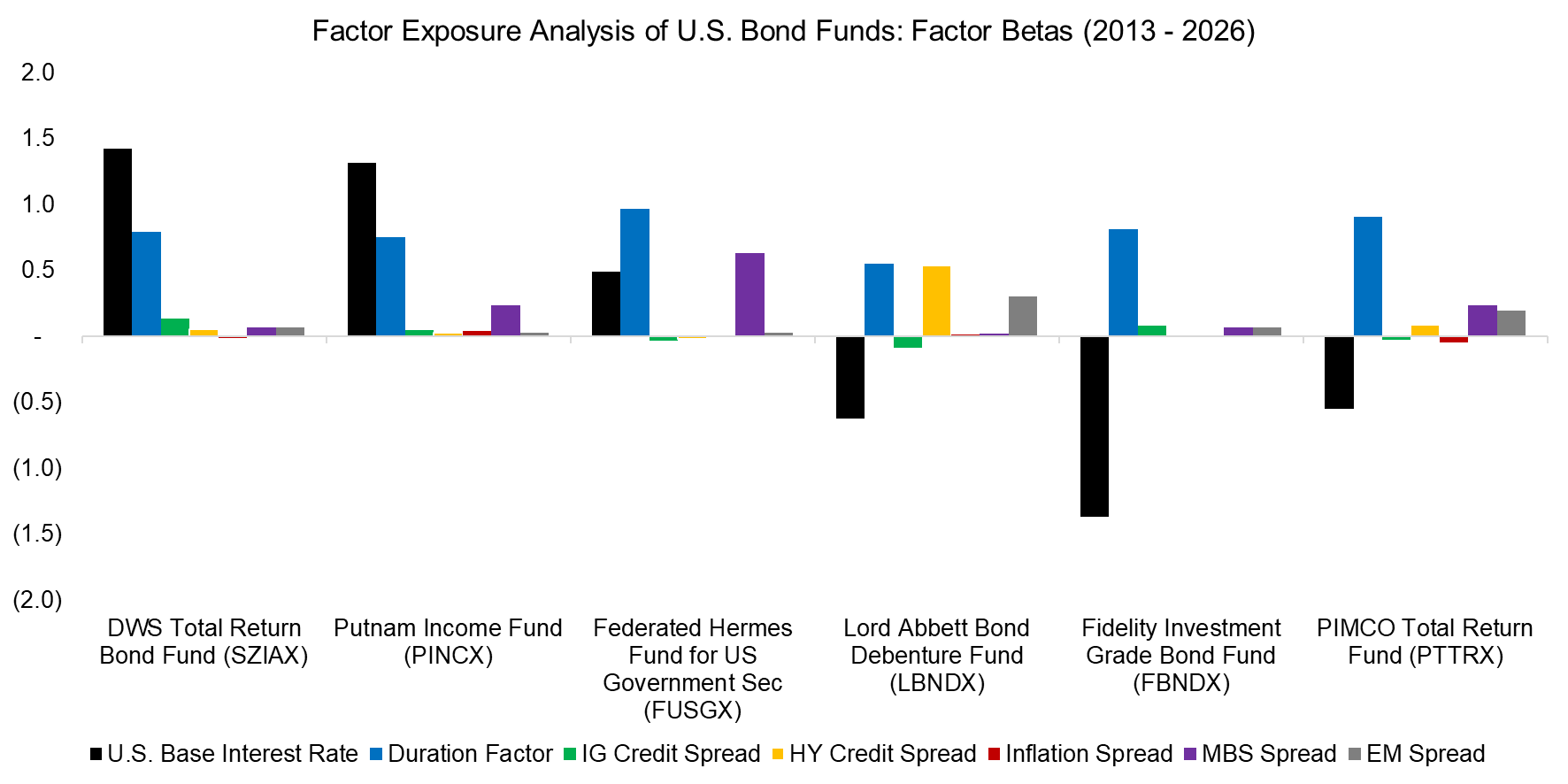
We select six U.S. bond mutual funds with at least 15 years of track record and compute their betas relative to the fixed-income factors. The largest betas are to the U.S. base interest rate – proxied by U.S. T-Bills – and to the duration factor. The base interest rate betas are negative for some funds, but this warrants careful interpretation: since betas are a function of the volatility of the underlying instrument, and T-Bills have near-zero volatility, these coefficients are best understood as statistical noise rather than meaningful economic exposures.
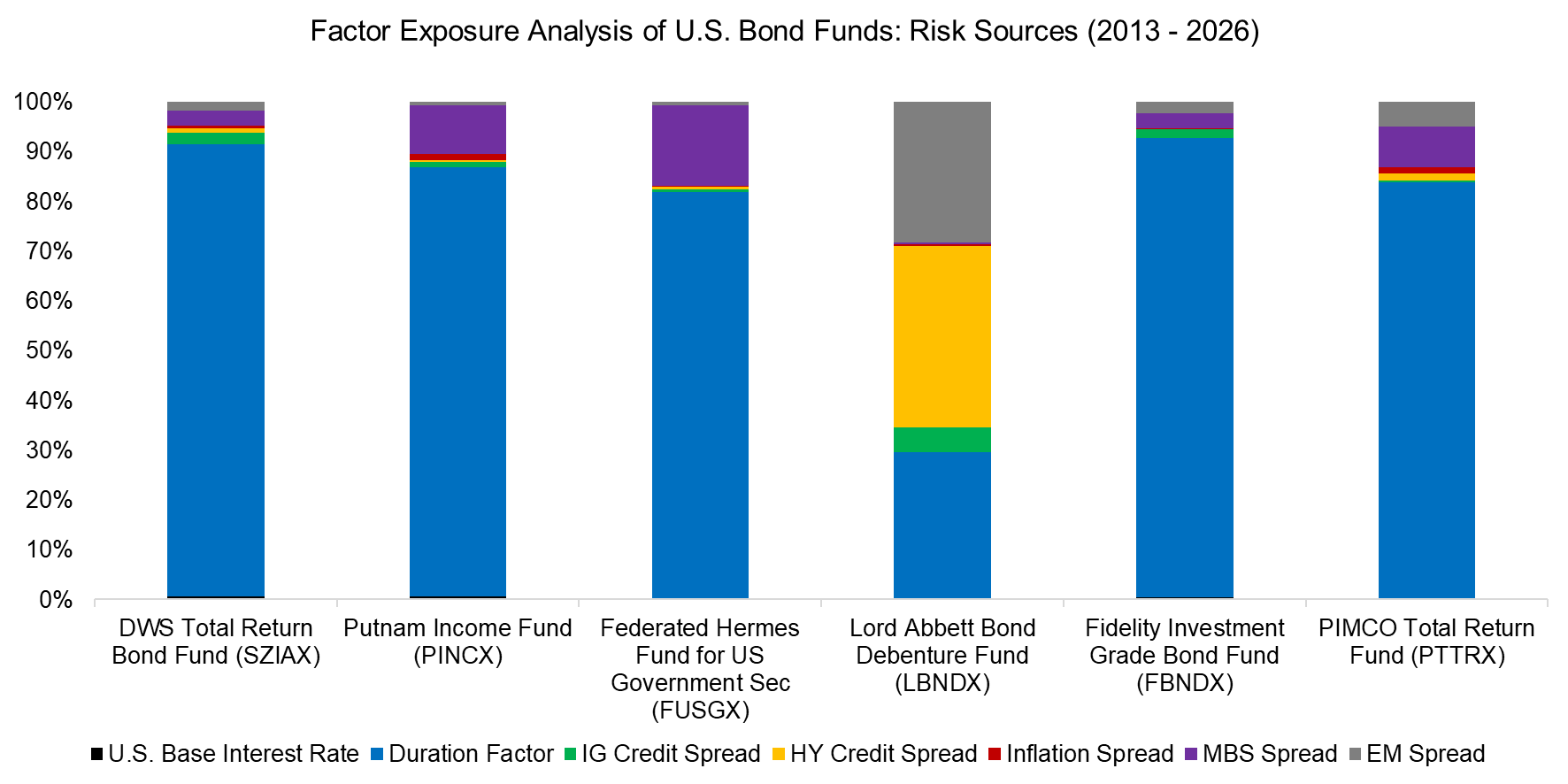
Rather than examining betas in isolation, investors gain a clearer perspective on a fund’s underlying drivers by focusing on risk contributions. For five of the six bond funds, almost all risk is explained by the duration factor – reflecting straightforward interest rate risk arising from holdings in longer-dated bonds.
The sole exception is the Lord Abbett Bond Debenture Fund (LBNDX), where the high yield and emerging market credit spreads account for the largest share of risk. This is consistent with the fund’s own factsheet, which confirms that high yield bonds represent the largest allocation – validating that the factor exposure analysis has correctly identified the primary risk driver.
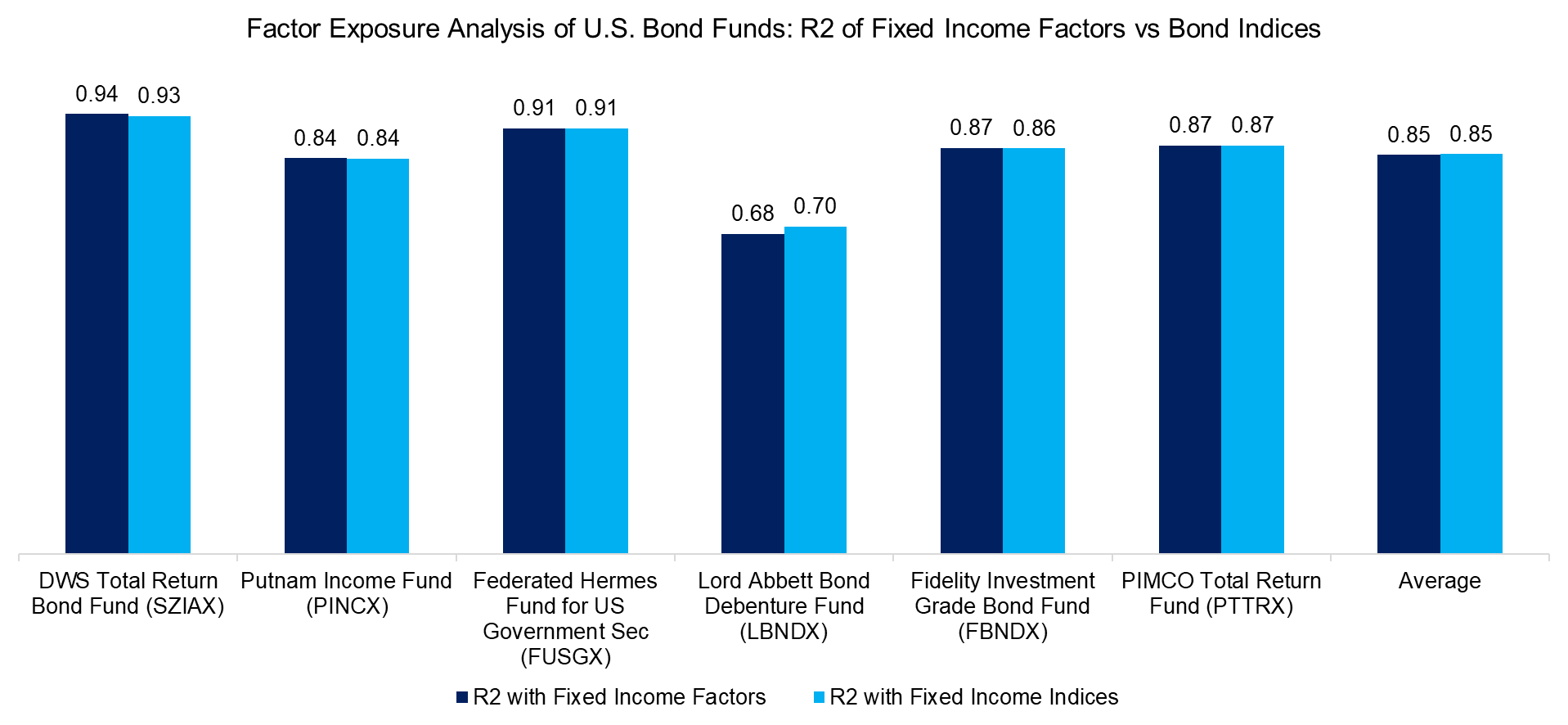
Consistent with our previous research, we evaluate the explanatory power of the factor exposure analysis. The R² values range from 0.68 for LBNDX to 0.94 for SZIAX, suggesting that the fixed income factors explain the returns and risk of the bond funds reasonably well. It is worth noting, however, that substituting plain-vanilla bond indices for the factors would have produced near-identical R² values, despite the indices being highly correlated variables.
Source: Finominal
FURTHER THOUGHTS
Consistent with our previous research on fixed income factor exposure analysis, this analysis does not point to a statistically superior approach. However, there is a clear practical advantage to using terminology that bond investors are already familiar with – such as duration and credit spreads. Framing the analysis in these terms may not improve the model’s explanatory power, but it meaningfully increases its intuitiveness and, therefore, its usefulness in practice.
RELATED RESEARCH
Factor Exposure Analysis 118: Factor-based Return Attribution Analysis
Factor Exposure Analysis 117: Risk Contribution Analysis
Factor Exposure Analysis 116: Residualized Indices
Factor Exposure Analysis 115: Measuring International Exposures
Factor Exposure Analysis 114: Factor Offsetting
Factor Exposure Analysis 113: Profitability vs Leverage Factors
Factor Exposure Analysis 112: Quality vs Growth Factors
Factor Exposure Analysis 111: What is Alpha?
Factor Exposure Analysis 110: Long-Short vs Long-Only Factors
Factor Exposure Analysis 109: Linear vs Lasso vs Elastic Net
Factor Exposure Analysis 108: Fixed Income Factors II
Factor Exposure Analysis 107: Fixed Income Factors
Factor Exposure Analysis 106: Macro Variables
Factor Exposure Analysis 105: Sectors versus Factors
Factor Exposure Analysis 104: Fixed Income ETFs
Factor Exposure Analysis 103: Exploring Residualization
Factor Exposure Analysis 102: More or Less Independent Variables?
Factor Exposure Analysis 101: Linear vs Lasso Regression
Factor Exposure Analysis 100: Holdings vs Regression-Based
ABOUT THE AUTHOR
Nicolas Rabener is the CEO & Founder of Finominal, which empowers professional investors with data, technology, and research insights to improve their investment outcomes. Previously he created Jackdaw Capital, an award-winning quantitative hedge fund. Before that Nicolas worked at GIC and Citigroup in London and New York. Nicolas holds a Master of Finance from HHL Leipzig Graduate School of Management, is a CAIA charter holder, and enjoys endurance sports (Ironman & 100km Ultramarathon).
Connect with me on LinkedIn or X.