
Diversification vs De-Risking: Evidence across Asset Classes
Do bonds diversify or only de-risk?
June 2026. Reading Time: 10 Minutes. Author: Nicolas Rabener.
SUMMARY
- Diversification and de-risking are different concepts
- Most assets de-risk rather than diversify
- Especially when measured against T-Bills
INTRODUCTION
Cliff Asness of AQR Capital Management commented on X on June 7th, 2026, that “bonds, as they are conventionally used, dilute equities much more than they diversify equities” – a striking observation given that most investors think of bonds primarily as diversifiers.
We have made similar observations across a range of alternative and options-based strategies that appear to offer little more than diluted equity exposure, often at significantly higher fees. Investors could replicate the risk profile of many such products simply by reducing their equity allocation and increasing their cash holdings. The popularity of products like the First Trust Long/Short Equity ETF (FTLS), which reached $2 billion in assets, is largely explained by persuasive marketing and the appeal to financial advisors of minimizing peak-to-trough drawdowns on client statements (read Replicating Popular Investment Strategies with Equities + Cash).
However, whether bonds and other conventional diversifiers are genuinely diversifying or merely diluting is a question that extends well beyond the alternative and options-based product universe. So how much are traditional asset classes – bonds, real estate, and gold – actually diversifying investor portfolios?
DIVERSIFICATION VS DE-RISKING VIA T-BILLS
Diversification is widely regarded as the only free lunch in investing. The core idea is that by allocating to uncorrelated assets, investors can harvest diversification benefits in the form of higher risk-adjusted returns without taking on additional risk.
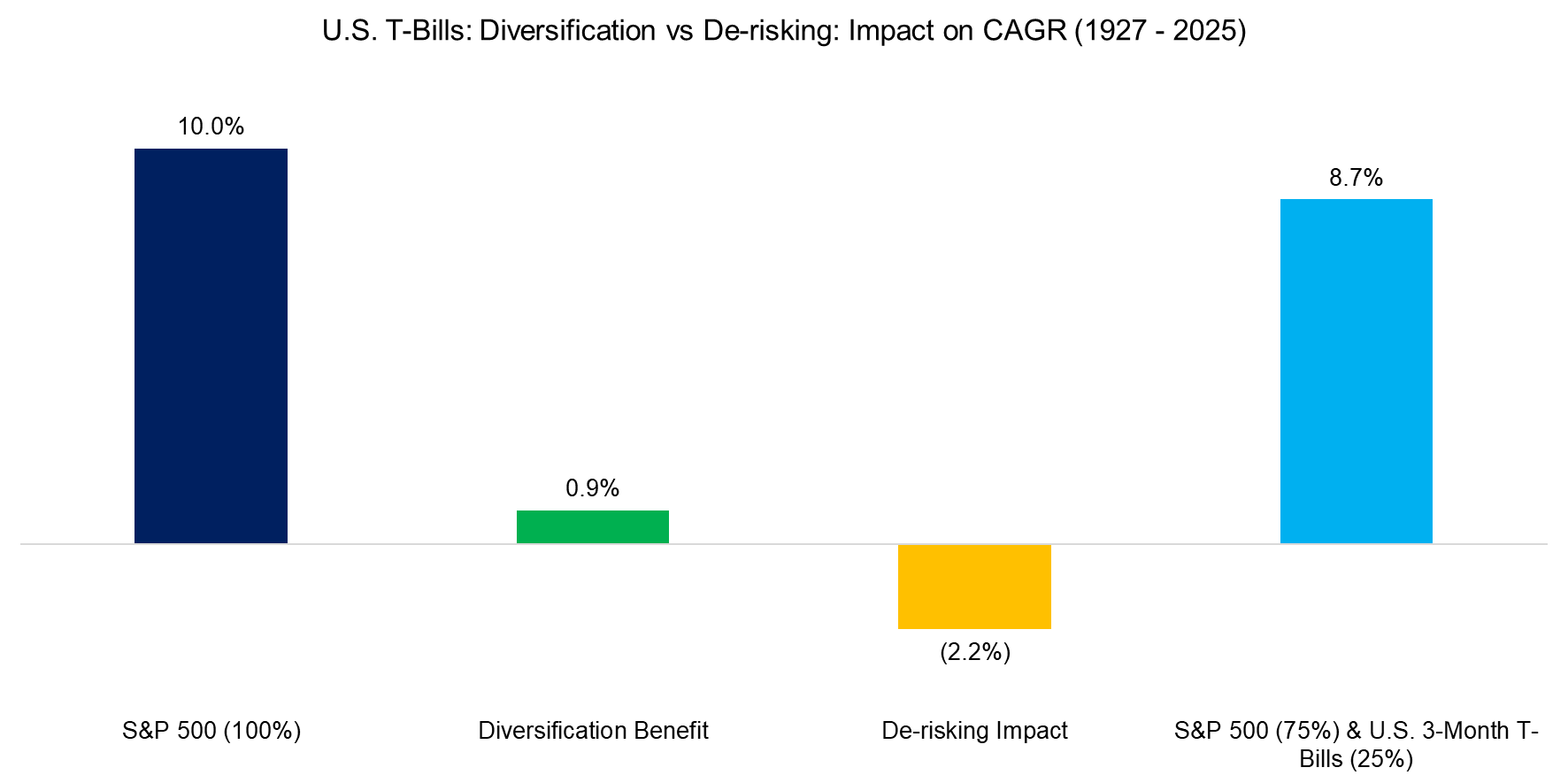
Using data from Professor Aswath Damodaran’s website, we simulate adding a 25% allocation to U.S. 3-Month T-Bills to a portfolio otherwise invested entirely in the S&P 500. Over the period from 1927 to 2025, the portfolio CAGR would have declined from 10.0% to 8.7% – as expected, given the lower return of T-Bills relative to equities. To isolate the diversification benefit, we compare this outcome against a 25% allocation to non-interest-bearing cash. A cash allocation of the same size would have reduced the CAGR by 2.2%, implying that the diversification contribution from T-Bills – over and above simple dilution – was 0.9% per annum.
Source: Finominal
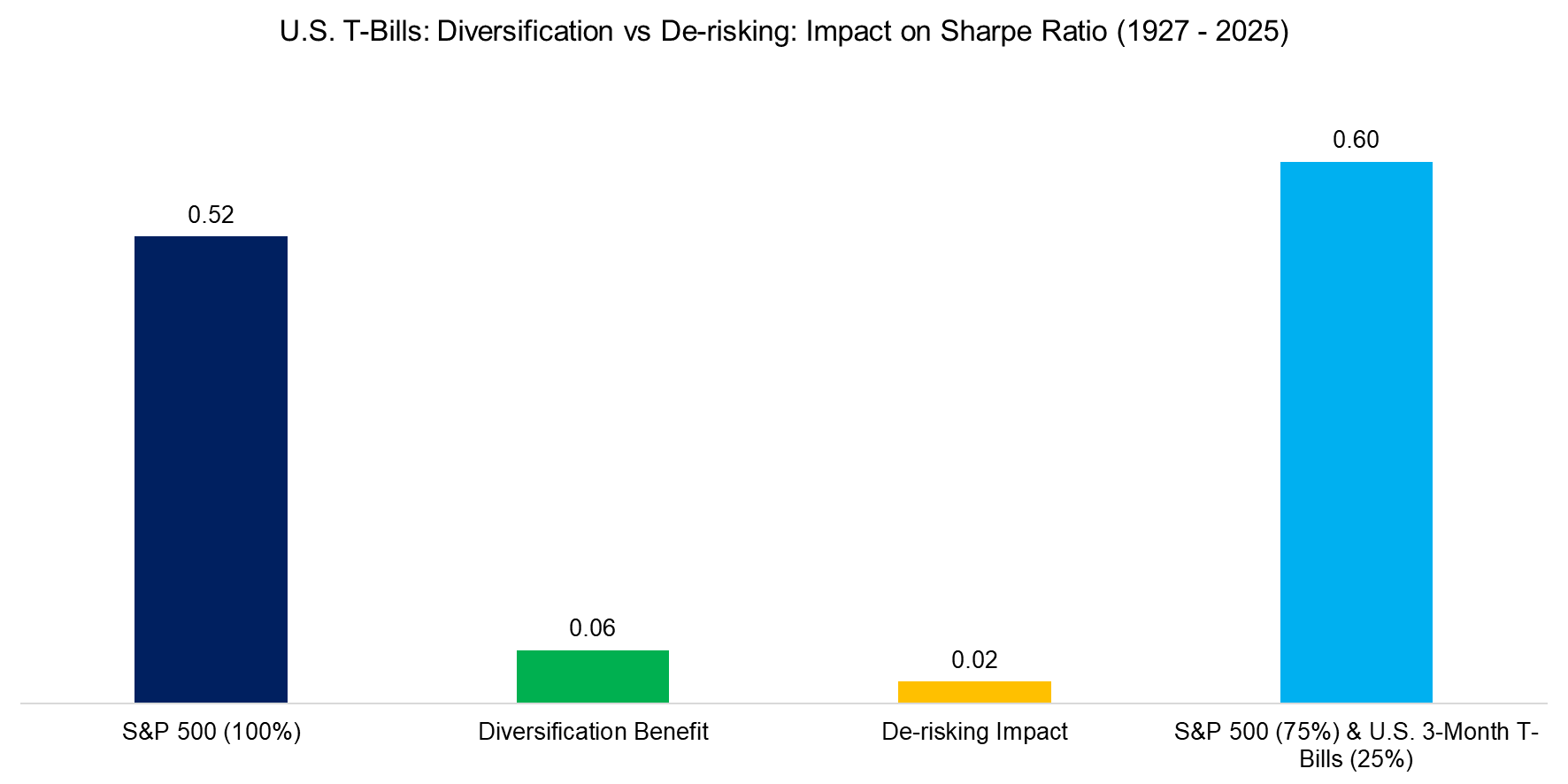
Shifting the perspective from returns to risk-adjusted returns, a 25% allocation to T-Bills would have increased the equity portfolio’s Sharpe ratio from 0.52 to 0.60 over the same period. Of this 0.08 improvement, the diversification benefit accounted for 0.06, while the de-risking impact contributed the remaining 0.02 – confirming that the majority of the gain came from diversification rather than simply reducing portfolio risk.
Source: Finominal
DIVERSIFICATION VS DE-RISKING VIA VARIOUS ASSETS
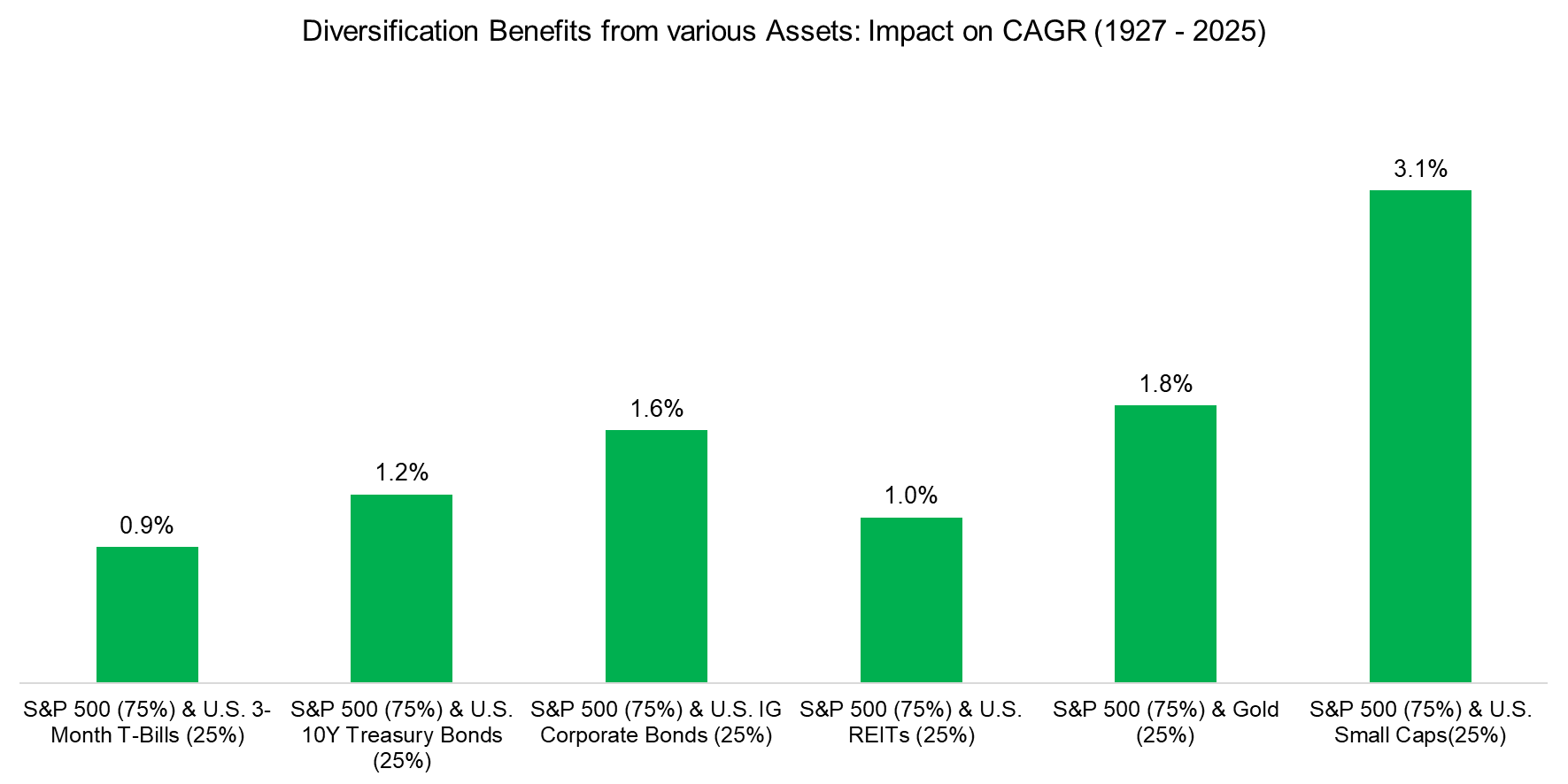
We next quantify the diversification benefits of adding a 25% allocation to each of the following asset classes in turn: U.S. 10-Year Treasury Bonds, U.S. Investment-Grade Bonds, U.S. REITs as a proxy for real estate, gold, and U.S. small-cap stocks. In each case, the asset class provided a positive diversification benefit relative to an equivalent 25% allocation to non-interest-bearing cash.
Source: Finominal
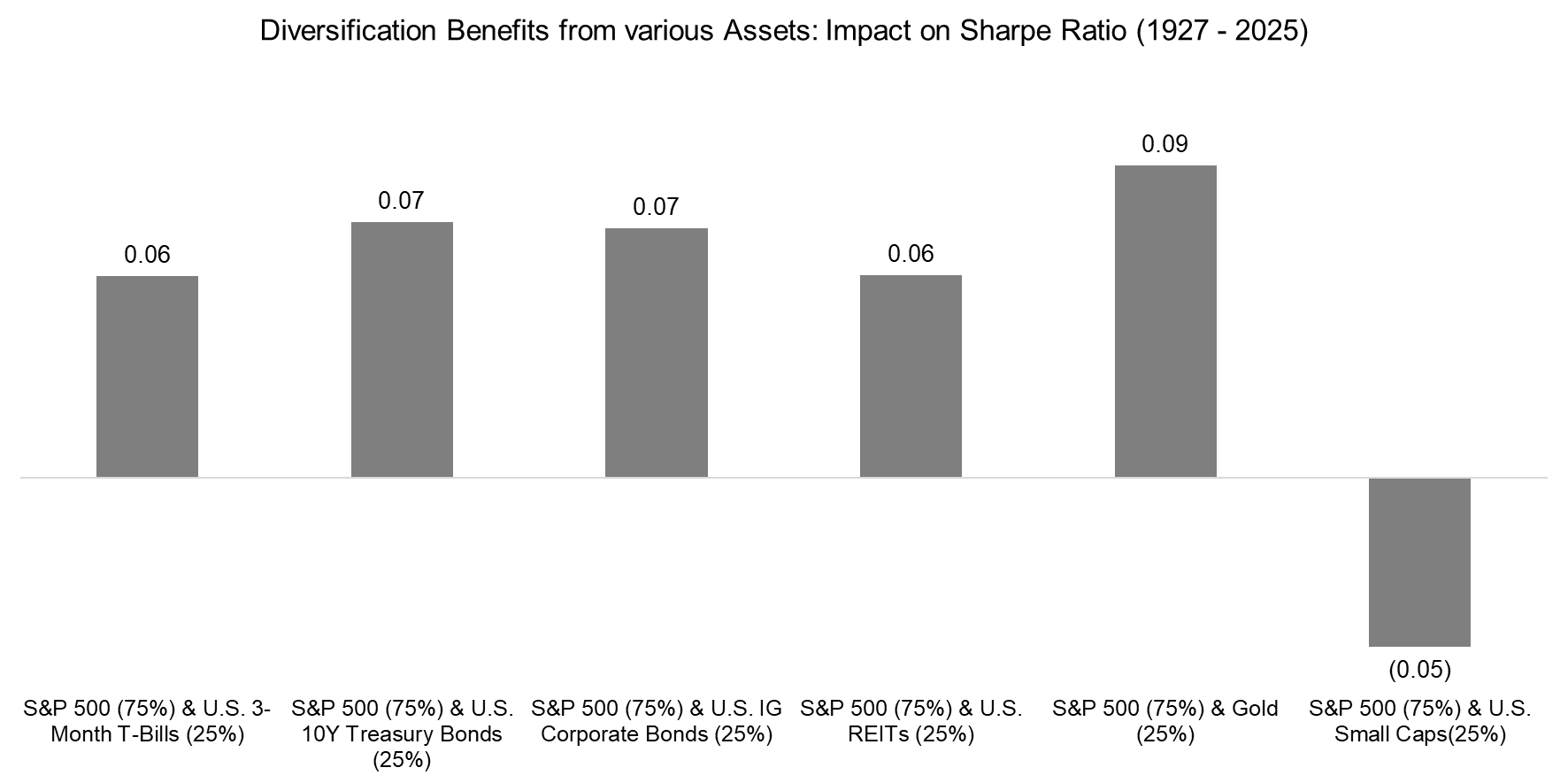
Switching to Sharpe ratios as the measure of diversification benefit, however, reveals a more nuanced picture. U.S. small-cap stocks, despite offering the highest CAGR-based diversification benefit, provided no meaningful improvement in risk-adjusted returns. This can be explained by the correlations between the S&P 500 and each asset class from 1927 to 2025. Government bonds and gold exhibited correlations close to zero with U.S. large-cap stocks, while investment-grade corporate bonds and small-cap stocks were considerably more correlated at 0.4 and 0.7, respectively. The higher the correlation, the lower the diversification benefit.
Source: Finominal
INCREASING THE HURDLE RATE
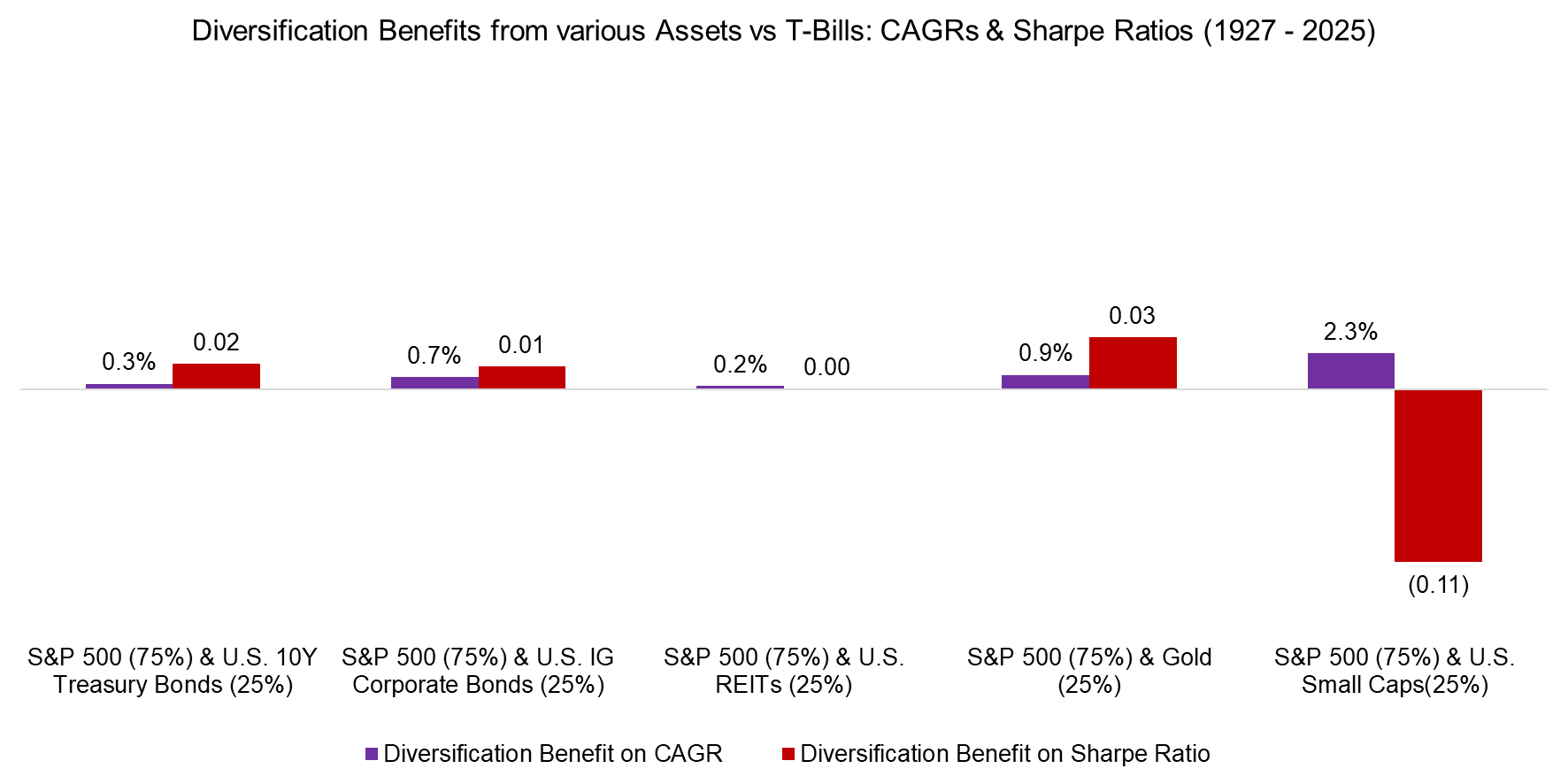
So far, we have measured the diversification benefit relative to an allocation to non-interest-bearing cash – but most investors hold short-term government bonds rather than uninvested cash. We therefore rerun the analysis, replacing the 25% cash allocation with T-Bills, thereby raising the hurdle rate for any additional diversification benefit.
The results show that diversification benefits over the full period from 1927 to 2025 in both CAGR and Sharpe ratio terms remained positive across most asset classes – with the exception of U.S. small-cap stocks, as previously discussed. However, the magnitude of these benefits was reduced to near zero for U.S. investment-grade corporate bonds and REITs. Only long-term U.S. government bonds and gold produced meaningful diversification benefits compared to simply holding T-Bills.
Source: Finominal
FURTHER THOUGHTS
Why should investors care about the distinction between diversification and de-risking?
Although both reduce portfolio volatility and maximum drawdowns, the key difference lies in what investors are paying for. Genuine diversification – where uncorrelated returns improve risk-adjusted performance – is worth paying active management fees for. De-risking, by contrast, can be achieved simply by reducing equity exposure and allocating to a T-BILL ETF or money market fund at minimal cost. We suspect that many alternative funds marketed as diversifiers in practice offer little more than de-risking – a hypothesis that warrants further research.
RELATED RESEARCH
Return vs Diversification: What Matters More?
Alts: Volatility Is Not Your Enemy
60/40 vs Leveraged Diversified Portfolio
Diversification versus Hedging II
Diversification versus Hedging
Finding Funds with Diversification Potential
Downside Betas vs Downside Correlations
Bonds vs Managed Futures: A 100-Year Perspective
60/40 Portfolios Without Bonds
Bonds versus CTAs for Diversification
ABOUT THE AUTHOR
Nicolas Rabener is the CEO & Founder of Finominal, which empowers professional investors with data, technology, and research insights to improve their investment outcomes. Previously he created Jackdaw Capital, an award-winning quantitative hedge fund. Before that Nicolas worked at GIC and Citigroup in London and New York. Nicolas holds a Master of Finance from HHL Leipzig Graduate School of Management, is a CAIA charter holder, and enjoys endurance sports (Ironman & 100km Ultramarathon).
Connect with me on LinkedIn or X.