
Fund Selection: Equity Substitutes vs Diversifiers
What funds are worth buying?
October 2026. Reading Time: 10 Minutes. Author: Nicolas Rabener.
SUMMARY
- Fund selection can be simplified into equity substitutes & diversifiers
- Less than 5% of all funds are attractive equity substitutes
- Less than 1% of all funds are superior diversifiers
INTRODUCTION
In 2023, J.P. Morgan’s long-term strategist Jan Loeys argued that most investors only need two funds: one for global equities and one for local bonds. Although this is sound advice, asset managers and banks make compelling cases for a wide range of other strategies, including high yield bonds, CLOs, preferreds, Taiwanese stocks, REITs, merger arbitrage, long-short equity, private equity, and cryptocurrencies.
Given the large universe of investment strategies and the many ways of combining them into portfolios, investors are often overwhelmed by asset allocation. However, investors can reduce this complexity by dividing strategies into two categories: equity substitutes and diversifiers. Equity substitutes are strategies that are moderately to highly correlated with the stock market. If they offer higher Sharpe ratios than the market (e.g., the S&P 500 in the U.S.), they can be considered attractive equity substitutes. If their risk-adjusted returns are lower, investors are better off buying the market via a passive index tracker. In contrast, low-correlation strategies are diversifiers, which we can further distinguish into superior and base diversifiers.
In this research article, we rank all U.S. mutual funds and ETFs using this simple asset allocation framework.
DIVERSIFICATION MATRIX
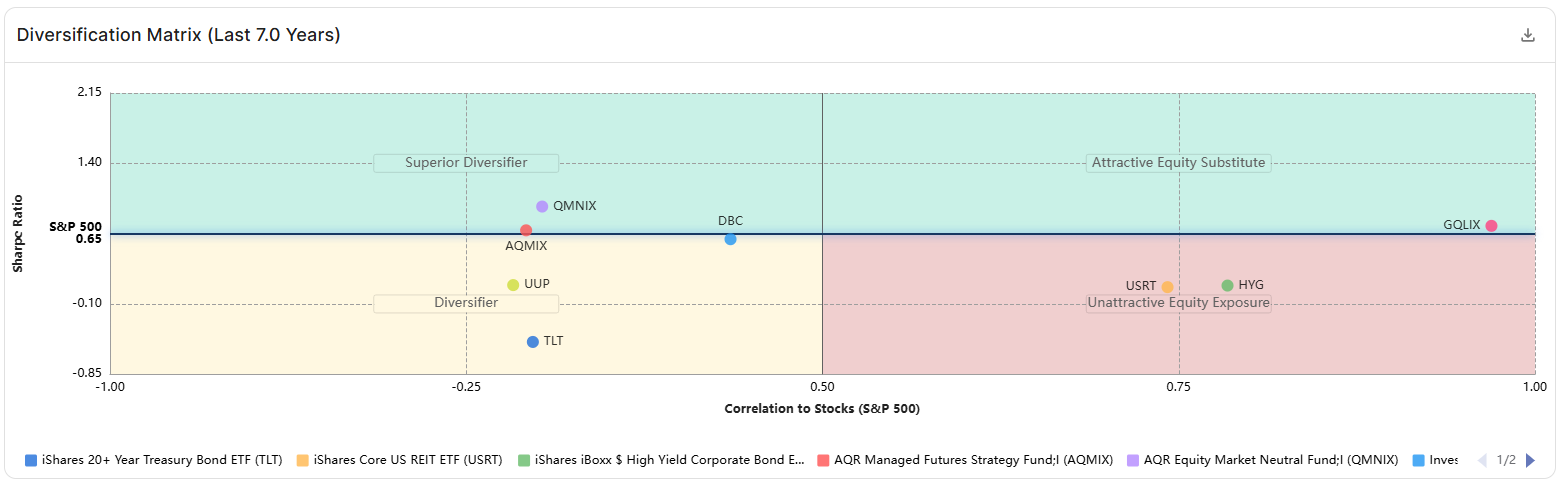
The starting point for almost every investor is the stock market, as it represents the core risk of most portfolios. We use the S&P 500 as the reference point and measure each fund’s Sharpe ratio and correlation with the S&P 500. A correlation of 0.5 serves as the threshold separating equity substitutes from diversifiers.
As a case study, we select eight funds representing major asset classes and map them onto this framework. Three are highly correlated with the stock market: U.S. high yield bonds (HYG), U.S. REITs (USRT), and a GMO equity mutual fund (GQLIX). However, only GQLIX generated a higher Sharpe ratio than the S&P 500 over the last seven years. From this perspective, it is questionable why investors should hold high yield bonds or REITs, given their lower risk-adjusted returns and high correlations.
The other five products – a managed futures fund (AQMIX), an equity market neutral fund (QMNIX), a commodity fund (DBC), a USD currency fund (UUP), and a long-term bond fund (TLT) – showed lower correlations and therefore offer diversification benefits. However, only QMNIX delivered a higher Sharpe ratio than the S&P 500, making it a superior diversifier.
U.S. FUNDS: EQUITY SUBSTITUTES & DIVERSIFIERS
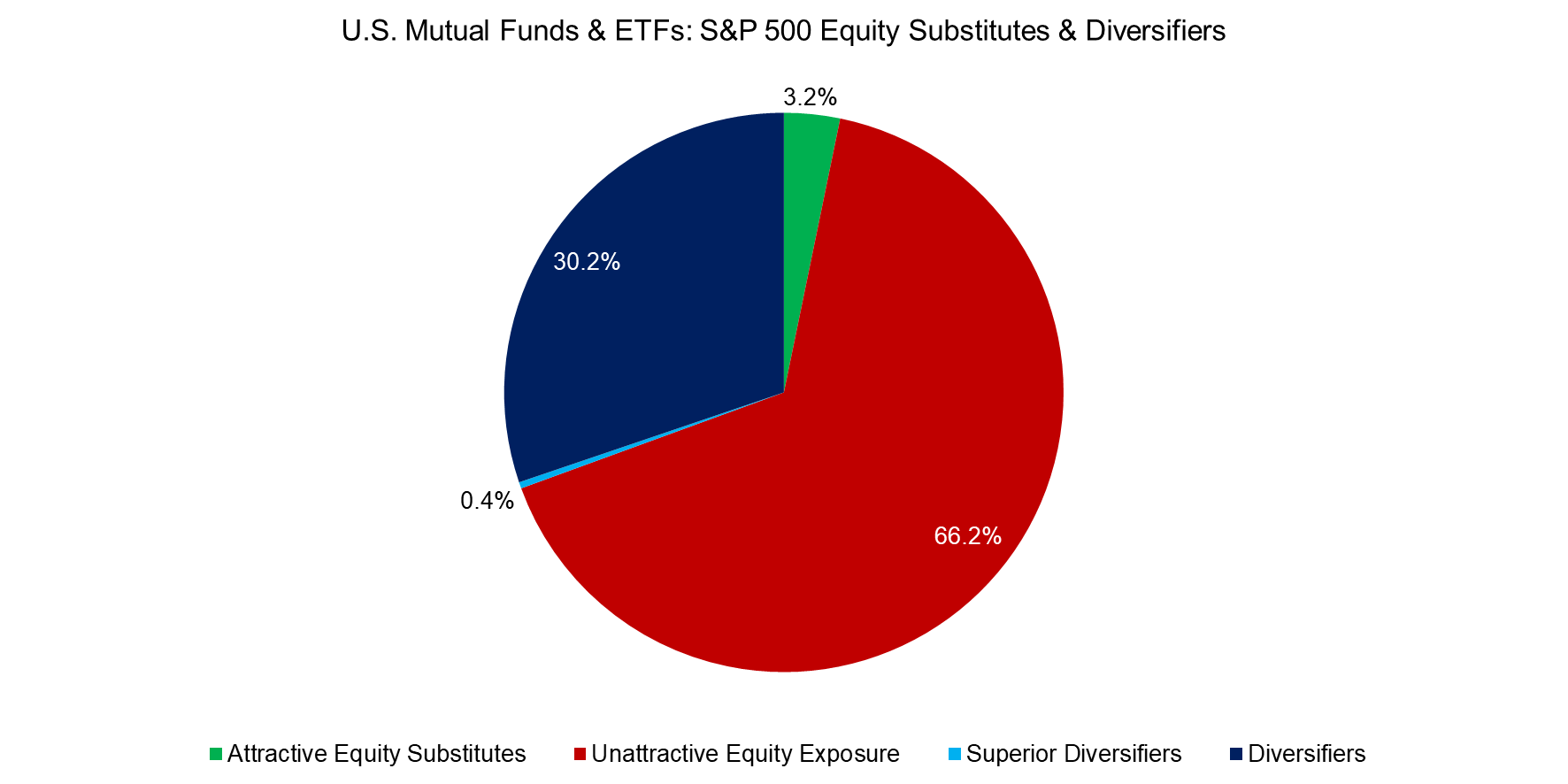
Next, we compute the Sharpe ratios and correlations with the S&P 500 for all U.S. mutual funds and ETFs over the last 10 years, a universe of 6,038 funds. Applying our asset allocation framework, 31% of funds qualify as diversifying strategies, but only 0.4% as superior diversifiers. Worse, 66% of funds are moderately to highly correlated with the S&P 500 and generated lower Sharpe ratios, which makes them unattractive. Only 3.2% generated higher risk-adjusted returns, making them attractive substitutes for the S&P 500.
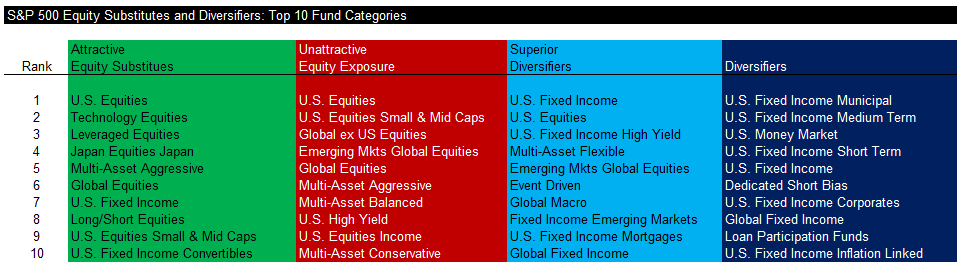
Finally, we review the top 10 fund categories for each of these quadrants. We observe significant overlap; for example, global equities funds and U.S. small & mid cap funds appear as attractive equity substitutes and unattractive equity exposure. Given the large universe of funds, this is to be expected.
The fund categories in superior diversifiers are diverse, covering equities, fixed income, and alternatives. In contrast, base diversifiers are primarily fixed income strategies. Given that bonds didn’t do well over the last 10 years because of rising interest rates, it is not surprising they generated lower Sharpe ratios than the S&P 500.
Source: Finominal
FURTHER THOUGHTS
The diversification matrix is a simple but powerful framework for reducing the complexity of asset allocation. Given that fewer than 5% of all non-diversifying funds have generated higher Sharpe ratios than the S&P 500, it is questionable whether investors should even be searching for outperforming funds. Investors who simply want higher returns can buy leveraged equity ETFs.
The matrix helps investors avoid strategies that essentially represent diluted equity exposure, such as high yield, REITs, option-based strategies, and long-short equity funds. The remaining universe of diversifying strategies can then be narrowed down relatively easily by comparing their returns to those of Treasury bills, as de-risking is different from diversification (read Diversifying vs De-Risking Funds). Naturally, we still need to consider how these strategies should be combined, but that is much easier with 10 strategies than with 1,000.
RELATED RESEARCH
Diversifying vs De-Risking Funds
Diversification vs De-Risking: Evidence Across Asset Classes
Return vs Diversification: What Matters More?
Alts: Volatility Is Not Your Enemy
60/40 vs Leveraged Diversified Portfolio
Diversification versus Hedging II
Diversification versus Hedging
Finding Funds with Diversification Potential
Downside Betas vs Downside Correlations
Bonds vs Managed Futures: A 100-Year Perspective
60/40 Portfolios Without Bonds
Bonds versus CTAs for Diversification
ABOUT THE AUTHOR
Nicolas Rabener is the CEO & Founder of Finominal, which empowers professional investors with data, technology, and research insights to improve their investment outcomes. Previously he created Jackdaw Capital, an award-winning quantitative hedge fund. Before that Nicolas worked at GIC and Citigroup in London and New York. Nicolas holds a Master of Finance from HHL Leipzig Graduate School of Management, is a CAIA charter holder, and enjoys endurance sports (Ironman & 100km Ultramarathon).
Connect with me on LinkedIn or X.