
Alternative Strategies vs Interest Rates
Similar performance – coincidence or causation?
July 2026. Reading Time: 10 Minutes. Author: Nicolas Rabener.
- CTAs & equity market neutral funds have benefited from rising rates
- However, they don’t exhibit interest rate-sensitivity per se
- Rather, the lack of trends and negative investor sentiment were detrimental
INTRODUCTION
What is the right benchmark for a hedge fund? The answer depends on the strategy, but for truly uncorrelated strategies, it should be at minimum the risk-free rate – typically proxied by short-term government bonds.
One of the less well-known features of certain hedge fund strategies is that futures-based approaches, such as managed futures and CTAs, only require a small portion of their capital as margin to support their trading activity. In practice, this means that 80 to 90 percent of the capital sits idle from the perspective of the core strategy and is typically invested in T-Bills. This embedded cash return forms a base return that can mislead allocators unaware of it – leading them to attribute performance to manager skill that is partly explained by prevailing interest rates.
Given that interest rates have risen sharply over the past few years, a natural question follows: have uncorrelated hedge fund strategies mechanically generated more attractive returns as a result? In this article, we explore the relationship between interest rates and the performance of two uncorrelated strategies – managed futures and equity market neutral hedge funds.
PERFORMANCE OF MANAGED FUTURES & EQUITY MARKET NEUTRAL FUNDS
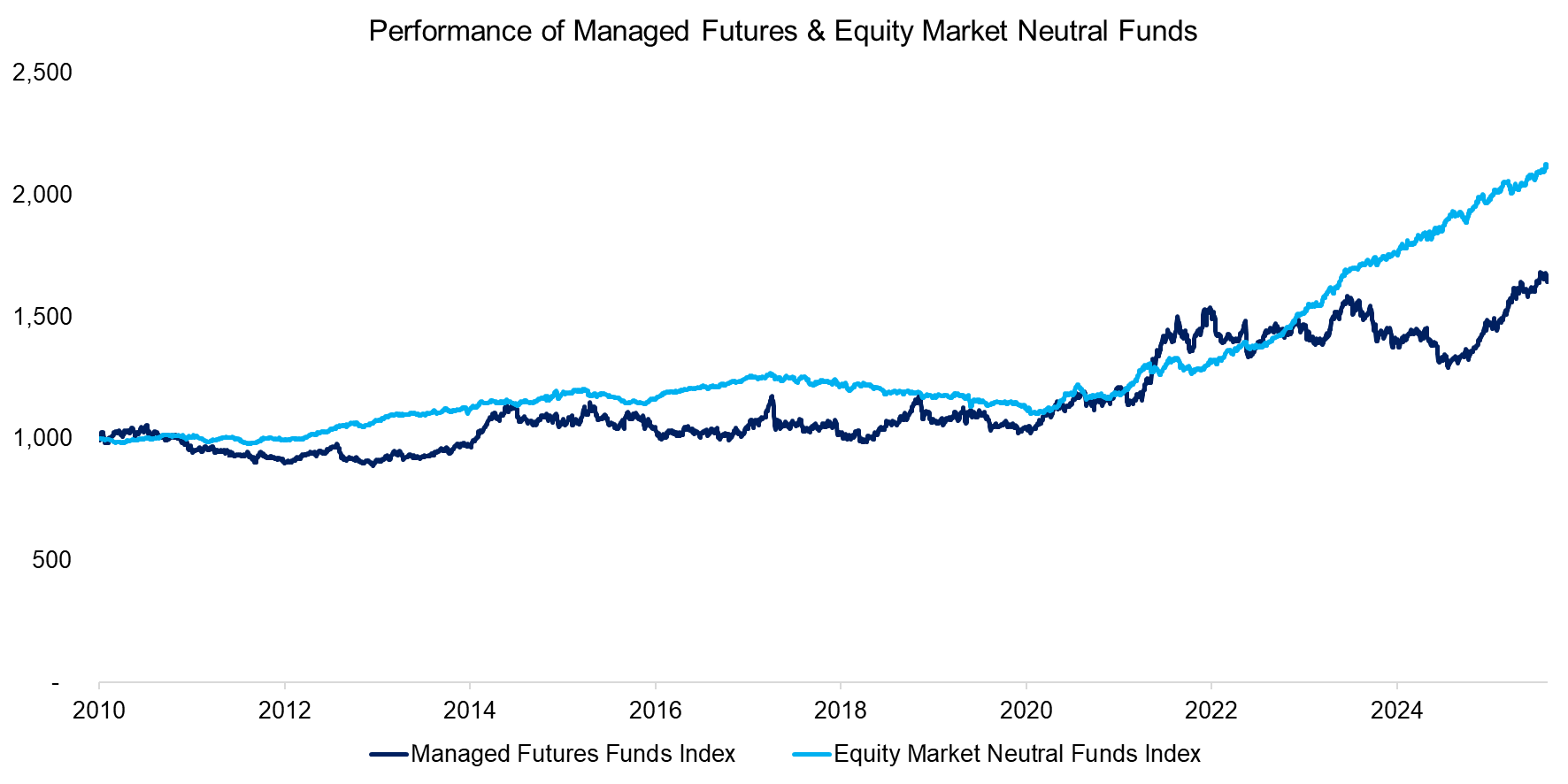
We construct two equal-weighted indices comprising publicly traded U.S. mutual funds – one for managed futures and one for equity market neutral strategies – selected primarily on the basis of low correlation to equities. The managed futures index has seven constituents (AHLPX, AQMNX, EVOIX, GMSSX, MFTNX, PQTIX, RYIFX), and the equity market neutral index has four (BDMIX, JMNSX, QMNIX, VMNIX). We use 2010 as the starting date, as this is the earliest point at which at least two funds were live within each index.
The performance of both strategies was broadly flat between 2010 and 2020, followed by a marked improvement thereafter. It should be noted that this fund set excludes liquidated funds and therefore suffers from survivorship bias, meaning the returns are likely overstated.
PERFORMANCE OF MANAGED FUTURES & EQUITY MARKET NEUTRAL FUNDS VS T-BILLS
We next compare the performance of both hedge fund strategies against U.S. T-Bills. Neither strategy meaningfully outperformed T-Bills over the decade between 2010 and 2020. Returns only began to improve in earnest when the U.S. Federal Reserve started raising interest rates in 2022.
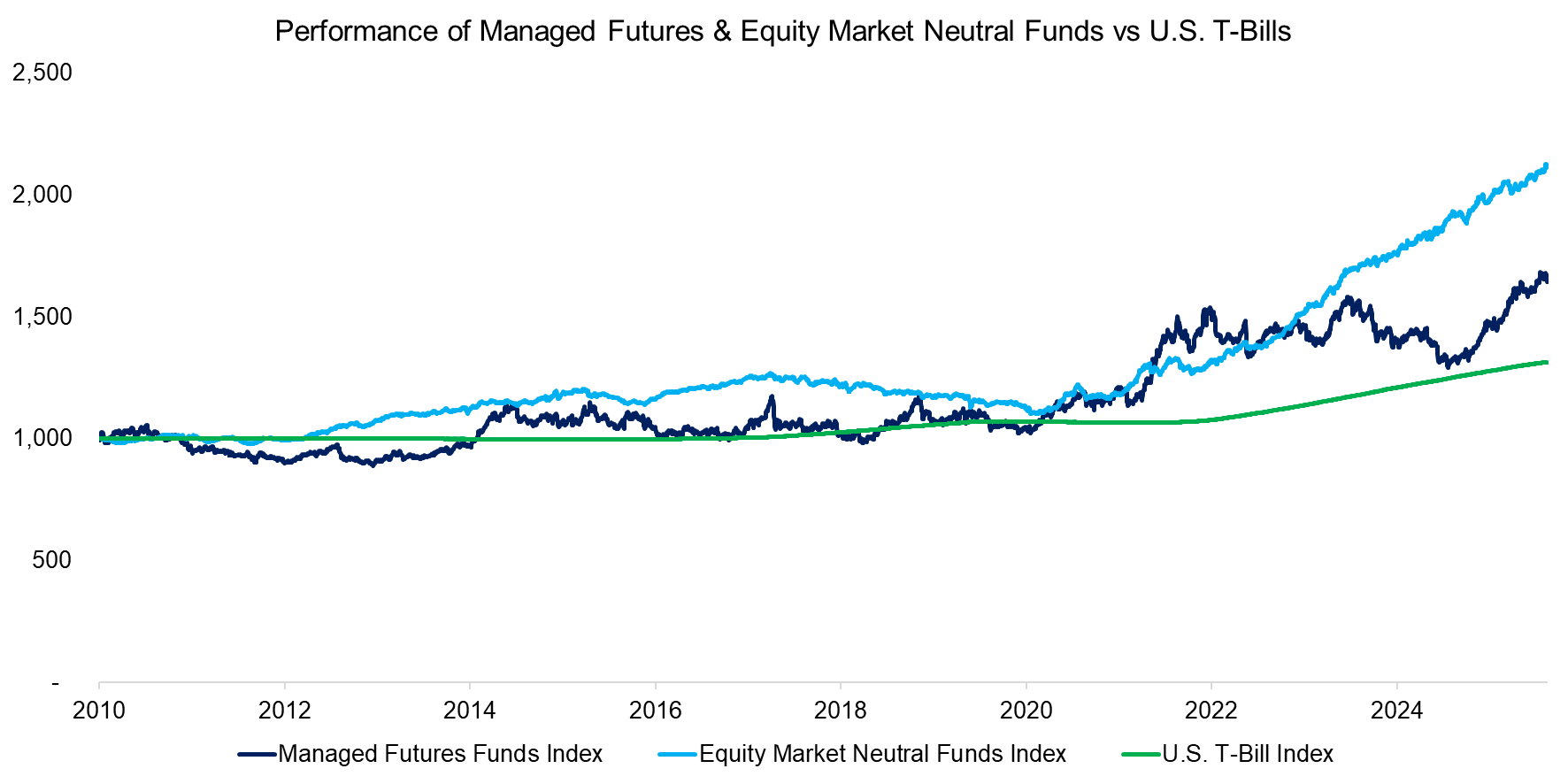
We should be careful, however, not to fall into the trap of chart magic – where two seemingly correlated time series give rise to a compelling but ultimately misleading narrative. While it is true that managed futures benefit mechanically from higher interest rates through their cash holdings, there is little empirical evidence that the strategy is fundamentally interest rate-sensitive.
The explanation for the flat returns during the low-interest-rate environment and the subsequent improvement is likely more straightforward. These strategies pursue trend following across asset classes, and when interest rates are anchored near zero, sustained directional trends are scarce and difficult to exploit. When rates began rising sharply, stronger and more persistent trends emerged across multiple asset classes – most notably the opportunity to short bonds – providing a more fertile environment for trend-following strategies regardless of the rate level itself.
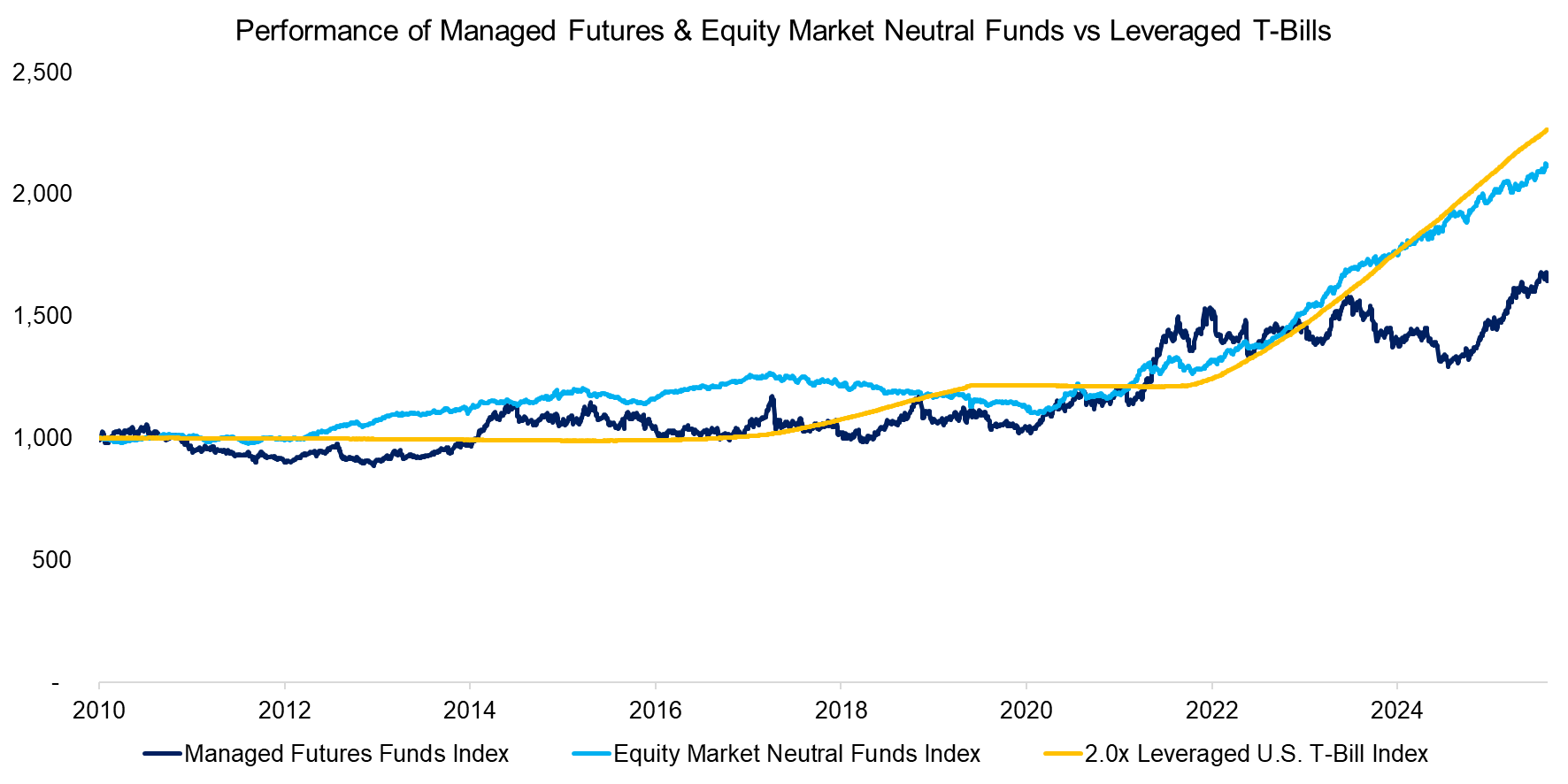
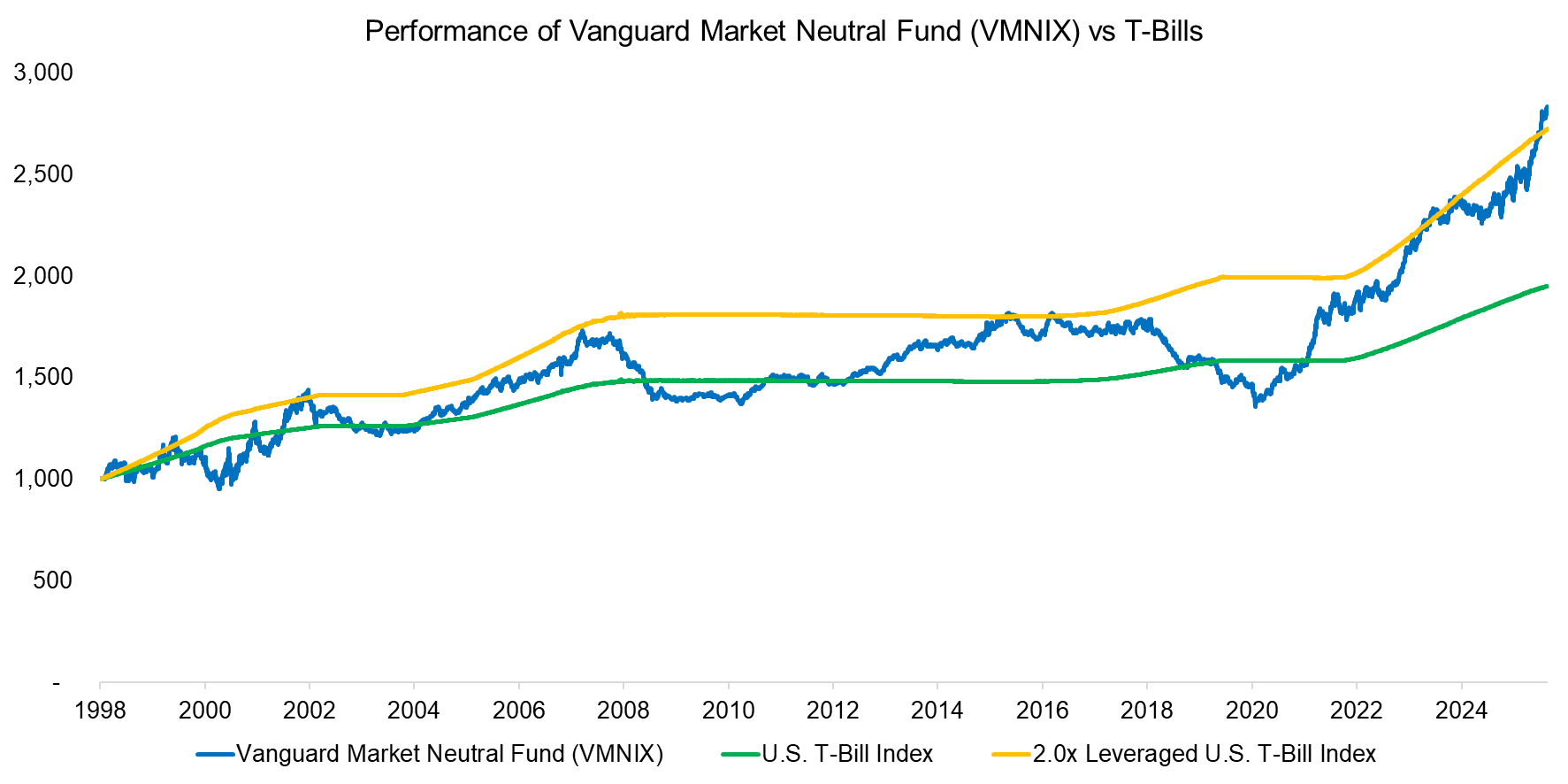
The relationship between equity market neutral strategies and interest rates is less straightforward to explain (read Factors & Interest Rates). Most of these funds pursue market-neutral multi-factor investing in equities, constructing portfolios from individual stocks rather than futures contracts. We can extend the analysis by drawing on the Vanguard Market Neutral Fund (VMNIX), which has a track record dating back to 1998. This longer history reinforces rather than resolves the apparent interest rate sensitivity – the fund performed strongly between 1998 and 2008 and again between 2020 and 2026, both periods of rising rates, while delivering poor returns during the low-rate environment of the 2010s.
Like many of its peers, the fund selects stocks primarily on the basis of momentum, value, and quality characteristics, consistent with the academic factor investing literature. The same explanation offered for managed futures – which also rely on momentum – applies here: a near-zero interest rate environment is not conducive to trend-following strategies, as sustained directional trends across asset classes are limited.
In previous research, we identified a strong relationship between equity market risk sentiment and value investing performance (read Improving the Odds of Value Investing). When investors are risk-averse, they are unlikely to rotate into distressed companies or out-of-favor industries – precisely the conditions that characterize value investing opportunities. The 2010s can be characterized as such a period, which also helps explain why interest rates were kept suppressed for so long. By contrast, the post-COVID environment brought both inflationary pressure and renewed economic optimism – partly a function of large-scale fiscal stimulus – which improved market sentiment and created a more favorable backdrop for value stocks. The quality factor, while typically negatively correlated with value, is of secondary importance here given that the combination of momentum and value characteristics tends to dominate the stock selection process.
We further extend the analysis to a full century by constructing an equal-weighted portfolio allocation to the momentum and value factors, sourced from the Kenneth R. French data library. It should be noted that these factors represent backtested returns rather than realized fund performance, and they exclude transaction costs and include micro-cap stocks that would be impractical to trade at scale. The returns should therefore be interpreted with appropriate caution.
The data reveals only two extended periods of flat interest rates: the 1930s and 1940s, and the 2010s. In both periods, the returns of the market-neutral value and momentum portfolio were poor. The comparison has clear limitations, however – both earlier periods coincided with the Great Depression, the Second World War, and their respective aftermaths, making it difficult to isolate the effect of interest rates from broader macroeconomic and geopolitical disruptions.
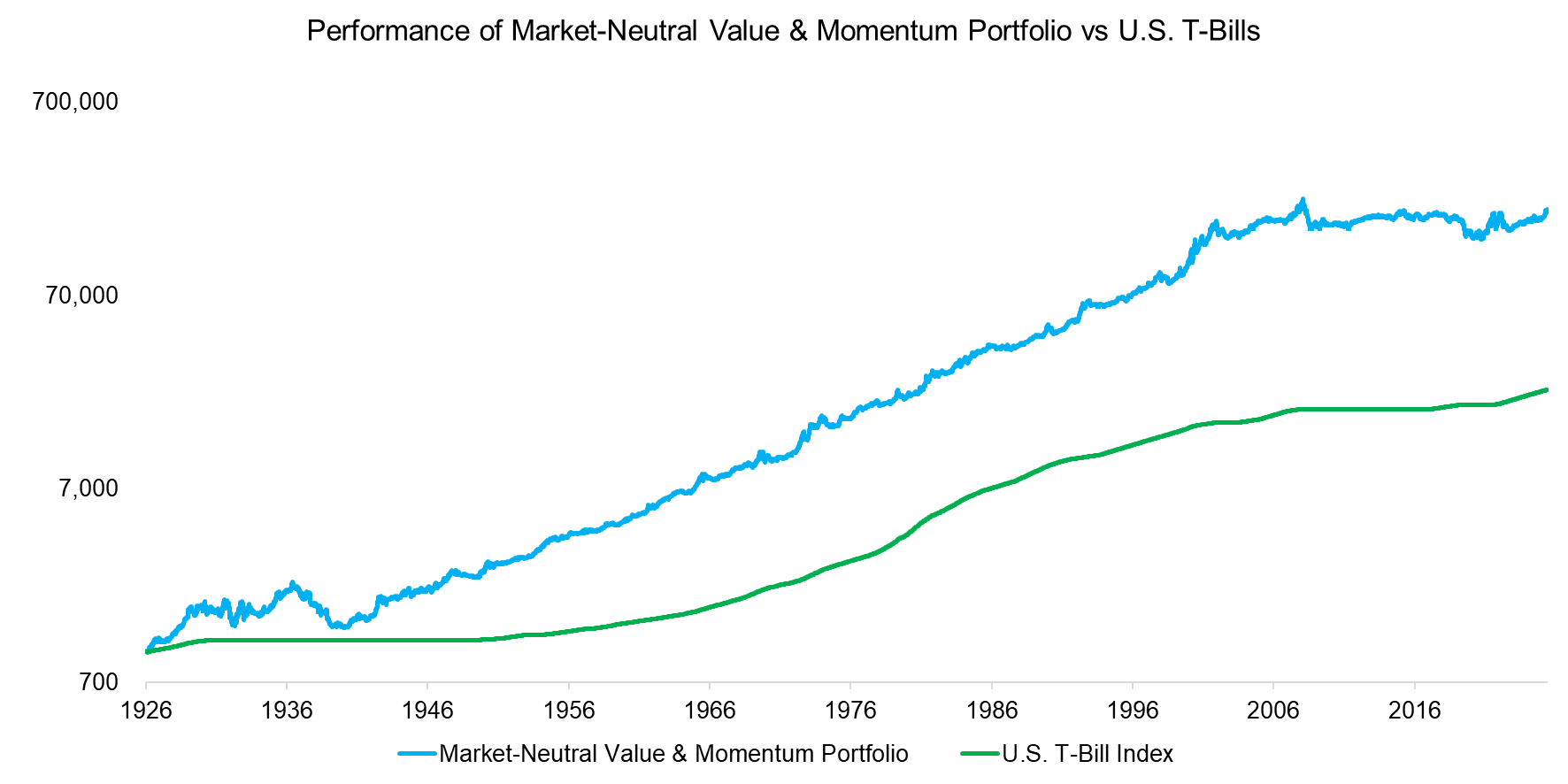
Source: Kenneth R. French Data Library, Finominal
FURTHER THOUGHTS
Should investors in managed futures or equity market neutral strategies be concerned that they are essentially betting on rising interest rates?
While some of the analysis presented here may suggest this, our other research indicates otherwise. CTAs and the momentum factor need clear trends that can be exploited, which are perhaps less prevalent in low-interest-rate environments. The value factor, the other core driver of equity market neutral strategies, also performs poorly in such environments, as low rates tend to signal economic malaise, where investors are less willing to bet on troubled companies.
RELATED RESEARCH
Factors & Interest Rates
Duration of U.S. Equities – II
Diversifying vs De-Risking Funds
Diversification vs De-Risking: Evidence Across Asset Classes
Improving the Odds of Value Investing
Managed Futures vs Factor Investing: A 100-Year Perspective
Bonds vs. Managed Futures: A 100-Year Perspective
Return vs Diversification: What Matters More?
Alts: Volatility Is Not Your Enemy
60/40 vs Leveraged Diversified Portfolio
How to Combine Alternative Strategies
Are Liquid Alts more than Diluted Equity Funds?
Myth Busting: Alts’ Uncorrelated Returns Diversify Portfolios
Are Alternative ETFs Good Diversifiers?
Creating Anti-Fragile Portfolios
Combining Risk-Managed Equities and Managed Futures – II
A Horse Race of Low-Beta Equity Strategies
Replicating Popular Investment Strategies with Equities + Cash
ABOUT THE AUTHOR
Nicolas Rabener is the CEO & Founder of Finominal, which empowers professional investors with data, technology, and research insights to improve their investment outcomes. Previously he created Jackdaw Capital, an award-winning quantitative hedge fund. Before that Nicolas worked at GIC and Citigroup in London and New York. Nicolas holds a Master of Finance from HHL Leipzig Graduate School of Management, is a CAIA charter holder, and enjoys endurance sports (Ironman & 100km Ultramarathon).
Connect with me on LinkedIn or X.