
Bonds vs Gold vs Managed Futures: A 100-Year Perspective
Rethinking traditional asset allocation
- Managed Futures were better diversifiers than bonds or gold over the last century
- Bonds and gold had more severe drawdowns, especially in real returns
- Traditional asset allocation is ill-suited for a world with record debt levels
INTRODUCTION
If you could pick only bonds or gold as a portfolio diversifier, which would you choose?
The answer likely depends on the type of bonds and the investment horizon. The U.S. 10-Year Treasury currently yields around 5%, implying an attractive real return of roughly 2%, assuming inflation averages 3% over the next decade. That assumption, however, is easy to challenge given the U.S. government’s large deficits and record debt levels. While financial restructuring in the U.S. seems unlikely in the short to medium-term, the same cannot be said for Japan or China, both of which also carry high public debt alongside declining populations. These conditions have made gold, despite offering no yield, an increasingly attractive safe-haven asset.
Forecasting is a treacherous exercise, prone to unexpected turns. Looking back, however, is far more straightforward – and lets us answer the question with the benefit of hindsight. In this research article, we examine bonds, gold, and managed futures as portfolio diversifiers over the past 100 years.
PERFORMANCE
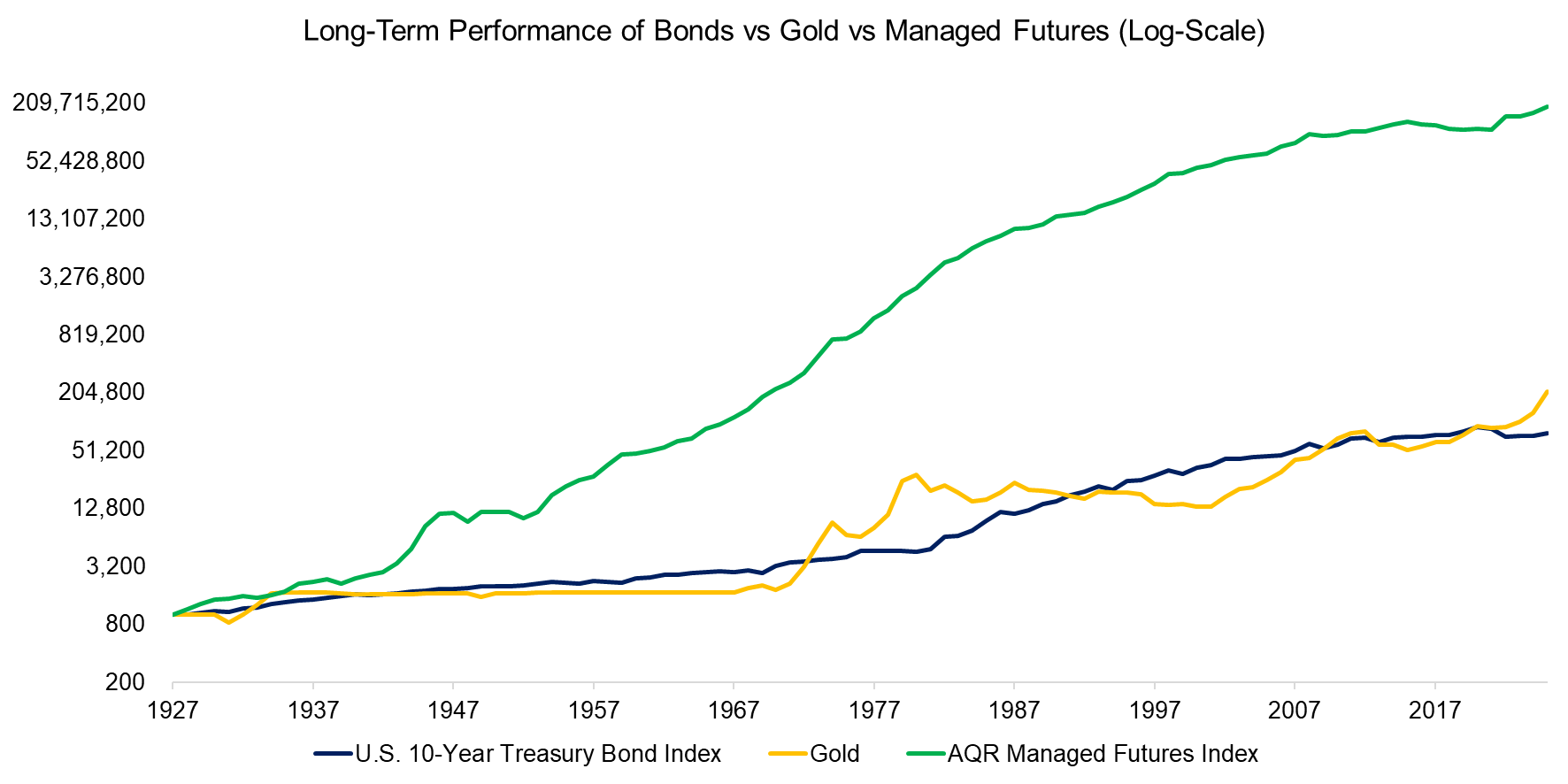
We use the U.S. 10-Year Treasury for bonds, sourcing this and gold data from Professor Aswath Damodaran’s data library at NYU Stern. For managed futures, we use a backtested managed futures index developed by AQR. Since the AQR index is only available through 2020, we extend the series thereafter using realized returns from the AQR Managed Futures Strategy Fund (AQMIX) (read Bonds vs. Managed Futures: A 100-Year Perspective and Managed Futures vs Factor Investing: A 100-Year Perspective).
When comparing the performance of bonds, gold, and managed futures over the last century, we find similar returns for bonds and gold, but a significantly higher return for managed futures. This latter result should naturally be treated with some caution, as it largely reflects a backtest rather than realized returns (read Gold & Silver: Buy-and-Hold vs Trend Following).
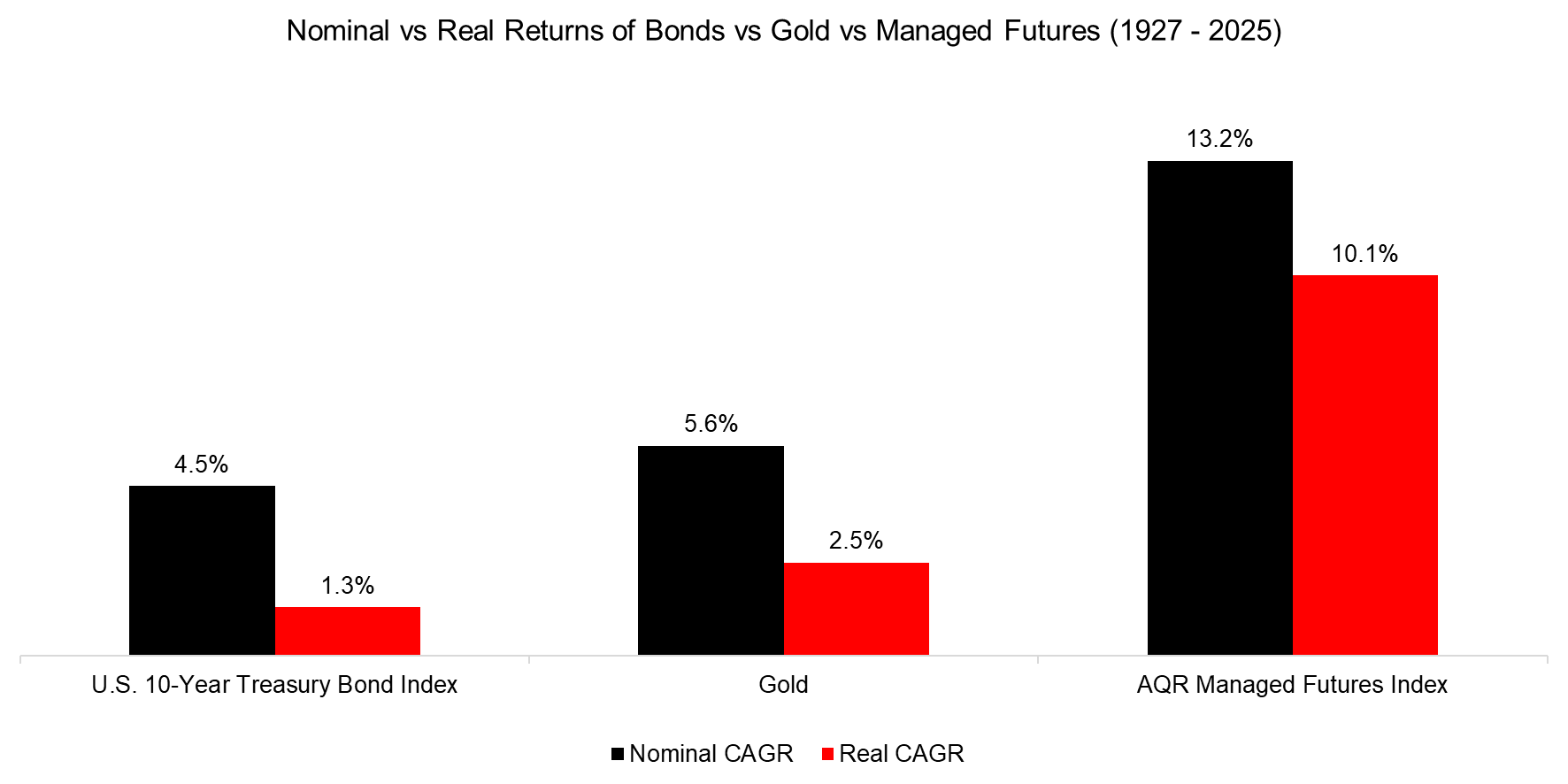
We also compute real returns by subtracting U.S. inflation from nominal returns. From 1927 to 2025, bonds delivered an annualized real return only slightly above 1%, compared with 2.5% for gold and 10.1% for managed futures.
DRAWDOWNS
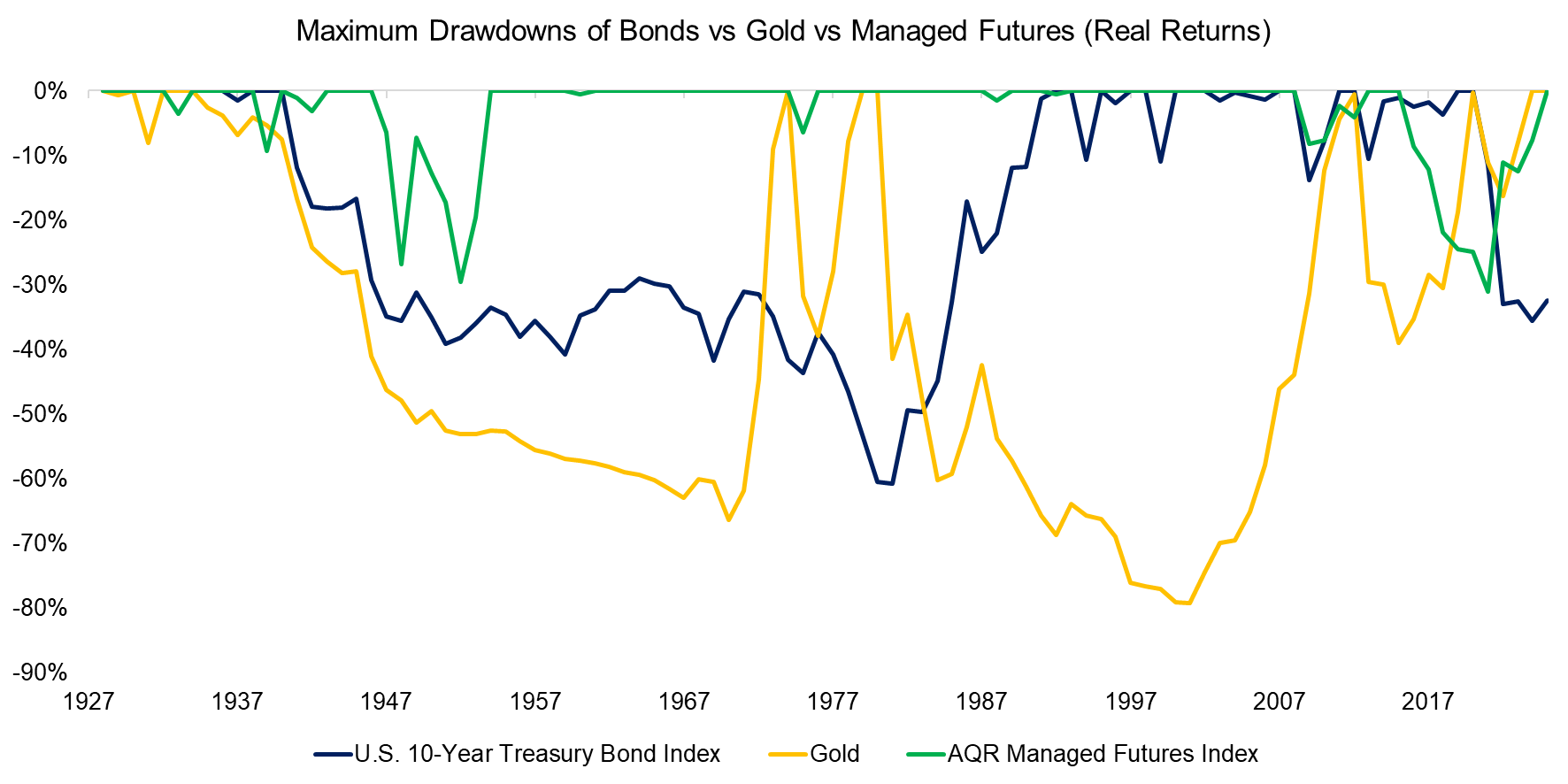
The biggest difference between these strategies appears in maximum drawdowns when measured in real returns: bonds fell as much as -61%, but gold declined even more, with approximately -80% between 1980 and 2001. The recovery period from the previous peak to a new high took 50 years for bonds, 35 years for gold, and just 10 years for managed futures, which only lost 31% at its maximum drawdown (read How Much Can You Lose with Bonds?).
CORRELATION ANALYSIS
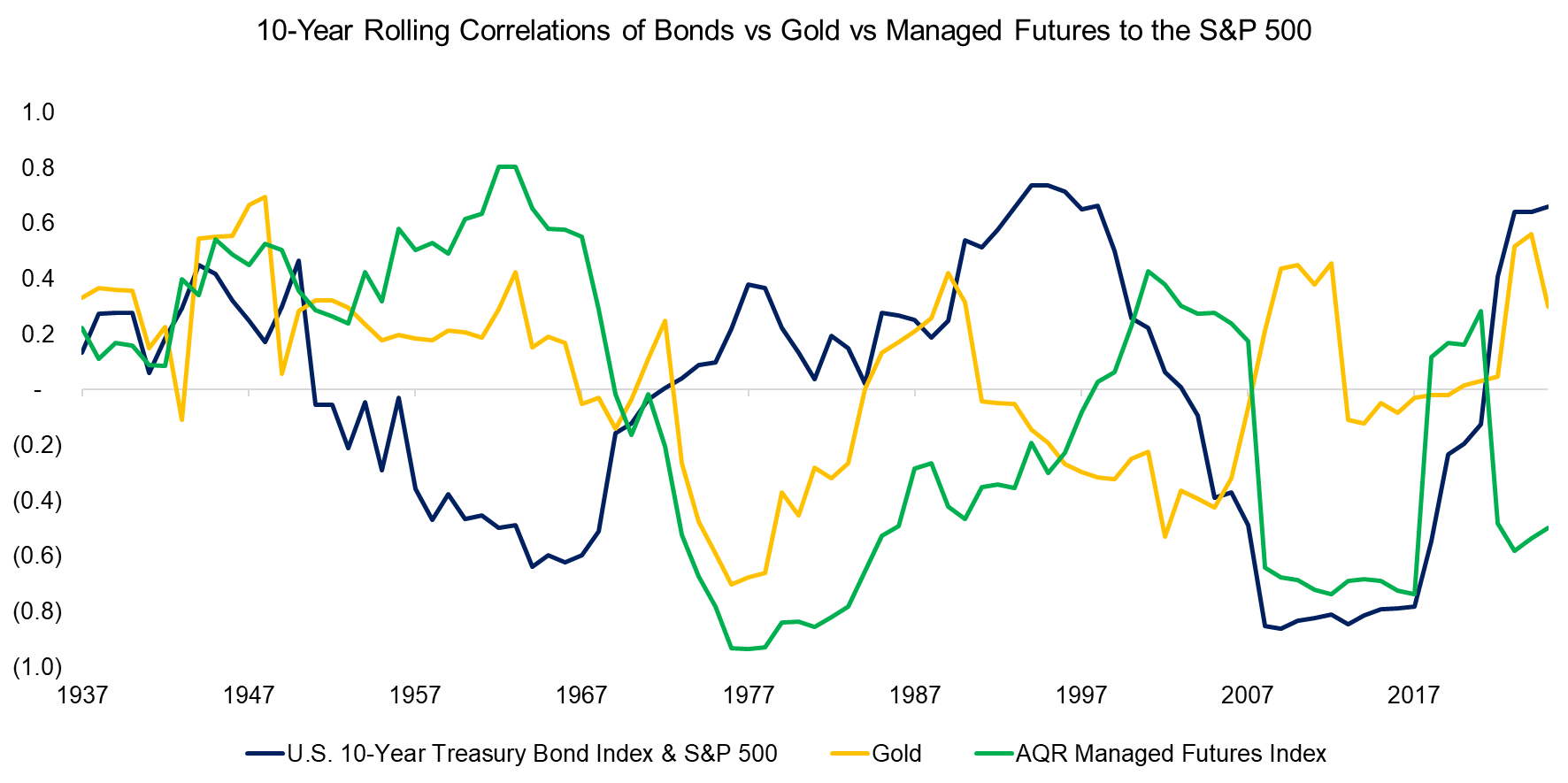
Next, we compute the average correlations of bonds, gold, and managed futures to the S&P 500. From 1927 to 2025, all three show average correlations close to zero. However, each has experienced periods of both strongly positive and strongly negative correlation.
DIVERSIFICATION BENEFITS
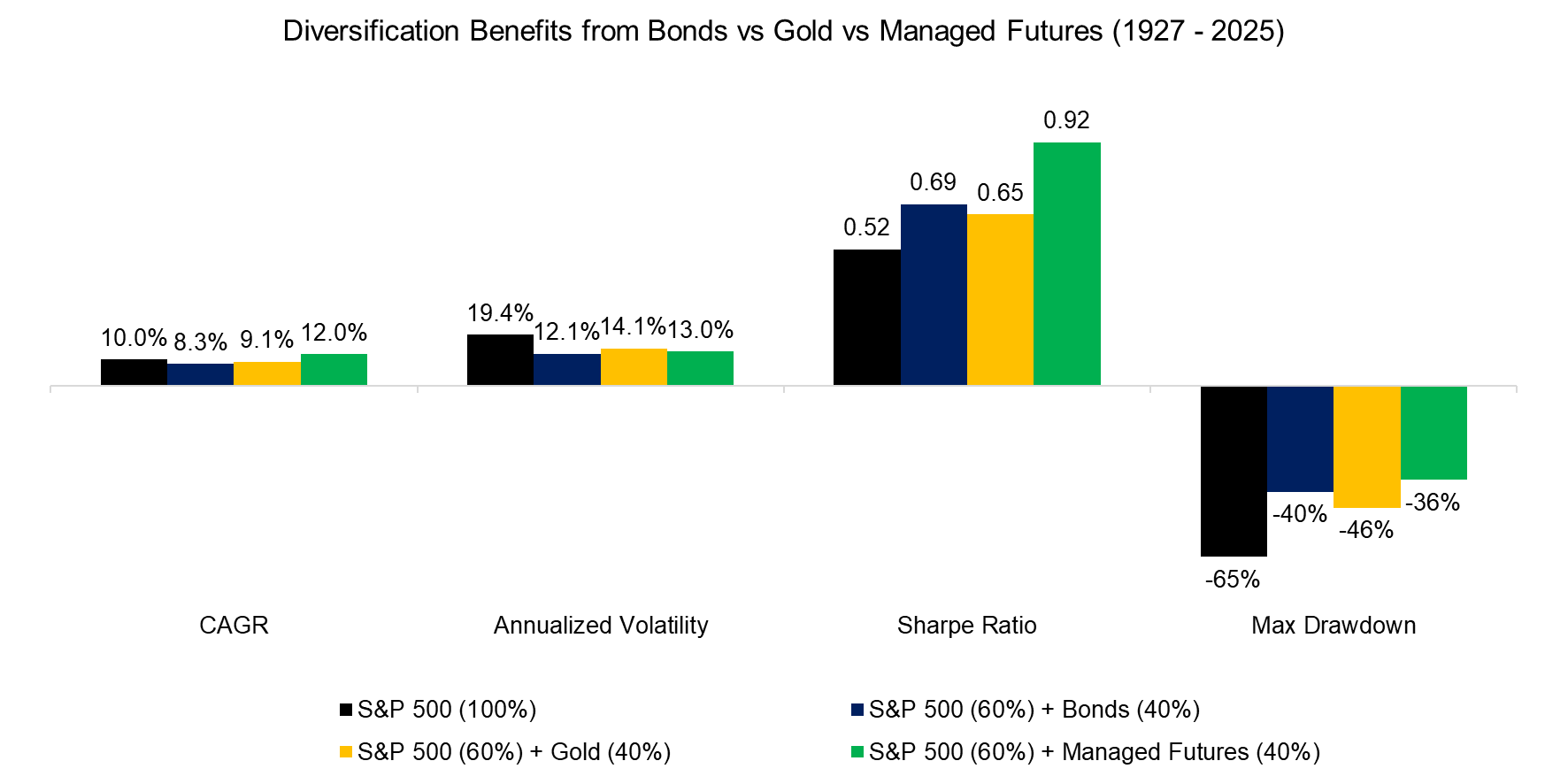
The low correlations to the U.S. stock market make all three strategies excellent diversifiers. We simulate adding a 40% allocation of each to a 100% equities portfolio over the last 100 years, which would have increased the Sharpe ratio in all three cases, assuming annual rebalancing and zero transaction costs. Managed futures generated the largest improvement, unsurprising given its vastly higher standalone returns. Bonds would have been marginally better than gold.
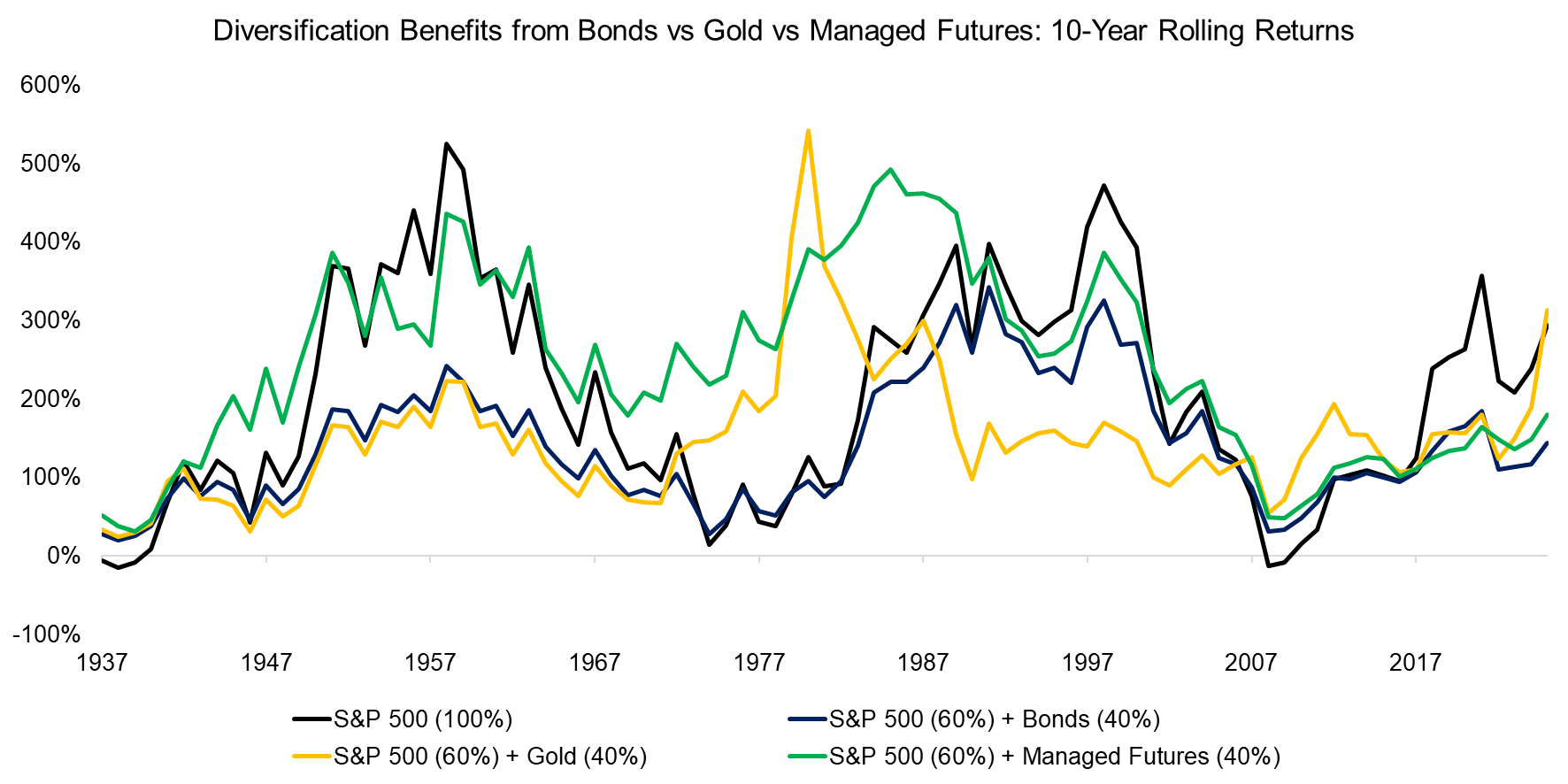
Although managed futures may have produced the best risk-adjusted returns over a century, no one has an investment horizon that long. Performance should therefore be sliced into decades, so we compute 10-year rolling returns. We observe that the S&P 500 posted negative returns only twice: once during the Great Depression in the 1930s, and again during the Great Recession, following 2008.
Combining stocks and bonds did not work well during the 1970s, when U.S. interest rates rose above 10% – a period in which gold generated significant diversification benefits. Overall, combining stocks and managed futures also generated more consistent returns across the decades.
The correlation analysis also highlighted that the three strategies were only weakly correlated with each other. Bonds showed zero correlation with both gold and managed futures, while gold and managed futures were only weakly correlated at 0.2 over the last 100 years.
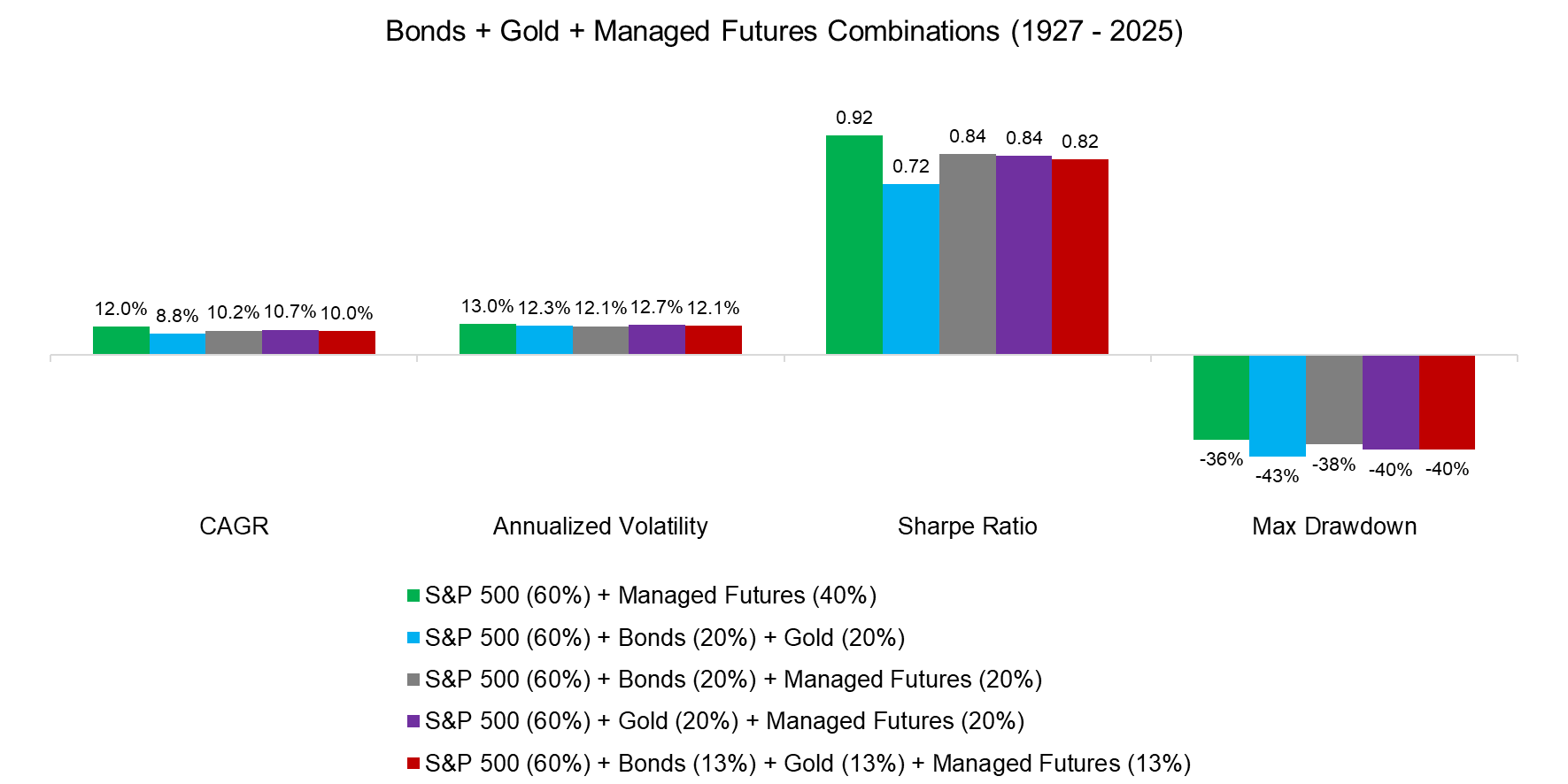
These low correlations make it interesting to combine all three, which we simulate against the best single-strategy scenario: a 40% allocation to managed futures. We find that the sole allocation to managed futures still dominates, delivering the highest return, Sharpe ratio, and lowest maximum drawdown. Combining bonds and gold was the worst-performing combination.
FURTHER THOUGHTS
Based on this analysis, investors need neither bonds nor gold for diversification and can use managed futures instead. Practically, managed futures will jump on any trend, providing bond or gold exposure whenever these assets develop positive price momentum.
That said, this analysis should be challenged on the grounds that the managed futures index is largely a backtest, whose returns are likely overstated. However, some managed futures funds have track records going back to the 1980s, so we could replicate this analysis using realized returns over a shorter lookback period.
Even with this skepticism over managed futures’ backtested returns, allocating to a strategy that can go long or short bonds should be structurally attractive in a world of record public debt, undisciplined governments, and negative demographics.
RELATED RESEARCH
Bonds vs. Managed Futures: A 100-Year Perspective
Managed Futures vs Factor Investing: A 100-Year Perspective
Diversifying vs De-Risking Funds
How Much Can You Lose with Bonds?
60/40 Portfolios Without Bonds
Bonds versus CTAs for Diversification
Gold & Silver: Buy-and-Hold vs Trend Following
How Much Should You Allocate to Managed Futures?
Combining Risk-Managed Equities and Managed Futures – II
Combining Risk-Managed Equities and Managed Futures
CTAs: With or Without Trend Following in Equities?
Carry versus Trend Following
Trend Following in Equities
Trend Following in Bear Markets
Replicating a CTA via Factor Exposures
Creating a CTA from Scratch – II
CTAs vs Global Macro Hedge Funds
Managed Futures: The Empire Strikes Back
Managed Futures: Fast & Furious vs Slow & Steady
Hedging via Managed Futures Liquid Alts
ABOUT THE AUTHOR
Nicolas Rabener is the CEO & Founder of Finominal, which empowers professional investors with data, technology, and research insights to improve their investment outcomes. Previously he created Jackdaw Capital, an award-winning quantitative hedge fund. Before that Nicolas worked at GIC and Citigroup in London and New York. Nicolas holds a Master of Finance from HHL Leipzig Graduate School of Management, is a CAIA charter holder, and enjoys endurance sports (Ironman & 100km Ultramarathon).
Connect with me on LinkedIn or X.