
Bonds vs Managed Futures: A 100-Year Perspective
Rethinking traditional asset allocation
- Managed futures generated a significantly higher long-term return than bonds
- U.S. Treasury Bonds experienced a 61% loss in real terms historically
- Correlations of bonds and equities are elevated, limited diversification benefits
INTRODUCTION
Most investors have portfolios that basically represent combinations of equities and bonds. Most investors buy bonds for diversification. And most investors are likely unaware that stocks and bonds are currently highly correlated, significantly reducing the diversification benefits bonds have historically provided.
For much of the 2000s, long-term U.S. government bonds benefited from steadily declining yields, generating attractive returns while maintaining a negative correlation with equities. That dynamic changed abruptly in 2022, when the U.S. Federal Reserve began aggressively raising interest rates to combat inflation. In real terms, U.S. 10-year Treasury bonds lost nearly 40% of their value – a drawdown that many investors, accustomed to stable bond returns, considered almost unthinkable.
While bonds struggled in 2022, managed futures strategies performed strongly, largely because they could shift from long to short bond positions as trends reversed. This resilience has fueled growing interest in managed futures and led to the launch of numerous ETFs offering access to the strategy (read Combining Risk-Managed Equities and Managed Futures – II).
Despite this renewed attention, many investors remain skeptical about the long-term performance of managed futures. In this research article, we compare the performance of bonds and managed futures over the past 100 years.
PERFORMANCE OF BONDS VS MANAGED FUTURES FUNDS
Managed futures funds, also known as CTAs or trend-following funds, take long and short positions across a wide range of asset classes based on recent price trends. A portfolio may be long gold, equities, and bonds while simultaneously short wheat, oil, and the Japanese yen against the U.S. dollar. As a result, the funds tend to be highly diversified and uncorrelated to equities and bonds.
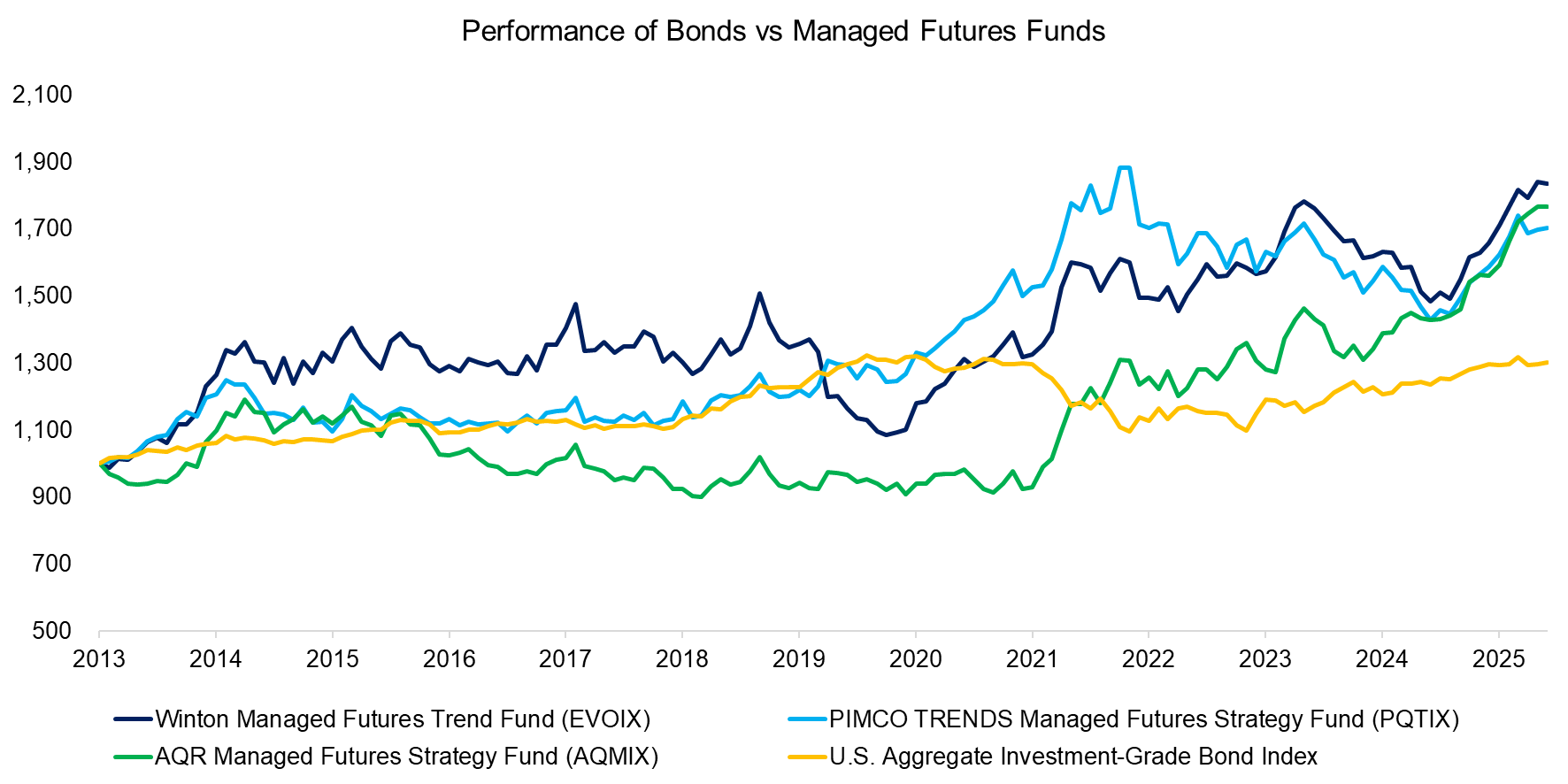
These strategies have been available through private funds since the 1970s, mutual funds since the 2010s, and ETFs since the 2020s. A comparison of three of the largest managed futures mutual funds – from Winton, PIMCO, and AQR – shows that all three have significantly outperformed U.S. investment-grade bonds since 2013.
Source: Finominal
LONG-TERM PERFORMANCE OF BONDS VS MANAGED FUTURES
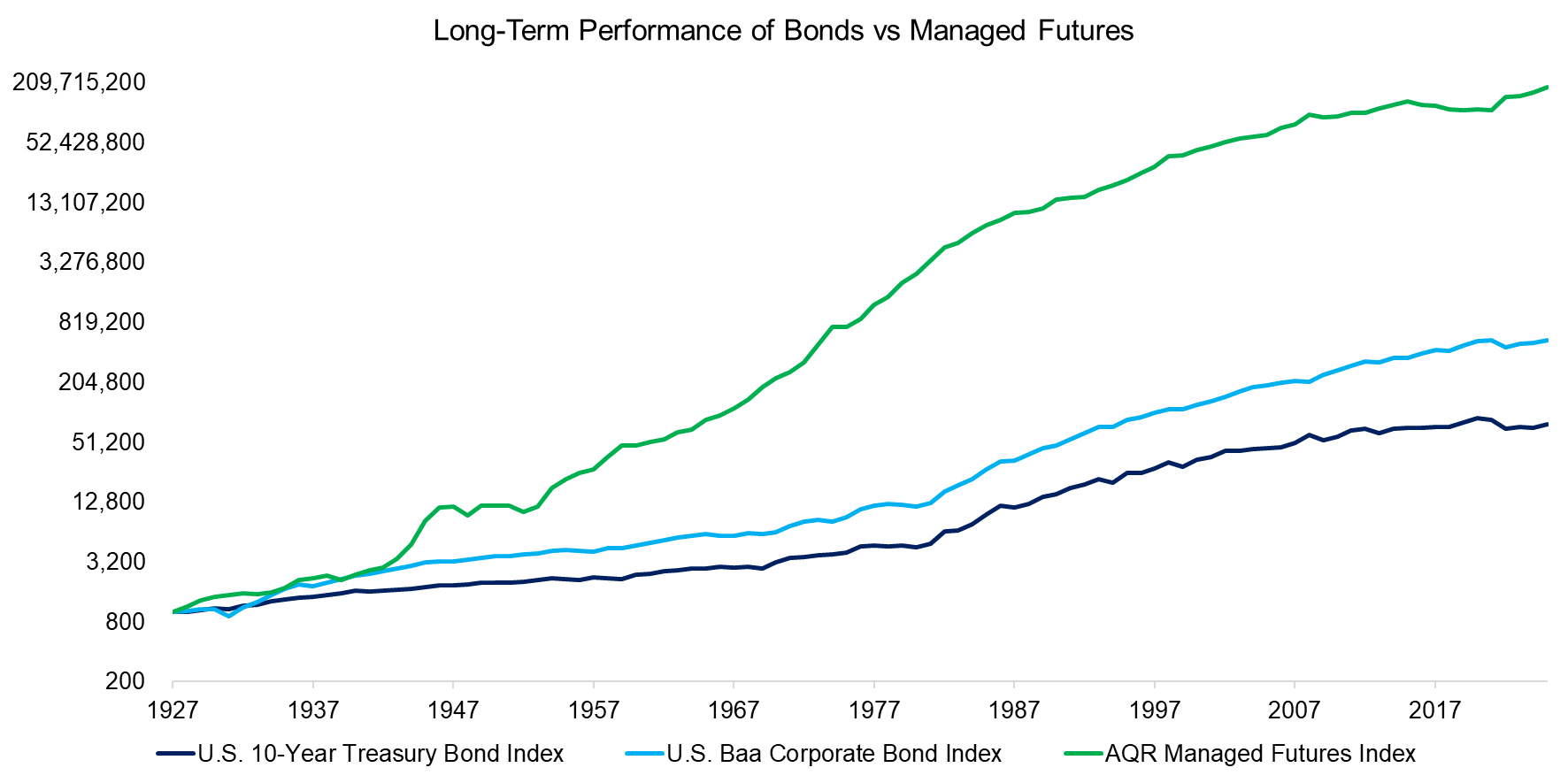
To compare the long-term performance of bonds and managed futures, we use fixed-income data from Aswath Damodaran and a back-tested managed futures index developed by AQR, both with close to 100 years of data. The AQR index is available only through 2020; thereafter, we extend it using realized returns from the AQR Managed Futures Strategy Fund (AQMIX).
We observe that managed futures significantly outperformed both U.S. 10-year Treasury bonds and U.S. Baa corporate bonds. Admittedly, the AQR index is based primarily on backtested data for much of its history. However, in previous research, we compared it with other CTA indices – including several with live track records spanning multiple decades – and found the return profiles to be broadly comparable (read How Much Should You Allocate to Managed Futures?).
Source: Professor Aswath Damodaran, AQR, Finominal
NOMINAL VS REAL RETURNS
One of the structural limitations in how financial returns are typically presented is that they are quoted in nominal terms, before inflation. This can be particularly misleading for low-return assets such as bonds, where inflation has a meaningful impact on long-term purchasing power.
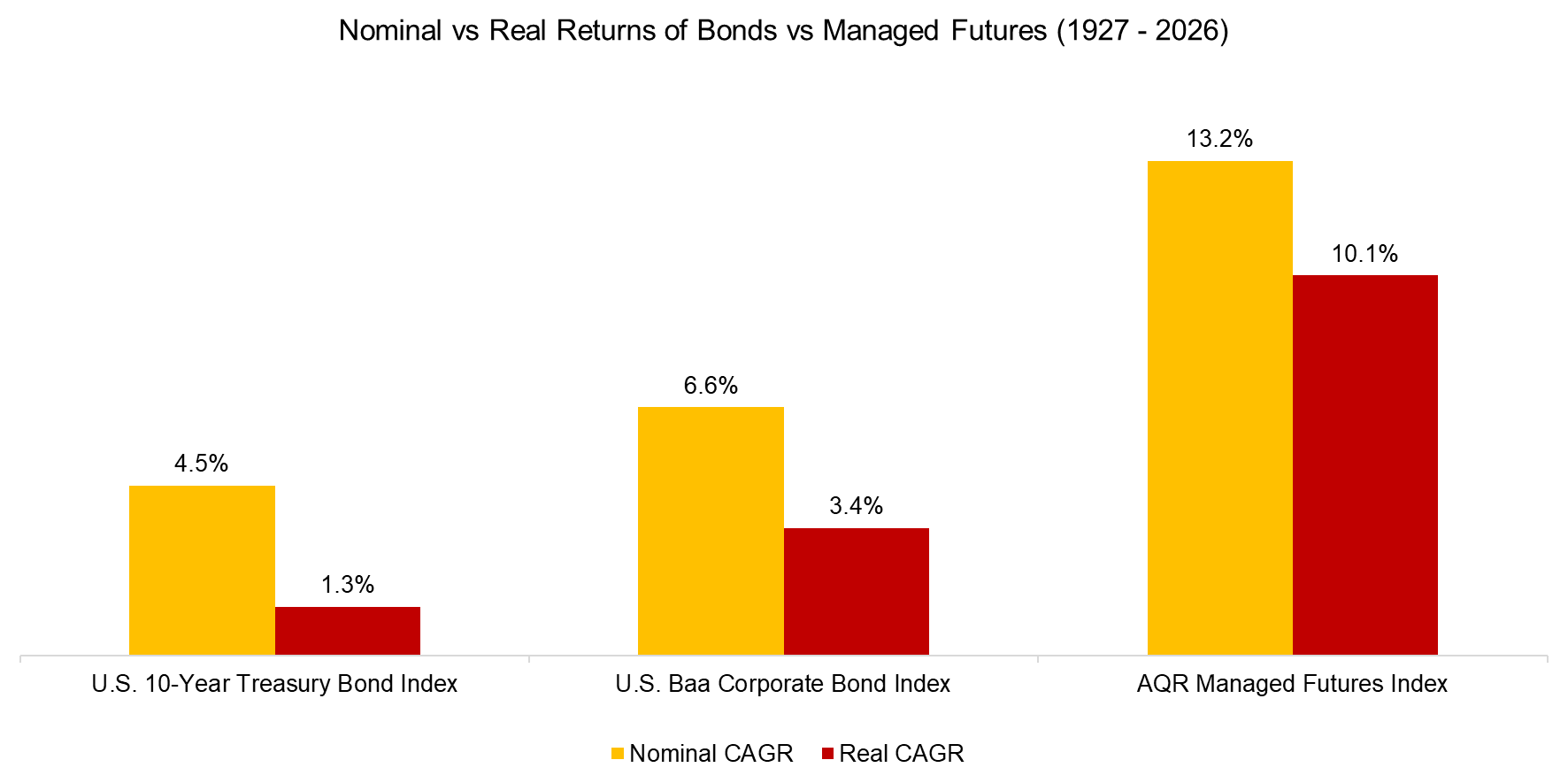
When we adjust for inflation and examine real returns over the past 100 years, the picture changes materially. U.S. 10-year Treasury bonds delivered only about 1.3% per annum in real terms. U.S. Baa corporate bonds performed somewhat better at roughly 3.4% per annum. In contrast, managed futures generated significantly higher real returns of approximately 10.1% per annum over the same period.
Source: Professor Aswath Damodaran, AQR, Finominal
MAXIMUM DRAWDOWNS
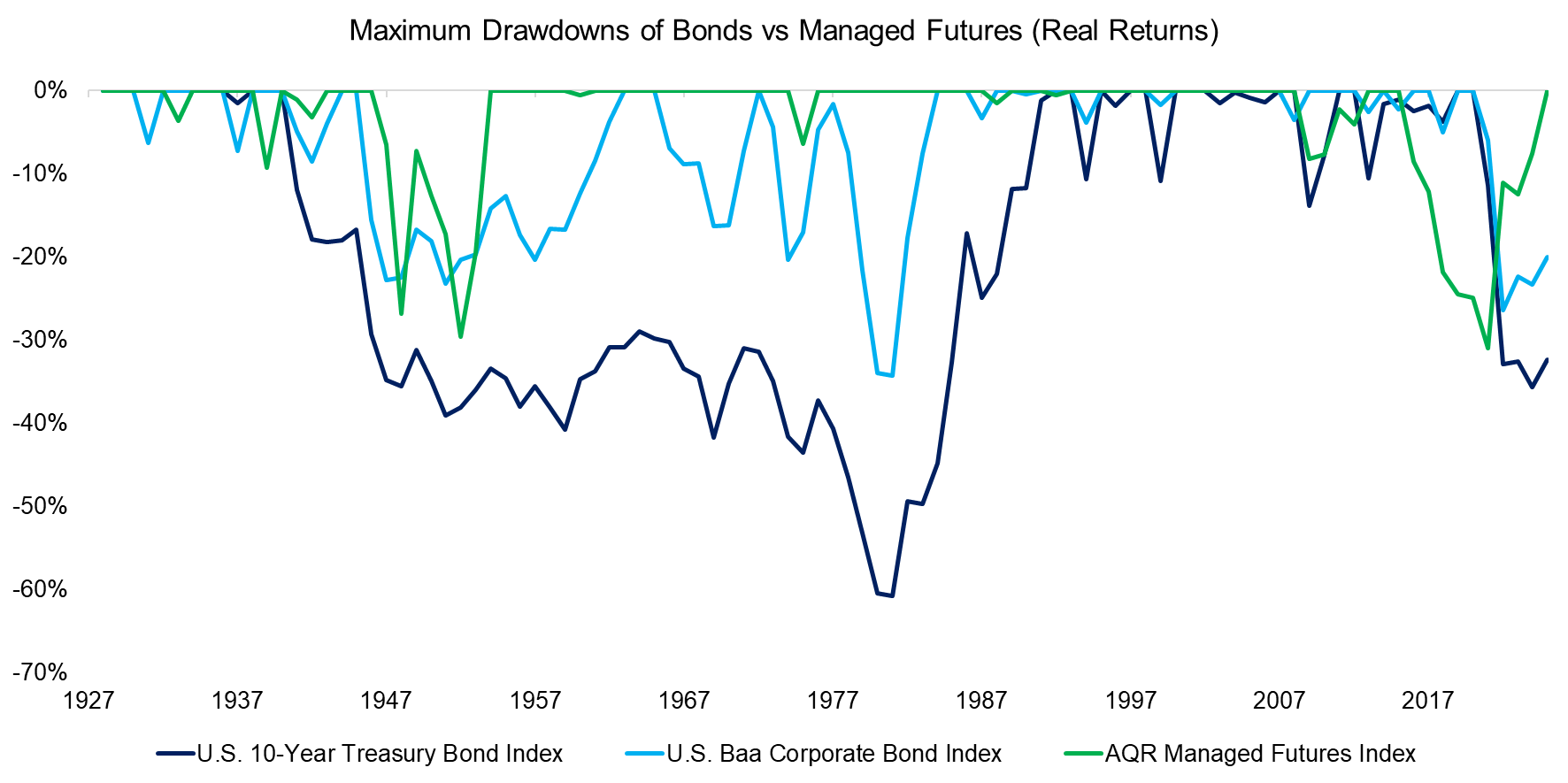
A real return of 1.3% per year on U.S. 10-year Treasury bonds may appear attractive at first glance, but it reflects an average over an entire century that masks long periods of substantial real losses. In particular, investors experienced a prolonged drawdown between 1937 and 1980, when inflation consistently outpaced bond yields and eroded purchasing power by roughly 61% in real terms. More recently, the 10-year Treasury suffered another severe decline of nearly 40% in real value during the 2022–2024 period, as interest rates adjusted sharply upward (read How Much Can You Lose with Bonds?).
Managed futures have also experienced drawdowns over time, but these have generally been smaller and less persistent than those of traditional “safe haven” assets like government bonds. Across historical data, the AQR Managed Futures Index reached a maximum drawdown of approximately 31% in 2021.
Source: Finominal
QUANTIFYING DIVERSIFICATION BENEFITS
Given the weak real returns of U.S. 10-year Treasury bonds, investors may be tempted to shift toward corporate bonds, which have historically delivered higher returns and, in some periods, lower maximum drawdowns. However, corporate bonds are not a pure diversifier: they can be viewed as a hybrid exposure to both government bonds and equities, making them far less effective as a portfolio hedge during equity stress.
This is reflected in their long-term correlation profile. Over the past century, U.S. corporate bonds exhibited an average correlation of approximately 0.5 with the S&P 500. In contrast, both U.S. Treasuries and managed futures showed much lower correlations, around 0.1, highlighting their greater potential diversification benefits within a multi-asset portfolio.
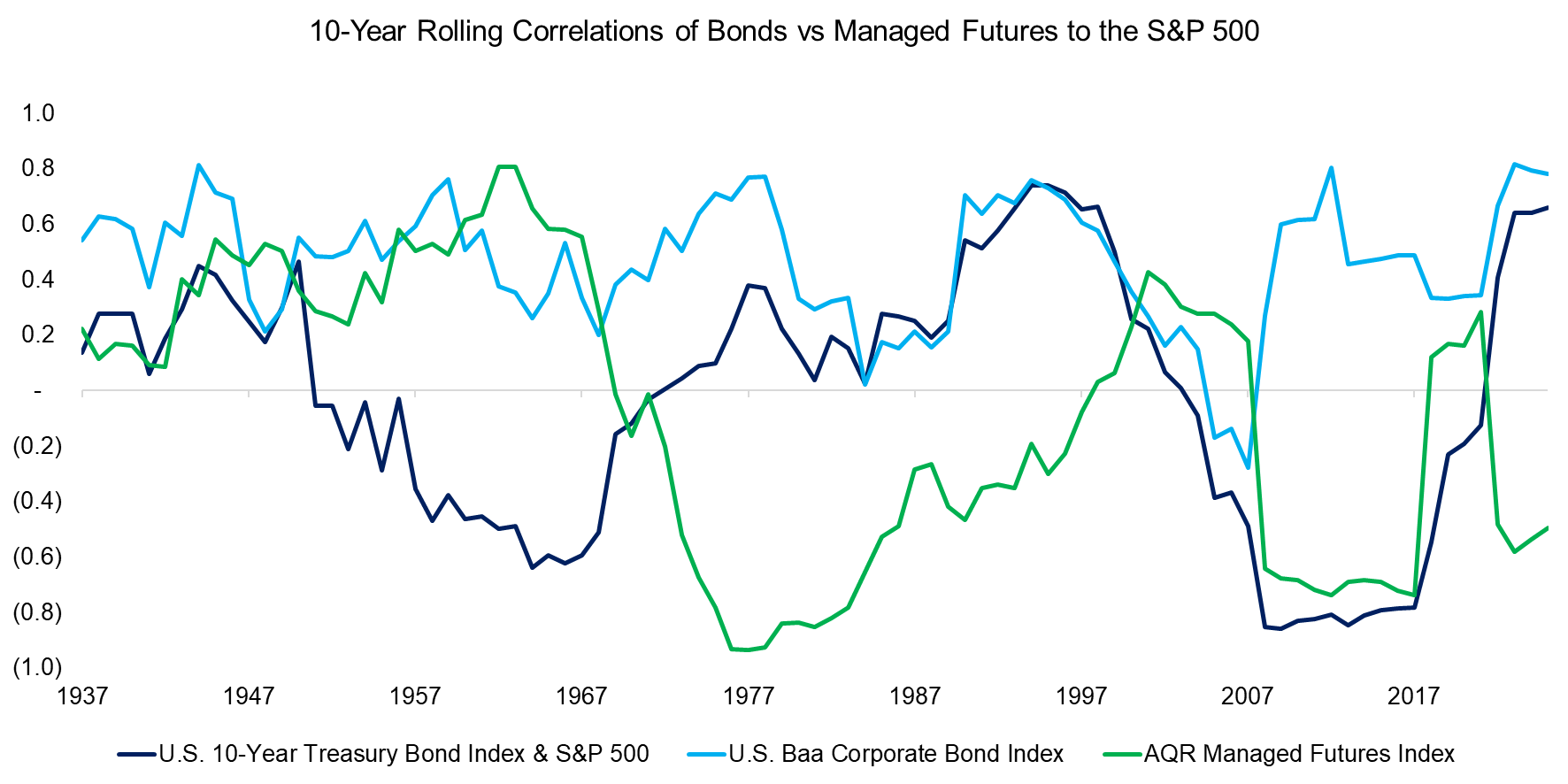
Source: Professor Aswath Damodaran, AQR, Finominal
FURTHER THOUGHTS
The currently elevated correlation between bonds and equities should prompt investors to reassess the effectiveness of traditional fixed income as a diversifier. If that alone is not sufficient, longer-term structural pressures may reinforce the case for caution: aging populations and historically high levels of public debt represent slow-moving but persistent forces that are likely to weigh on bond markets over time. While the timing and magnitude of these effects remain uncertain and may unfold over decades, they challenge the assumption that bonds will reliably provide stable diversification going forward.
Against this backdrop, allocating to strategies that can dynamically adjust exposure – going long or short bonds depending on prevailing trends – may offer a more robust alternative. Managed futures are supported by a long body of empirical research and have demonstrated the ability to adapt across regimes. This flexibility makes them a sensible core component of long-term asset allocation.
RELATED RESEARCH
How Much Can You Lose with Bonds?
60/40 Portfolios Without Bonds
Bonds versus CTAs for Diversification
Bonds & The Invisible Thief
How Much Should You Allocate to Managed Futures?
Combining Risk-Managed Equities and Managed Futures – II
Combining Risk-Managed Equities and Managed Futures
Managed Futures versus Market-Neutral Multi-Factor Investing
Factor Investing Is Dead, Long Live Factor Investing!
CTAs: With or Without Trend Following in Equities?
Carry versus Trend Following
Trend Following in Equities
Trend Following in Bear Markets
Replicating a CTA via Factor Exposures
Creating a CTA from Scratch – II
CTAs vs Global Macro Hedge Funds
Managed Futures: The Empire Strikes Back
Managed Futures: Fast & Furious vs Slow & Steady
Hedging via Managed Futures Liquid Alts
ABOUT THE AUTHOR
Nicolas Rabener is the CEO & Founder of Finominal, which empowers professional investors with data, technology, and research insights to improve their investment outcomes. Previously he created Jackdaw Capital, an award-winning quantitative hedge fund. Before that Nicolas worked at GIC and Citigroup in London and New York. Nicolas holds a Master of Finance from HHL Leipzig Graduate School of Management, is a CAIA charter holder, and enjoys endurance sports (Ironman & 100km Ultramarathon).
Connect with me on LinkedIn or X.