
Diversifying vs De-Risking Funds
Getting more bang for your buck
July 2026. Reading Time: 10 Minutes. Author: Nicolas Rabener.
SUMMARY
- Investors should differentiate between diversifying and de-risking funds
- Most fixed income funds are de-risking strategies
- Equity strategies provide the lowest diversification benefits
INTRODUCTION
In our recent research article, Diversification vs De-Risking: Evidence Across Asset Classes, we differentiated between diversification and de-risking: the former involves providing positive, uncorrelated returns, while the latter can be achieved simply by reducing the equity allocation and moving into cash or risk-free assets like T-Bills.
We evaluated long-term U.S. government bonds, U.S. investment-grade corporate bonds, REITs, gold, and U.S. small-cap stocks for this differentiation. The analysis highlighted that the improvement in the Sharpe ratio of an equities portfolio from a 25% allocation to any of these assets ranged from -0.11 to 0.03 over the last 100 years, when compared to an equivalent allocation to T-Bills. Aside from gold, the diversification benefits versus T-Bills can be viewed as marginal.
In this research article, we will investigate the diversification benefits for a wider set of investment strategies.
DIVERSIFICATION VS DE-RISKING
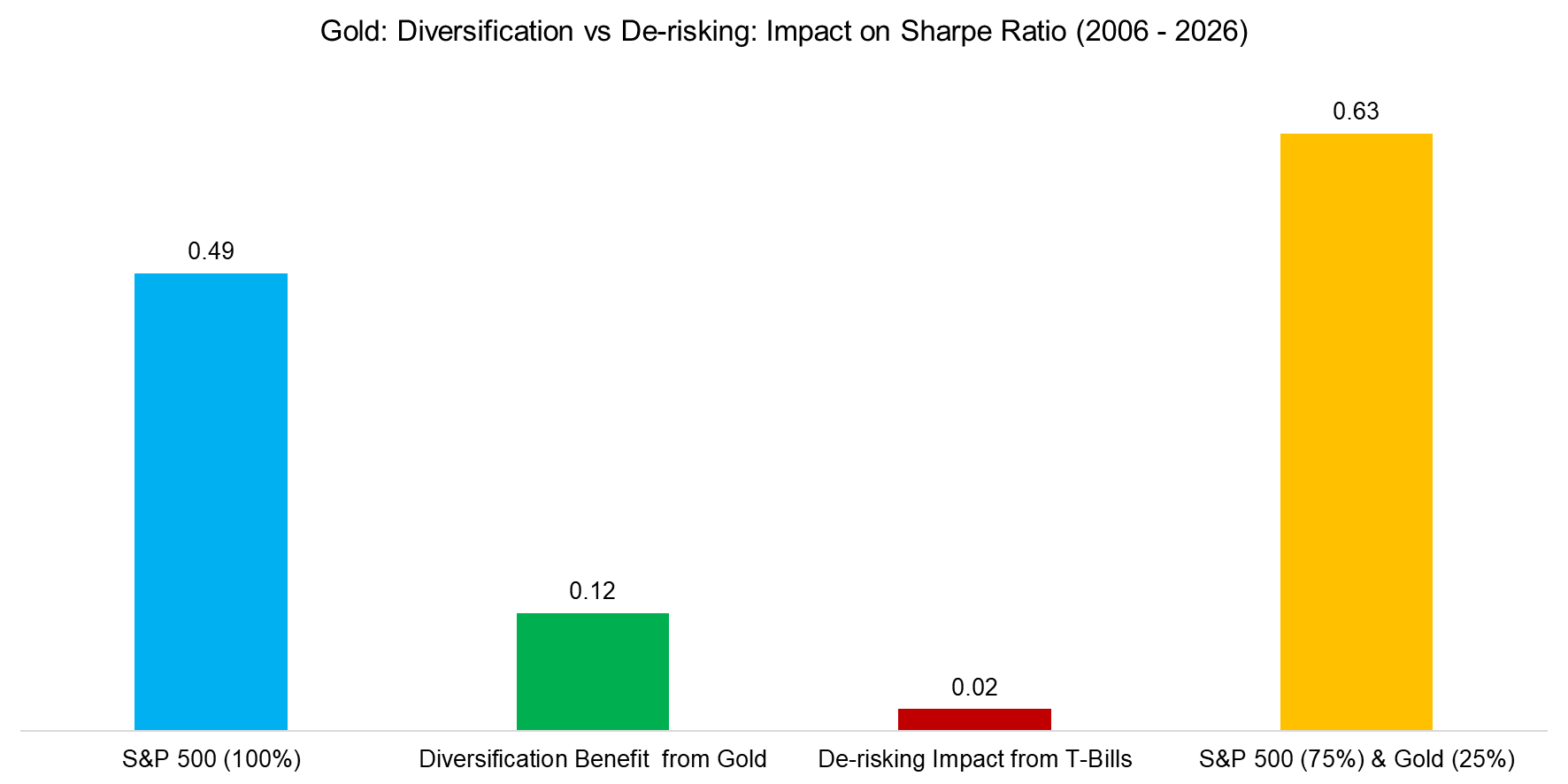
We select all mutual funds and ETFs trading in the U.S. with a track record of at least 19 years, resulting in a universe of more than 6,000 funds. We compute the Sharpe ratio of an equities portfolio comprised exclusively of the S&P 500, then simulate adding a 25% allocation to T-Bills with quarterly rebalancing, which would have increased the Sharpe ratio from 0.49 to 0.51. The de-risking impact of the allocation to the risk-free asset would therefore have been 0.02. If an investor had allocated 25% to gold rather than T-Bills, the Sharpe ratio of the combined portfolio would have been 0.63, resulting in a diversification benefit of 0.12.
Source: Finominal
TOP 25 FUND CATEGORIES WITH LARGEST DIVERSIFICATION BENEFITS
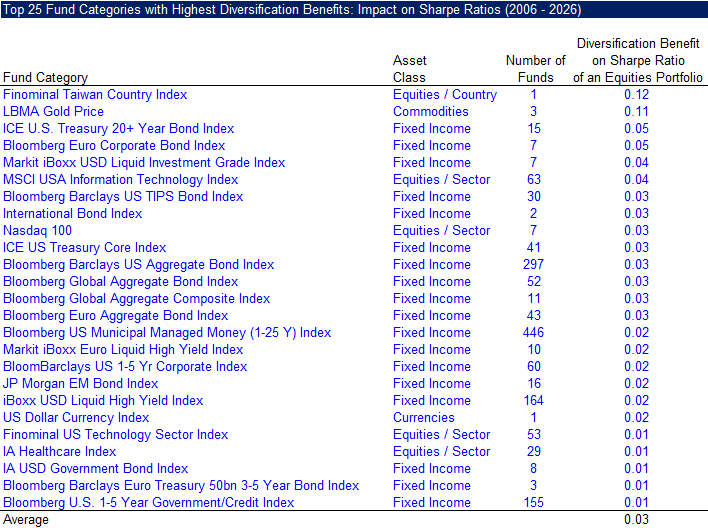
Next, we review the top 25 fund categories that generated the highest diversification benefits, measured as the improvement in the Sharpe ratio of an equities portfolio relative to using T-Bills as an alternative. The average improvement in the Sharpe ratio attributable to diversification was 0.03, which again seems marginal.
The fund category with the greatest diversification benefit would have been Taiwanese equities, though this is only due to the near-exponential performance of the Taiwan stock market over the last two years, driven by enthusiasm for semiconductor stocks like TSMC. Second comes gold, and thereafter it is primarily fixed income strategies. Given that these were lowly correlated to equities over the last 20 years, this is somewhat expected.
It might be surprising that there are no hedge fund strategies within the top 25 fund categories, but we can attribute this to the minimum track record requirement of 19 years. Although there are dozens of such funds trading as funds and ETFs today, almost none have such long track records.
Source: Finominal
BOTTOM 25 FUND CATEGORIES WITH LOWEST DIVERSIFICATION BENEFITS
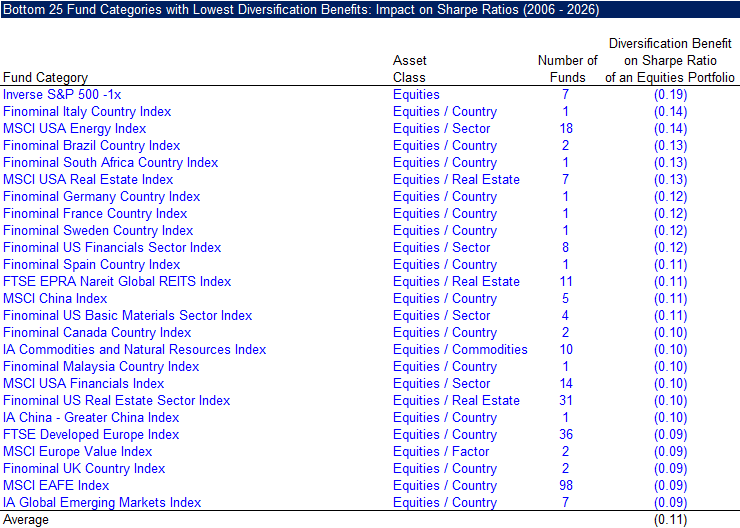
We also review the bottom 25 fund categories that generated the worst diversification benefits, with an average of -0.11. The worst category was inverse S&P 500 funds, which is logical given the strong performance of the S&P 500. Thereafter, it is exclusively equity categories, mixed between countries and sectors. Stated differently, for most U.S. investors, international diversification has not paid off over the last two decades.
Source: Finominal
FURTHER THOUGHTS
Investors need better tools to differentiate what is worth paying for and what is not. Paying high fees for long-short equity hedge funds that only offer diluted equity exposure – i.e., de-risking only, with no diversification benefit – is unattractive.
Our mission at Finominal is to provide transparency and ultimately improve investment outcomes. We will soon add analytical tools to let investors differentiate between de-risking and diversifying funds. Stay tuned.
RELATED RESEARCH
Diversification vs De-Risking: Evidence Across Asset Classes
Return vs Diversification: What Matters More?
Alts: Volatility Is Not Your Enemy
60/40 vs Leveraged Diversified Portfolio
Diversification versus Hedging II
Diversification versus Hedging
Finding Funds with Diversification Potential
Downside Betas vs Downside Correlations
Bonds vs Managed Futures: A 100-Year Perspective
60/40 Portfolios Without Bonds
Bonds versus CTAs for Diversification
ABOUT THE AUTHOR
Nicolas Rabener is the CEO & Founder of Finominal, which empowers professional investors with data, technology, and research insights to improve their investment outcomes. Previously he created Jackdaw Capital, an award-winning quantitative hedge fund. Before that Nicolas worked at GIC and Citigroup in London and New York. Nicolas holds a Master of Finance from HHL Leipzig Graduate School of Management, is a CAIA charter holder, and enjoys endurance sports (Ironman & 100km Ultramarathon).
Connect with me on LinkedIn or X.