
EM Small-Cap Funds: A Niche Alpha Story?
Evaluating active managers in less crowded markets
August 2026. Reading Time: 10 Minutes. Author: Nicolas Rabener.
SUMMARY
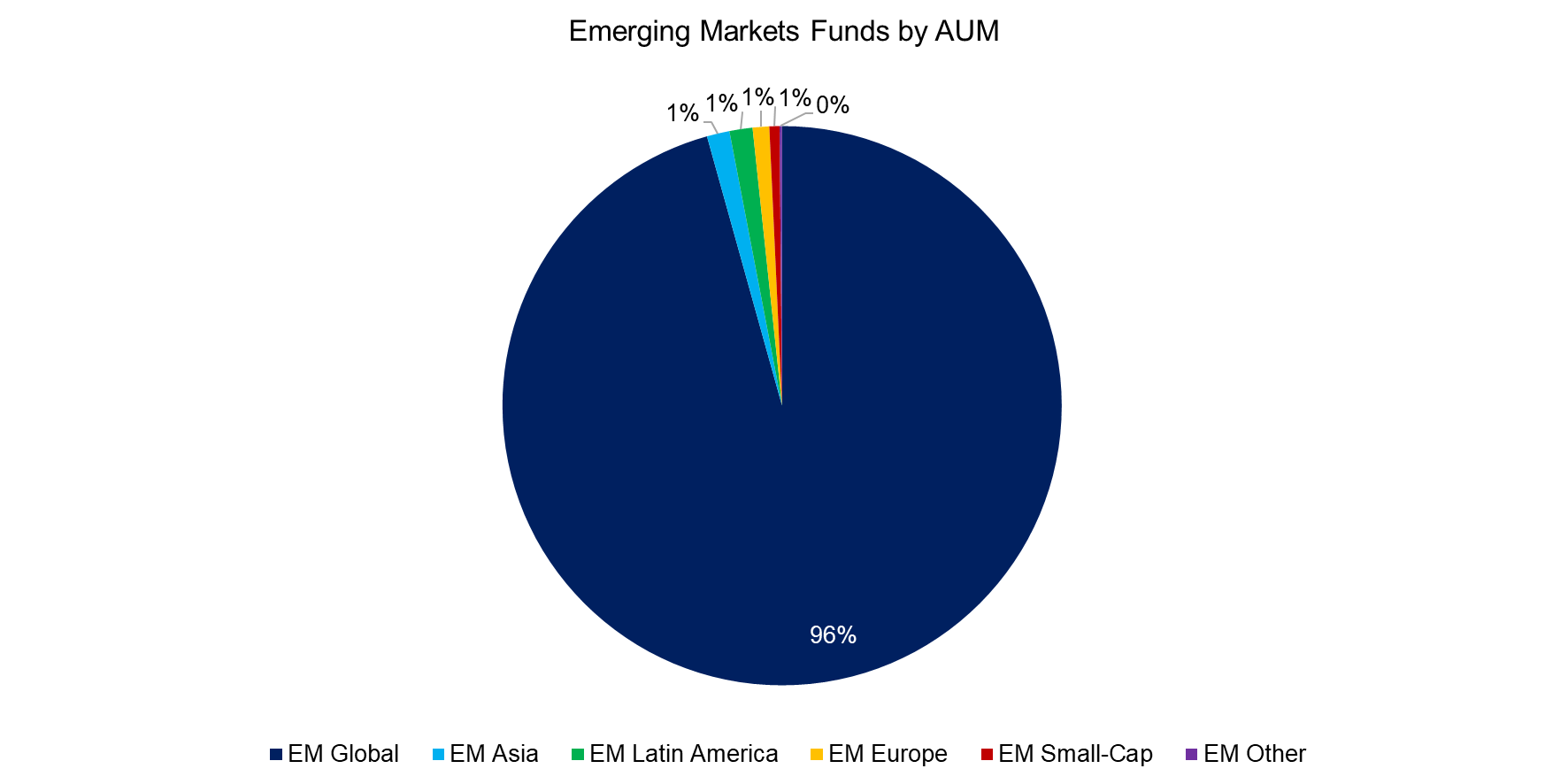
- 96% of the AUM in EM funds is allocated to global funds
- Intuitively, there should be more alpha opportunities in EM small-caps
- Managers do not seem to take enough risks to exploit these
INTRODUCTION
Intuitively, less crowded markets should offer more business opportunities, so in investing, it should be easier to generate alpha in emerging markets than in developed ones. Apple (APPL) is covered by dozens of research analysts scrutinizing the company, its competitors, its clients, its regulators, and the rest of its ecosystem in real time. In contrast, plenty of companies in other markets receive very little attention. In Singapore, the government has started paying brokers S$6,000 each time they publish a report on a Singapore-listed stock.
Yet despite this intuition, the data shows that generating alpha in emerging markets (“EM”) is remarkably difficult, as our previous research has shown. EM mutual fund managers have been unable to beat their benchmarks (read Less Efficient Markets = Higher Alpha?). Multi-factor investing hasn’t been value-creating there either, despite supportive academic research (read Multi-Factor Investing in Emerging Markets). And even hedge funds struggle to exploit these seemingly less efficient markets (read EM Hedge Funds: Extracting Alpha from Inefficient Markets?).
Perhaps the answer is to go to even less crowded corners of the market. In this research article, we explore the case for active management in small caps within emerging markets.
EM FUNDS OVERVIEW
In the U.S. and Europe, more than 5,000 emerging markets actively and passively managed mutual funds and ETFs manage more than $2.8 trillion in assets. However, a distribution analysis of assets shows that 96% is allocated to global emerging markets funds, while regional, small-cap, and other strategies each received less than 1% of the capital. This may simply reflect that allocators want to give their emerging markets fund managers maximum flexibility in deciding which countries and types of companies to invest in. But it could also foreshadow that EM small caps are less attractive than we might hope, since otherwise they would likely have attracted more assets.
Source: Finominal
PERFORMANCE OF SMALL-CAP EMERGING MARKETS FUNDS
Few mutual funds or ETFs in the U.S. focus specifically on small caps in emerging markets, so we focus on European managers instead. This represents a universe of approximately 100 funds, though many are simply share classes of the same fund in different currencies and passively managed ETFs. Narrowing this down to actively managed funds with a single share class each leaves us with fewer than 15 funds. Some have track records extending back before the 2008 global financial crisis, but we build an equal-weighted index starting only from 2014, since that’s when we have close to 10 funds available.
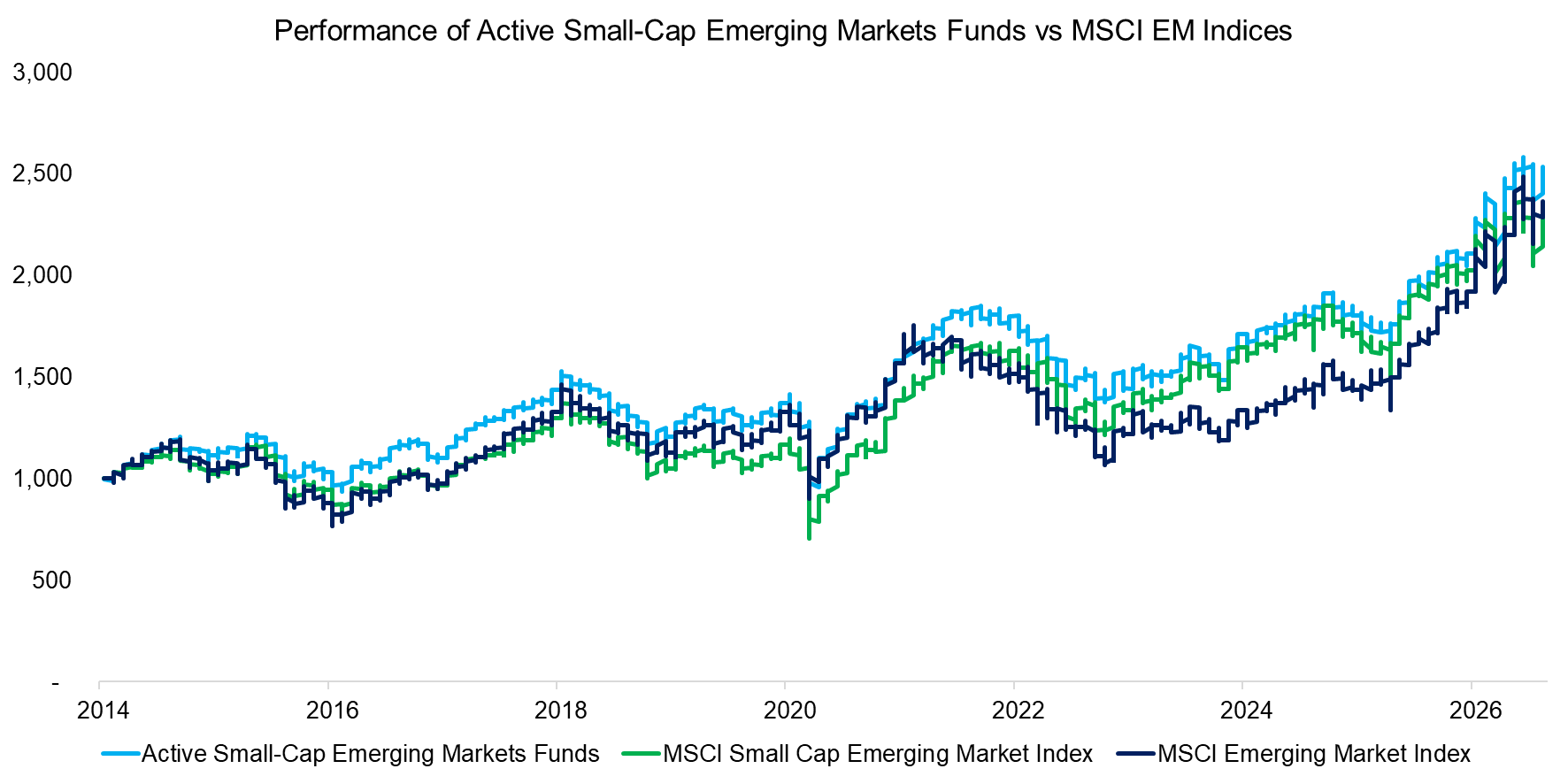
Comparing the performance of these actively managed small-cap EM fund managers shows that, collectively, they generated a higher total return since 2014 than both the MSCI Small Cap EM Index and the broader MSCI EM Index. However, this outperformance was not consistent over time.
Source: Finominal
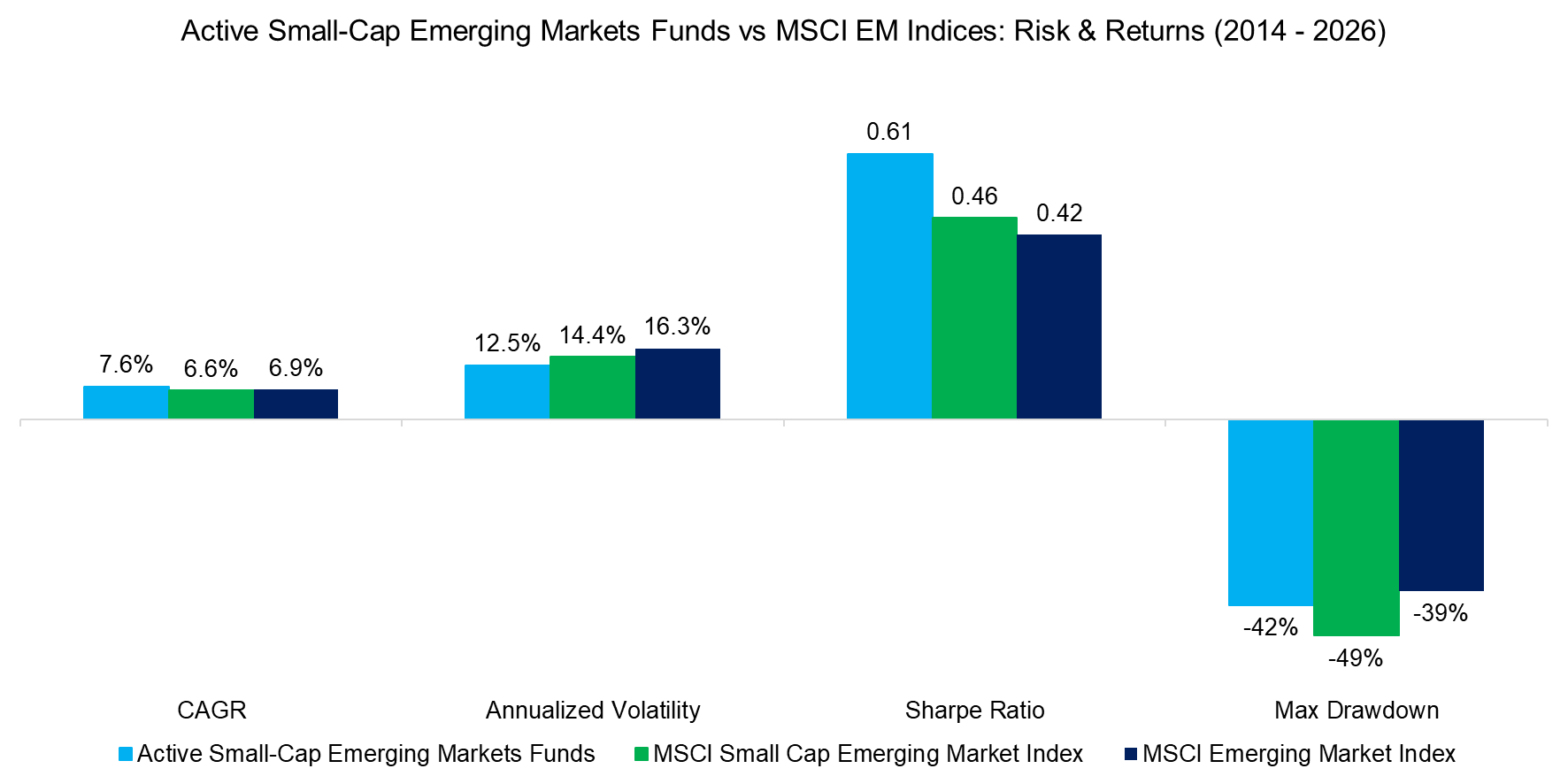
Shifting the perspective from returns to risk, we find that the actively managed small-cap EM funds not only generated a higher return, but did so with less risk. This results in a significantly higher Sharpe ratio for these funds, a pattern that also holds for the MSCI Small Cap EM Index relative to the broader MSCI EM Index.
Source: Finominal
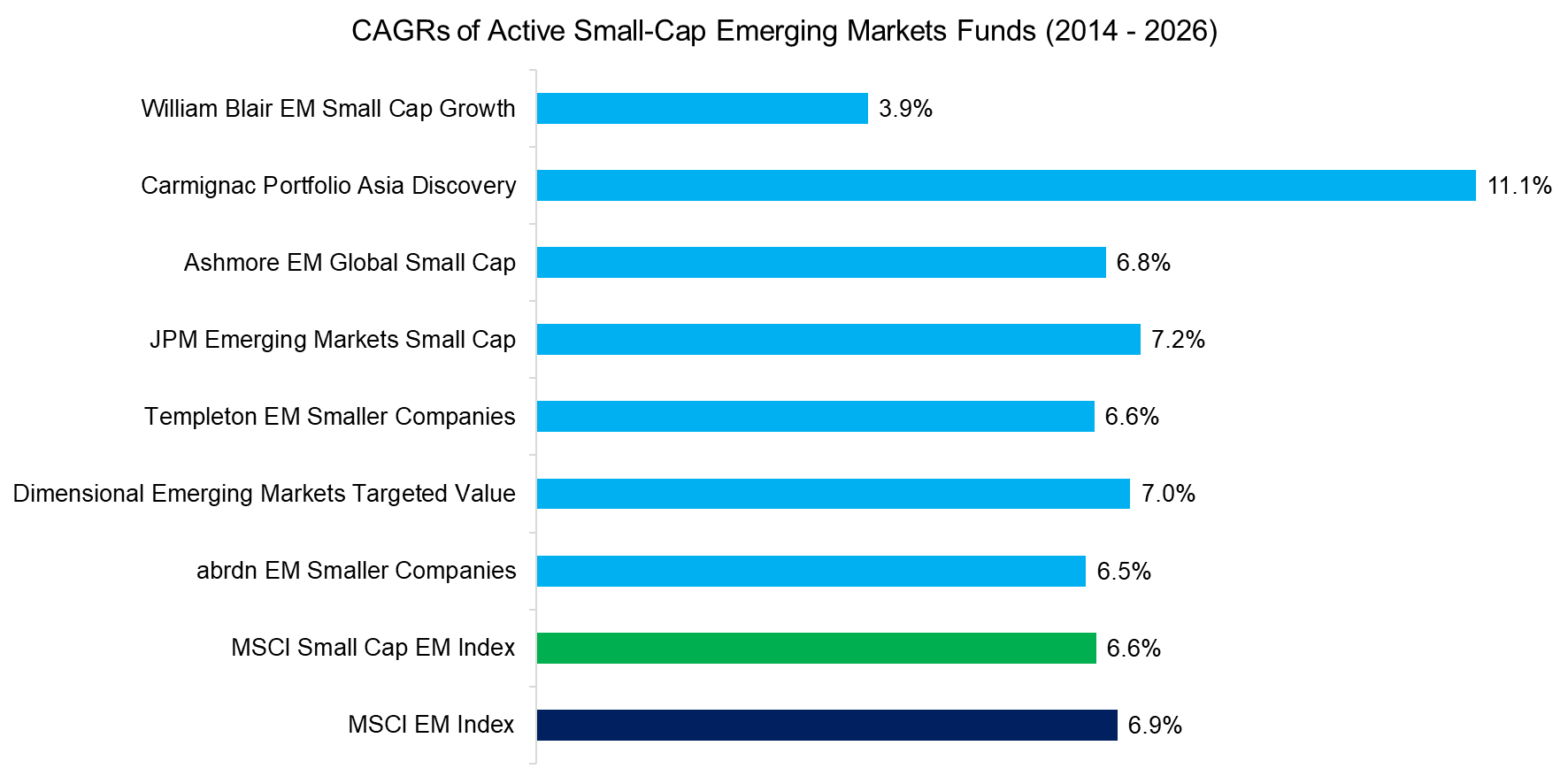
Next, we review the total returns of the actively managed funds with track records going back to at least 2014. This narrower set of seven shows that five generated returns close to the benchmark, suggesting these funds are likely managed with tight tracking error relative to their benchmark indices.
Only two funds show significantly different returns: the William Blair EM Small Cap Growth Fund, which significantly underperformed, and the Carmignac Portfolio Asia Discovery, which outperformed. The latter is geographically focused on Asia and benefited significantly from the AI boom fueling the Korean and Taiwanese stock markets. Before 2025, there was hardly any outperformance versus the MSCI EM Index.
For actively managed funds aiming to exploit inefficiencies across a diverse set of countries, we would have expected much higher dispersion in manager returns.
Source: Finominal
Although this analysis suggests that actively managed small-cap fund managers outperformed their benchmarks over the last 12 years, these results should be viewed cautiously, as they focus only on surviving funds and exclude those that were liquidated. Given this survivorship bias, the returns are likely overstated and the risks understated.
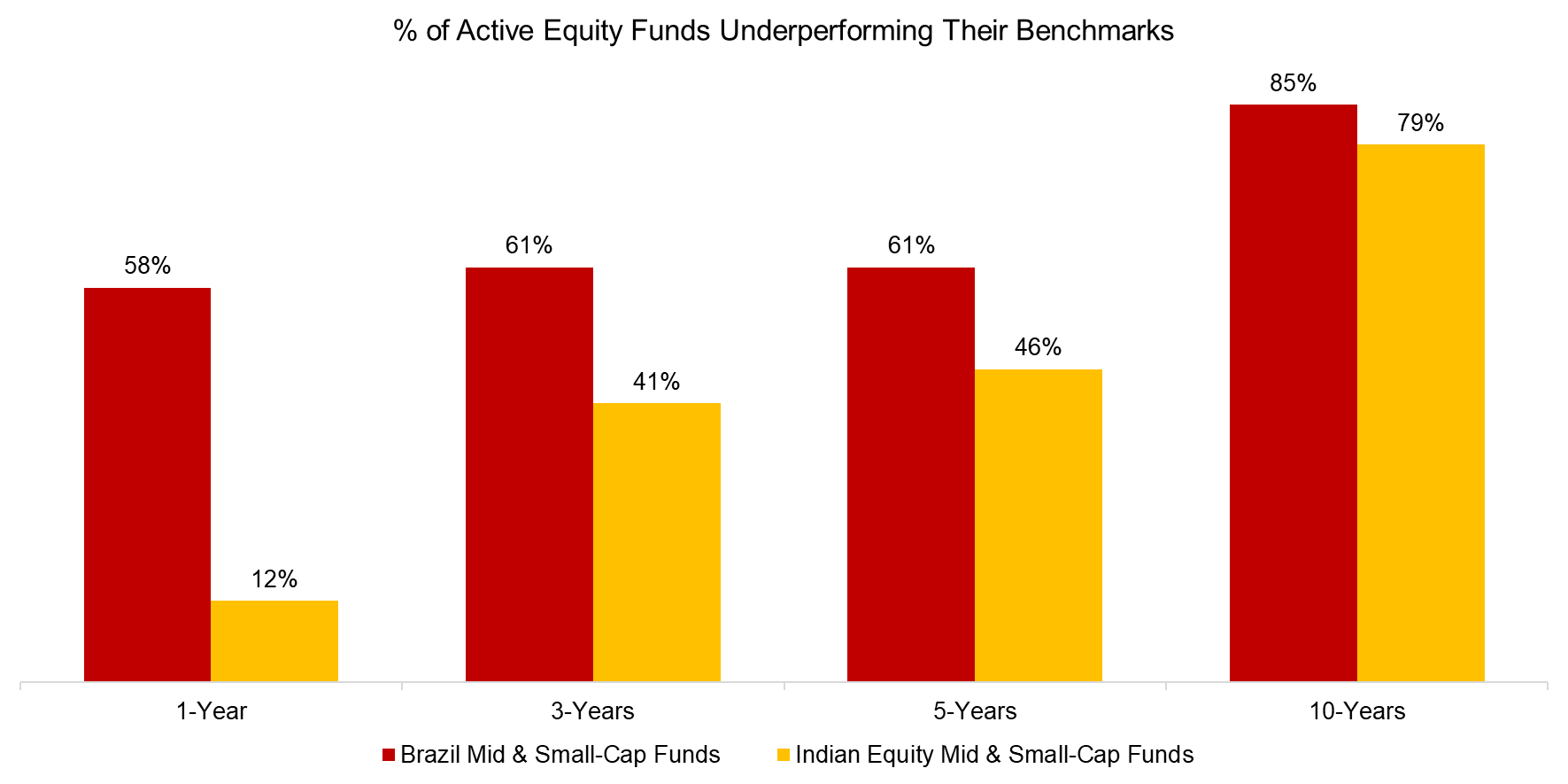
S&P has published research via its S&P SPIVA Scorecards on the performance of actively managed funds across various countries. Among emerging markets, only two, Brazil and India, have available data specifically for small-cap managers. Over the last five years, approximately 50% of these funds underperformed their benchmarks, rising to approximately 80% over ten years.
Source: S&P SPIVA, Finominal
FURTHER THOUGHTS
Unfortunately, this analysis confirms our previous research that even in less crowded markets like small-cap emerging markets, hardly any fund managers create substantial value for their shareholders. Why is that?
Partly, high fees erode any alpha generated, but the low dispersion in manager returns also suggests a lack of willingness to take risk. These markets are less efficient than the U.S. stock market, but managers need to be more active to exploit inefficiencies. Yes, this also means more funds will be liquidated due to poor performance, but it should also produce funds that find a strategy to consistently exploit opportunities in more opaque markets.
RELATED RESEARCH
Less Efficient Markets = Higher Alpha?
Multi-Factor Investing in Emerging Markets
The Case against EM Equities
Emerging Market Funds: Same, Same, but Different?
Momentum in Emerging Markets
EM Equities vs Debt: Same, Same, but Different?
EM Debt: To Hold or Not To Hold?
Factor Investing in Emerging Markets
EM Hedge Funds: Extracting Alpha from Inefficient Markets?
Alpha Generation: Equity Generalists vs Sector Specialists
Momentum Investing on Country Level
ABOUT THE AUTHOR
Nicolas Rabener is the CEO & Founder of Finominal, which empowers professional investors with data, technology, and research insights to improve their investment outcomes. Previously he created Jackdaw Capital, an award-winning quantitative hedge fund. Before that Nicolas worked at GIC and Citigroup in London and New York. Nicolas holds a Master of Finance from HHL Leipzig Graduate School of Management, is a CAIA charter holder, and enjoys endurance sports (Ironman & 100km Ultramarathon).
Connect with me on LinkedIn or X.