
Evaluating Metrics for Fund Selection – II
What works, what doesn’t?
March 2026. Reading Time: 10 Minutes. Author: Nicolas Rabener.
SUMMARY
- Most common fund selection metrics are ineffective
- Beating the benchmark is easier in some asset classes than others
- Fees matter
INTRODUCTION
In June 2025, we published our first article evaluating popular fund selection metrics used by data services such as Morningstar, Lipper, and S&P Global for ranking funds (read Evaluating Metrics for Fund Selection). Our analysis concluded that most of these metrics lack predictive power – for example, identifying the top-performing funds in the past does not guarantee they will continue to outperform in the future.
That said, our initial study had limitations. It focused exclusively on U.S. equity mutual funds and ETFs between 2015 and 2025, ranking funds in 2019 based on the prior five years of data and tracking their subsequent five-year performance.
In this research article, we expand the scope by incorporating multiple in-sample and out-of-sample tests and extending the analysis to additional asset classes.
METHODOLOGY
We consider all mutual funds and ETFs trading in the U.S. market between 2000 and 2025, including both currently active and liquidated funds, to avoid survivorship bias. From an initial universe of roughly 50,000 funds, we exclude multiple share classes and funds employing leveraged, short, volatility, or option-based strategies, resulting in a final sample of approximately 11,000 funds.
Our analysis uses a universe of 45 benchmark indices spanning equities, fixed income, multi-asset, and commodities. Each fund is assigned a benchmark using our standard methodology, which evaluates the ratio of tracking error to correlation. At the end of each financial year, we rank funds within each benchmark category by percentiles across several metrics: excess return, excess Sharpe ratio, information ratio, consistent outperformance, factor alpha, R² relative to the benchmark, and total expense ratio.
We calculate these metrics using 1-year, 3-year, and 5-year lookback periods (in-sample) and then track the subsequent performance of funds in each percentile (out-of-sample). Finally, we aggregate the results across all years from 2000 to 2025.
OUTPERFORMANCE AS A FUND SELECTION METRIC
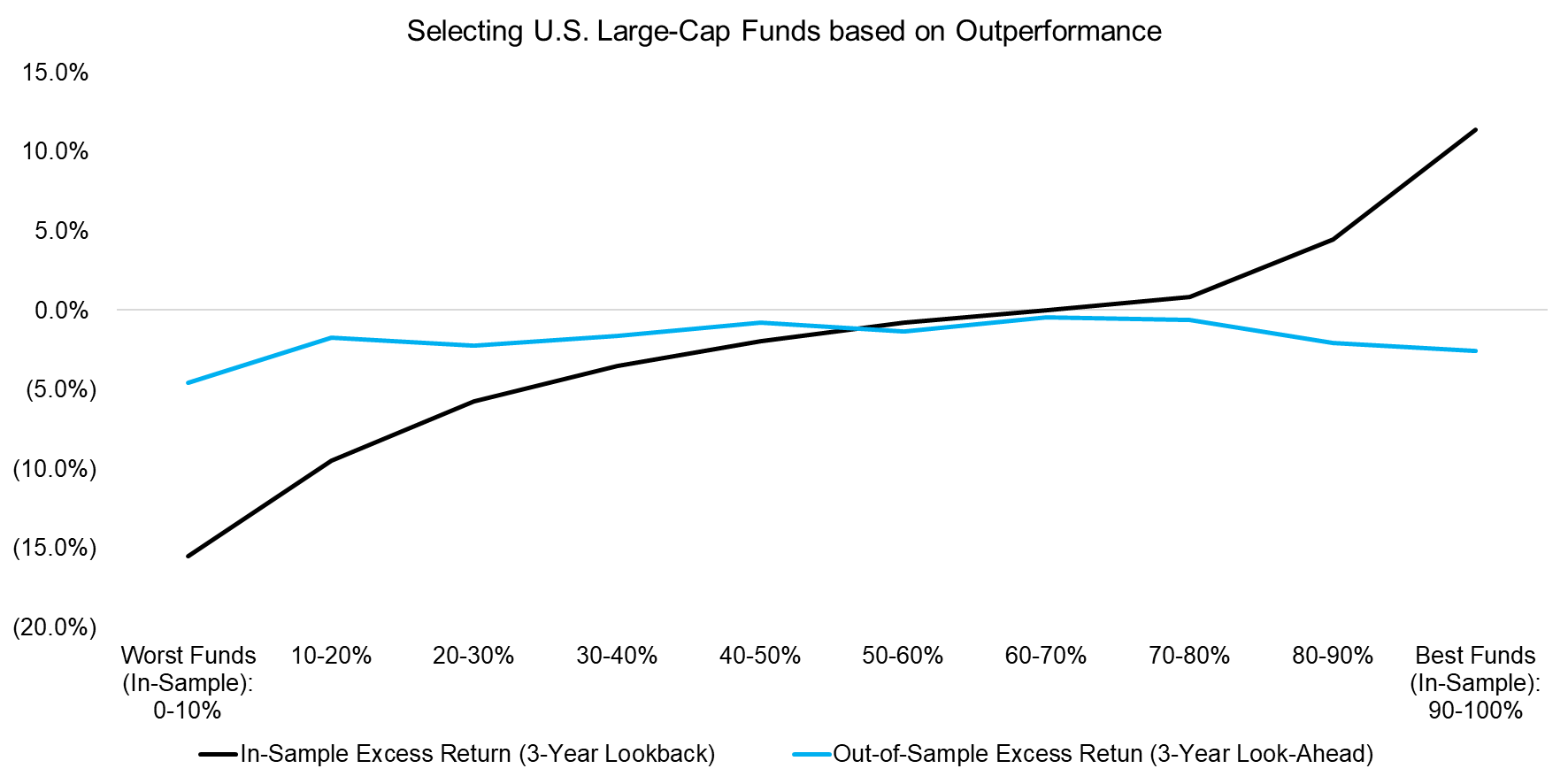
We begin this analysis by focusing on a single metric – outperformance – within a single benchmark category, the S&P 500, before expanding the comparison across all metrics and asset classes. The results below show the three-year in-sample and out-of-sample median excess returns by percentile relative to the S&P 500, based on funds trading between 2000 and 2025. In-sample, the bottom 10% of funds underperformed the S&P 500 by 15.5%, while the top 10% outperformed by 11.4%. Over the subsequent three years (out-of-sample), the worst-performing funds continued to lag, though by a smaller margin of -4.6%, and the best-performing funds also slightly underperformed, at -2.6%.
Investors may find it surprising that all percentiles underperformed the S&P 500 out-of-sample. However, this aligns with other research, such as the S&P SPIVA Scorecards. There are exceptions within each percentile: some funds outperformed, but the majority did not.
Unsurprisingly, this confirms that past outperformance does not predict future results, consistent with our earlier research and the standard risk disclosures that financial regulators worldwide require in marketing materials for investment products.
Source: Finominal
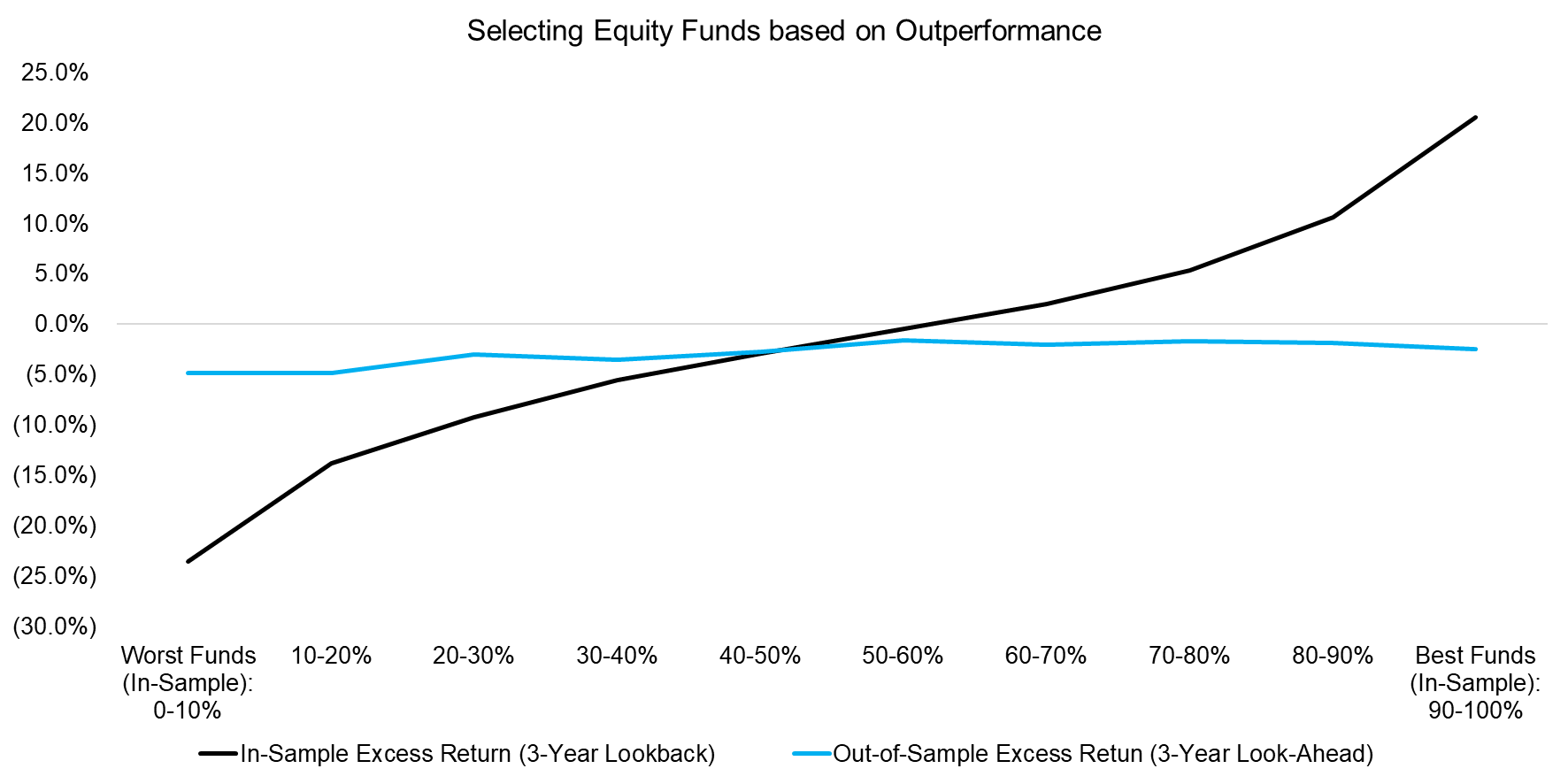
Next, we broaden our focus from ranking funds on outperformance versus the S&P 500 to general equity funds trading in the U.S., covering 33 benchmark categories, including indices such as the MSCI ACWI and the Nikkei 225. In-sample, excess returns rise linearly across percentiles, by definition. However, out-of-sample, funds across all percentiles show consistent underperformance. The patterns observed with the S&P 500, therefore, extend across global equity markets.
Source: Finominal
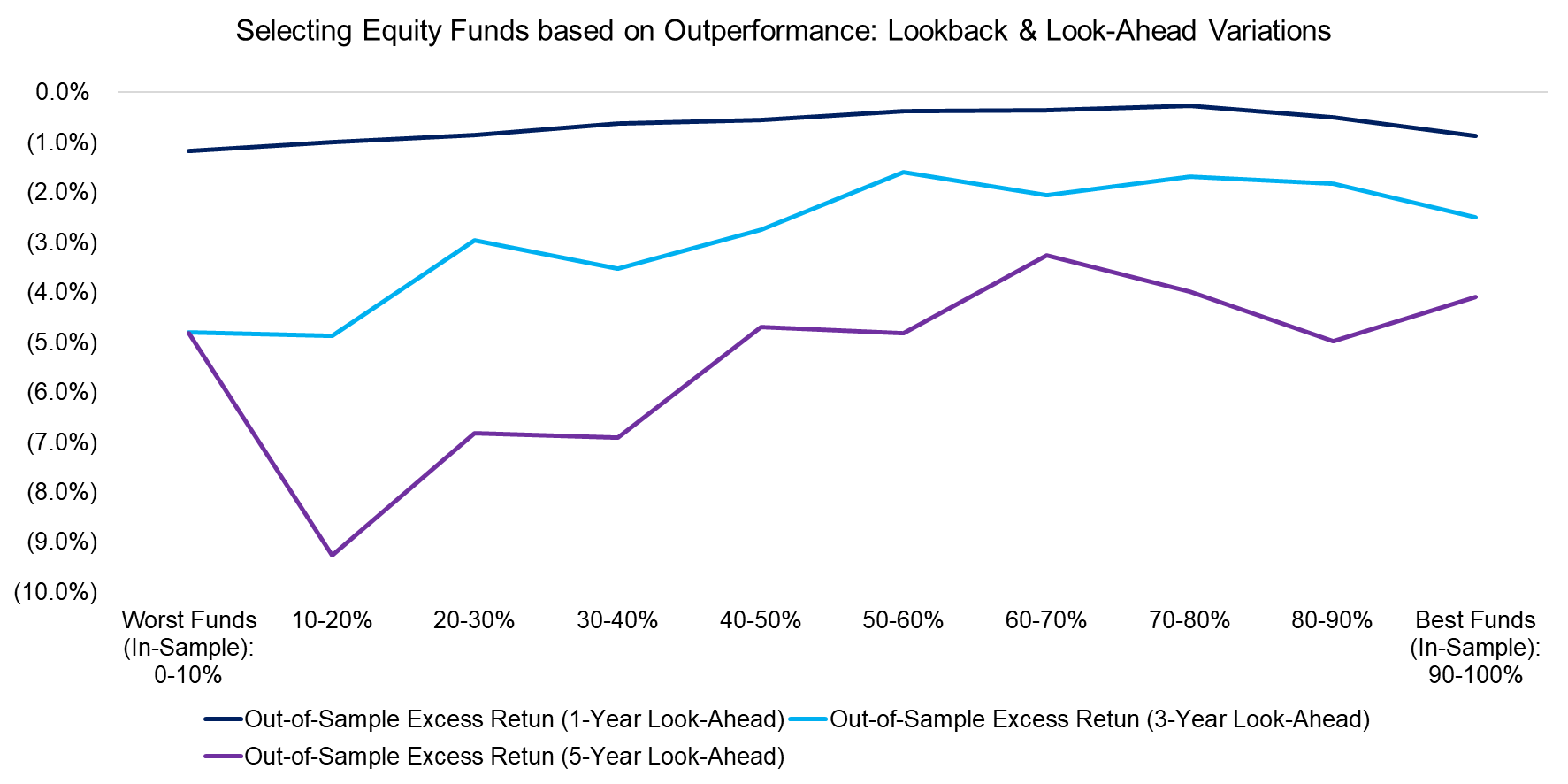
We also examine the effect of the lookback period, varying it from 1 to 5 years while keeping the out-of-sample (look-ahead) period the same. Shorter lookback periods tend to produce lower and less volatile future underperformance.
Much of the underperformance is likely driven by high mutual fund fees, which have a progressively larger negative impact over longer look-ahead periods. However, the trends across the percentiles remain largely the same, i.e., the worst-performing funds continue to underperform more than the best-performing funds.
Source: Finominal
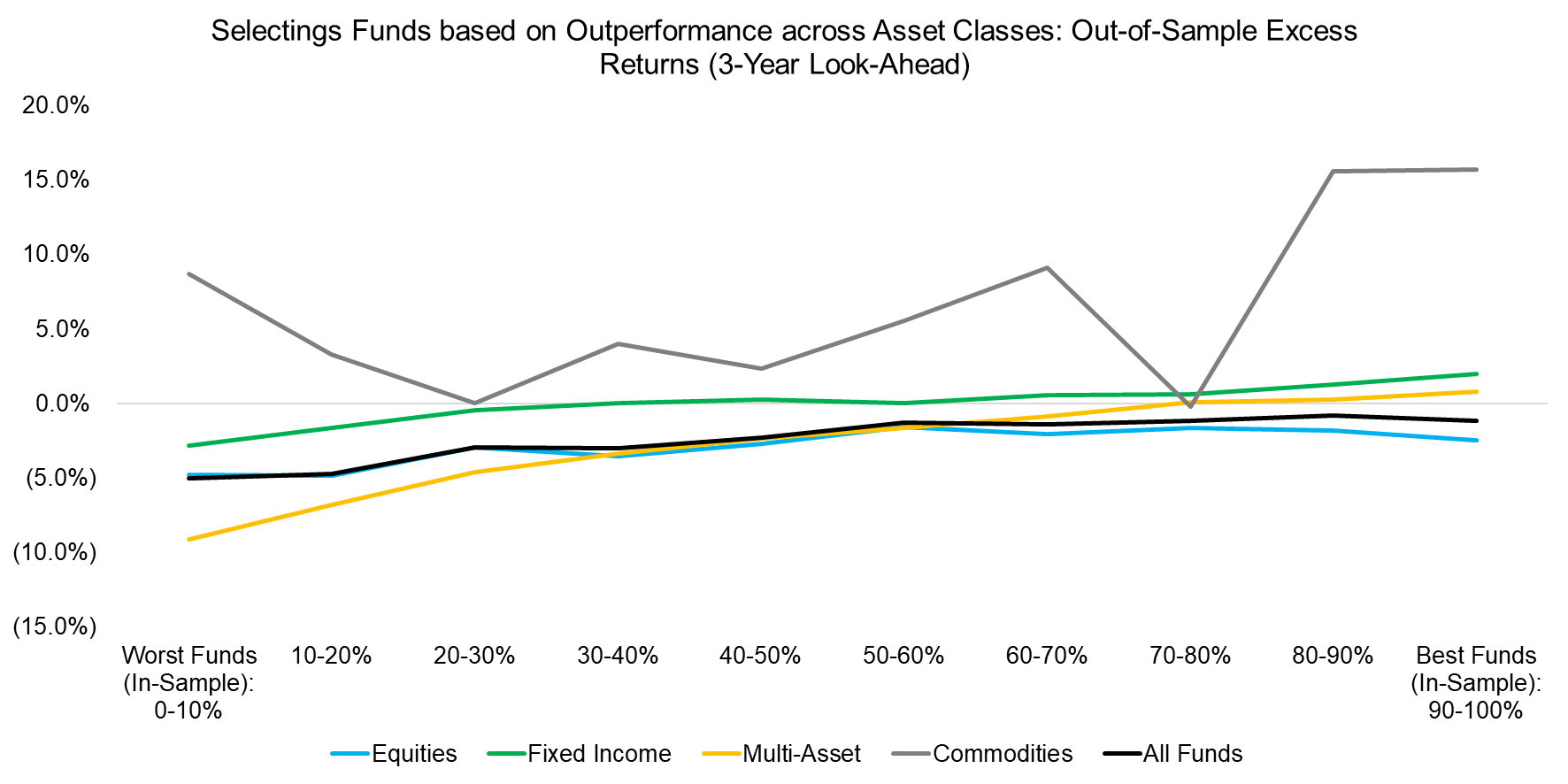
Extending the analysis beyond equities to all asset classes reveals more divergent outcomes. In fixed income and multi-asset funds, the worst-performing funds continued to underperform out-of-sample, while the best-performing funds delivered benchmark outperformance over the subsequent three years.
The results for commodities are even more striking, as the majority of funds outperformed their benchmark. This may partly reflect characteristics of the benchmark itself – for example, the S&P GSCI Index may be less efficiently constructed and therefore easier to outperform than equity benchmarks such as the S&P 500. The number of commodity funds is also relatively small, meaning the sample is less statistically robust than in many equity categories, which often include hundreds of funds.
Source: Finominal
COMPARING VARIOUS FUND SELECTION METRICS
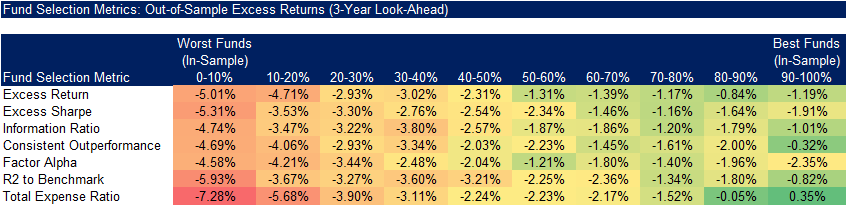
Finally, we present the subsequent returns across all funds for each selection metric. We find that three-year out-of-sample excess returns were negative across all percentiles, although selecting the worst-ranked funds consistently resulted in poorer outcomes than selecting the best-ranked funds. Only one metric – total expense ratio – produced positive out-of-sample excess returns, with funds in the lowest-cost percentile outperforming their benchmarks.
Source: Finominal
FURTHER THOUGHTS
This analysis substantiates our findings from last year: widely used fund selection metrics such as past outperformance, Sharpe ratios, and information ratios are ineffective at identifying funds that will outperform in the future. Expense ratio is the only metric that consistently matters.
That said, drawing an analogy to factor investing – where individual factors are often combined into multi-factor strategies – further research is needed to determine whether combining multiple metrics could yield a more effective fund-ranking methodology.
RELATED RESEARCH
Evaluating Metrics for Fund Selection
Chasing Mutual Fund Performance
Measuring Performance Chasing
The Fallacy of Betting on the Best Stock Market
Thematic versus Momentum Investing
An Anatomy of Thematic Investing
Thematic Investing: Thematically Wrong?
Stock Selection versus Asset Allocation
The Juggernaut Index
Top Fee Generating, Wealth Creating and Destroying ETFs
ABOUT THE AUTHOR
Nicolas Rabener is the CEO & Founder of Finominal, which empowers professional investors with data, technology, and research insights to improve their investment outcomes. Previously he created Jackdaw Capital, an award-winning quantitative hedge fund. Before that Nicolas worked at GIC and Citigroup in London and New York. Nicolas holds a Master of Finance from HHL Leipzig Graduate School of Management, is a CAIA charter holder, and enjoys endurance sports (Ironman & 100km Ultramarathon).
Connect with me on LinkedIn or X.