
Factor Exposure Analysis 120: Risk & Return Contribution Analysis of Fixed Income Strategies
Bonds provide uncorrelated returns to stocks, right?
August 2026. Reading Time: 10 Minutes. Author: Nicolas Rabener.
SUMMARY
- Fixed income markets are diverse, and so are their risk & return drivers
- Contribution analysis helps identify hidden risks
- Many bond types are unattractive given high correlations to equities
INTRODUCTION
iShares’ Core U.S. Aggregate Bond ETF (AGG) is the largest bond fund, with $140 billion in assets, and a cornerstone holding in traditional equity/bond portfolios. Yet most investors would likely struggle to say precisely what AGG holds. The consensus guess would be “U.S. investment-grade bonds” – but what does that actually mean in practice?
AGG allocates 46% to U.S. Treasuries and 21% to agency mortgage-backed securities, with the remainder split across corporate bonds and smaller sleeves in other fixed income sectors. In total, the portfolio holds more than 13,000 securities. This makes it a reasonable proxy for the U.S. investment-grade bond market as a whole, but it also illustrates just how heterogeneous that market is.
However, AGG can also be challenged in that, given its broad universe, it is not as uncorrelated to equities as commonly perceived, and therefore provides less diversification benefit than commonly assumed.
In this research report, we analyze the various segments of the fixed-income universe using risk and return contribution analysis.
FIXED INCOME MARKET SEGMENTS
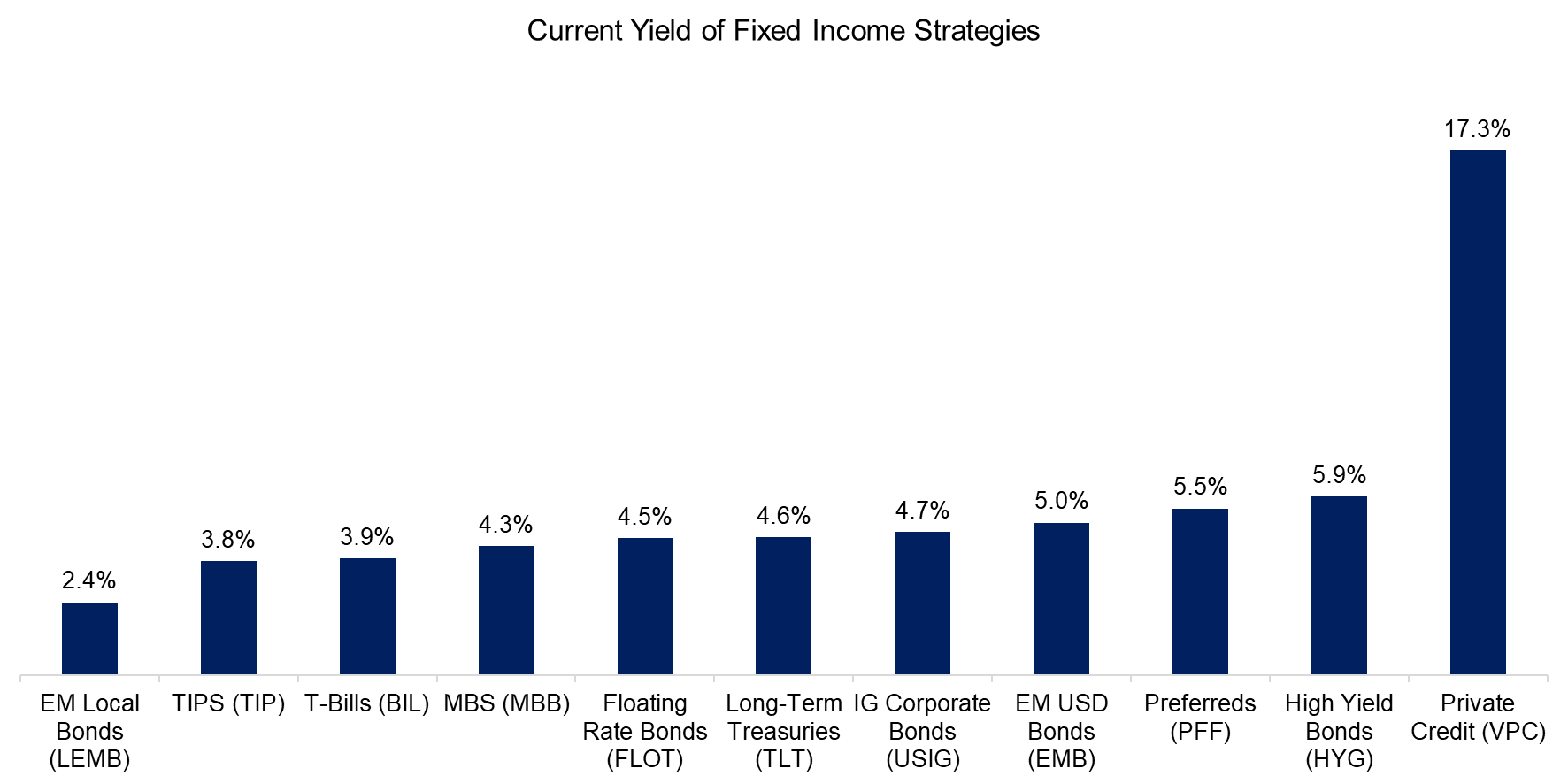
The fixed income market is diverse, and we focus on 11 segments: EM local currency-denominated bonds, TIPS, T-Bills, mortgage-backed securities (MBS), floating-rate bonds, long-term Treasuries, IG corporate bonds, EM USD-denominated bonds, preferreds, high yield bonds, and private credit.
We use the largest ETFs trading in the U.S. that provide exposure to each strategy and compare them based on their yields, the core reason for buying bonds in the first place. EM local bonds currently offer the lowest yield, and private credit the highest. The former may be surprising and is explained by exposure to low-yielding sovereign debt from countries like China, Thailand, and Poland.
Source: Finominal
PERFORMANCE OF FIXED INCOME STRATEGIES
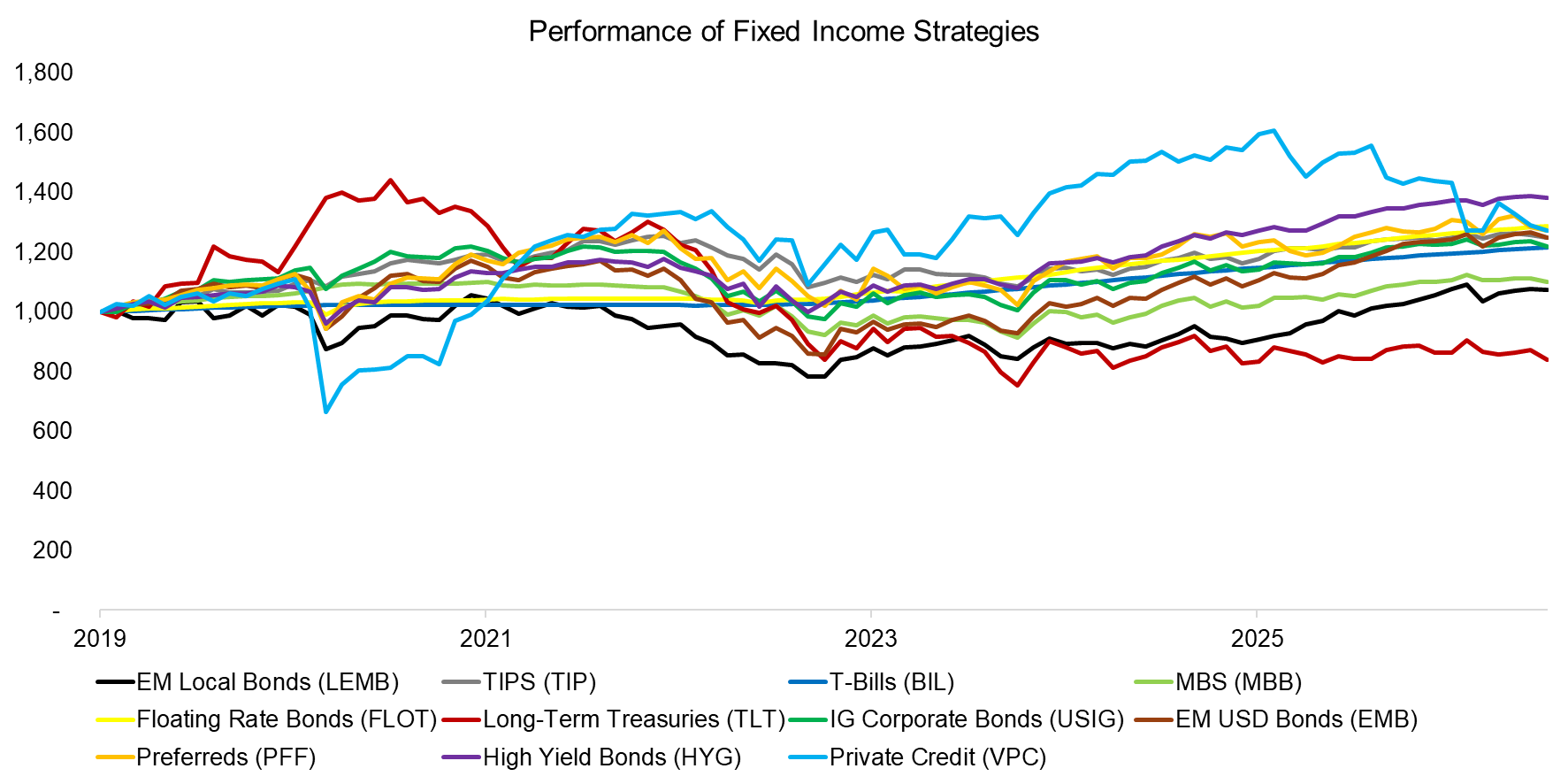
The oldest private credit ETF, the Virtus Private Credit Strategy ETF (VPC), only has a track record going back to 2019. Comparing performance over this period shows CAGRs ranging from -2.3% for long-term U.S. Treasuries to 4.4% for high yield bonds. The downturn in the bond market as interest rates rose is evident across the various strategies, except for T-Bills and floating-rate debt, which benefited from it.
Source: Finominal
RISK CONTRIBUTION ANALYSIS
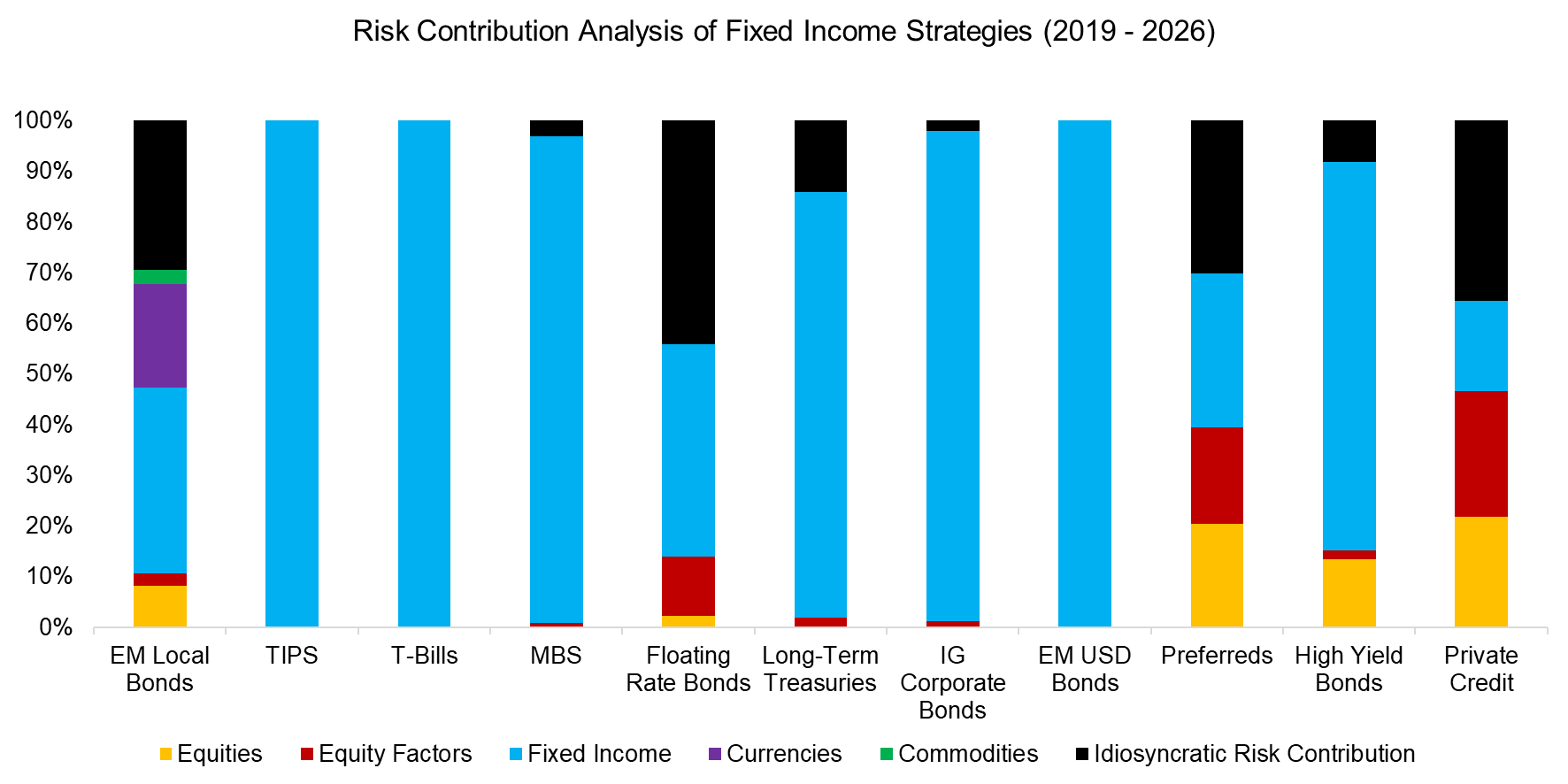
We run a returns-based risk contribution analysis using Finominal’s set of country, sector, equity factor, fixed income factor, commodity, and currency indices. The analysis highlights that only TIPS, T-Bills, MBS, long-term Treasuries, IG corporate bonds, and EM USD-denominated bonds derive almost all of their risk from fixed income factors. In contrast, EM local bonds, floating-rate bonds, preferreds, high yield bonds, and private credit have various risk contributors, including equities.
It is worth noting that our risk model does not explain all fixed-income strategies well; for example, the idiosyncratic risk of floating-rate bonds was 44%, reflected in a low R2 of 0.6.
Source: Finominal
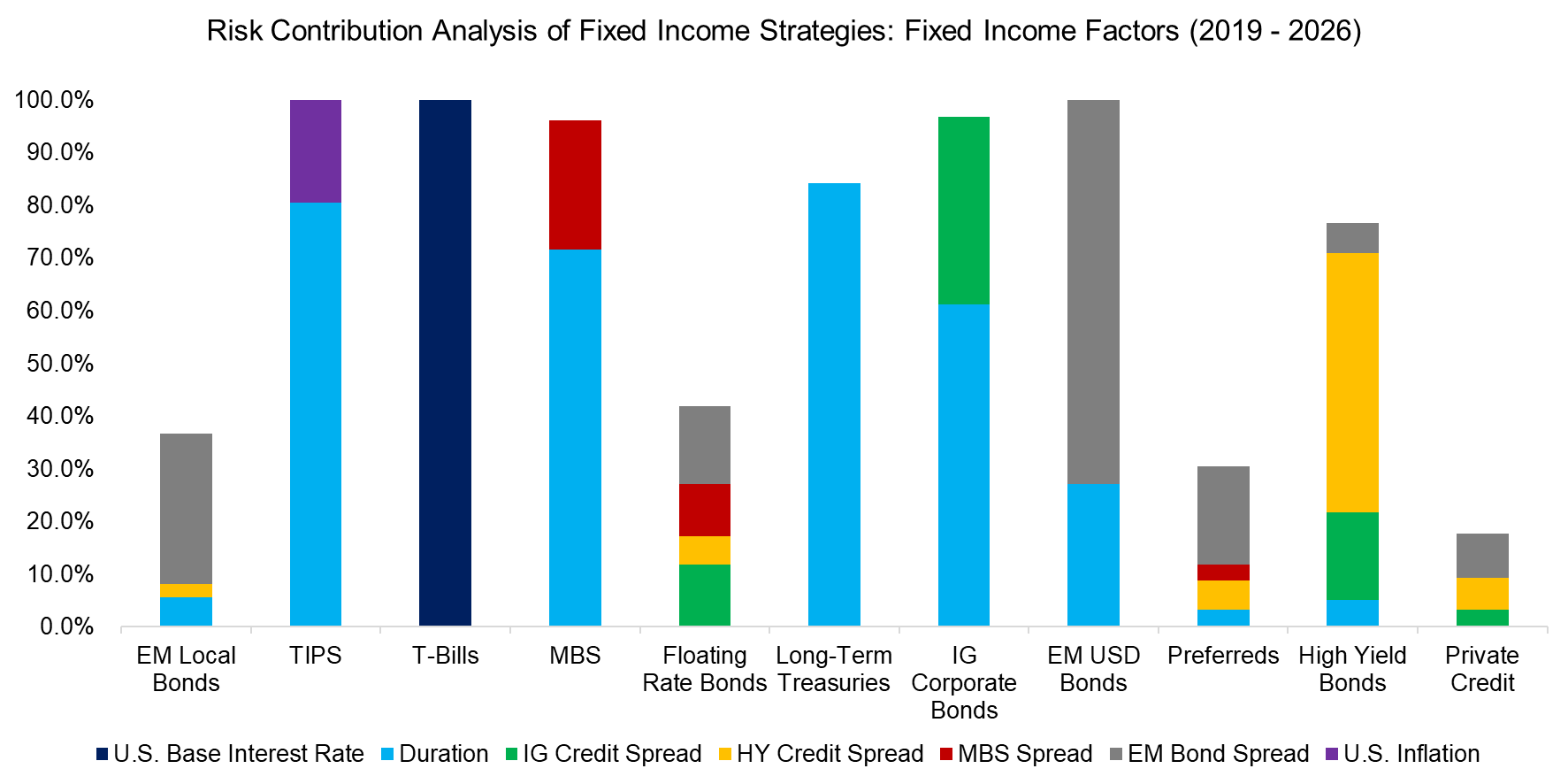
We drill into the fixed income factors, which again shows a relatively diverse picture. The largest driver was duration, but it only mattered significantly for TIPS, MBS, long-term Treasuries, IG corporate bonds, and USD-denominated EM debt. Other exposures are intuitive: for example, the EM spread contributed to EM bonds, the U.S. base interest rate to T-Bills, and the HY credit spread to high yield bonds.
Source: Finominal
RETURN CONTRIBUTION ANALYSIS
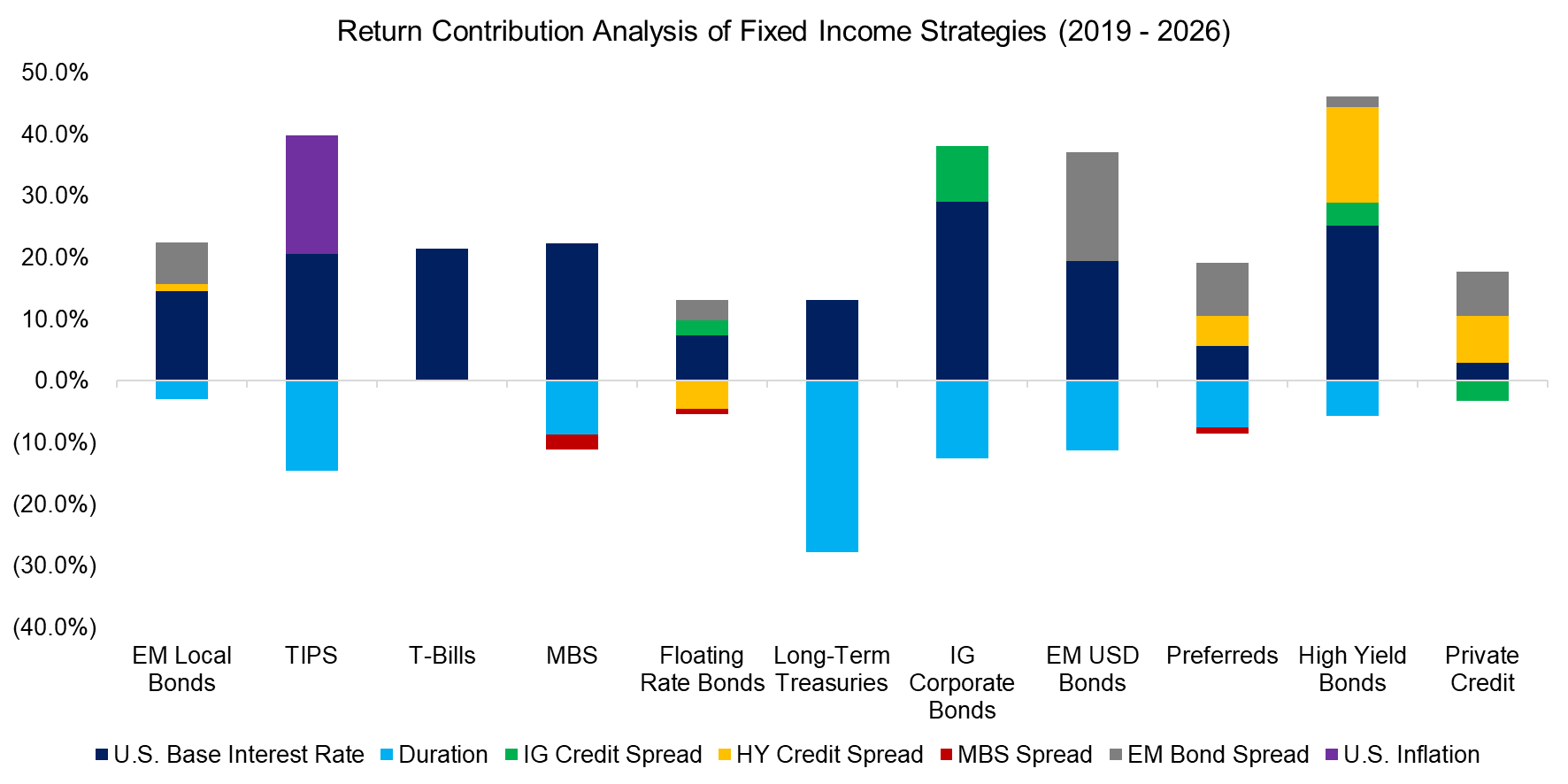
Next, we run a return contribution analysis for the period between 2019 and 2026. As expected given the rise in interest rates since 2022, duration contributed negatively, while the U.S. base interest rate contributed positively. Although TIPS disappointed investors in 2022, when they declined significantly along all long-dated fixed-rate bonds, inflation still contributed positively to their returns.
Source: Finominal
CORRELATION ANALYSIS
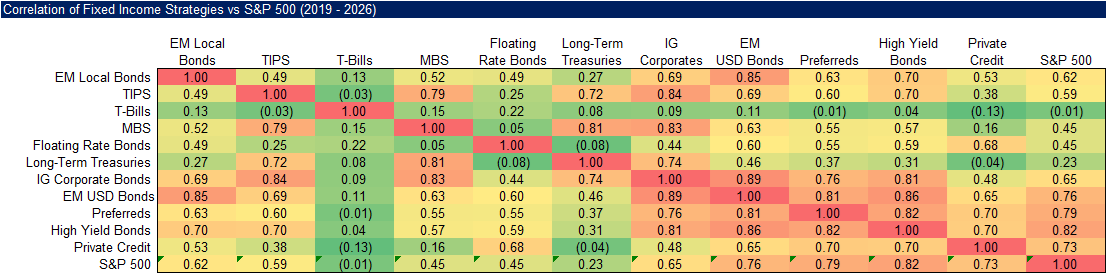
Aside from earning income from a relatively low-risk investment, investors primarily allocate to bonds to harvest diversification benefits. However, reviewing the correlation to the S&P 500 over the last 7.5 years reveals a range from -0.01 for T-Bills to 0.82 for high yield bonds. Naturally, diversification benefits with equities are limited when correlations are this high.
Source: Finominal
FURTHER THOUGHTS
Most investors allocate to bonds for income and diversification. However, investors don’t really need yield, as they can simply sell part of their portfolio for cash whenever needed, which is often more tax-favorable. Diversification is maximized by selecting fixed income strategies with the lowest correlations to equities, which is essentially only T-Bills and long-term Treasuries.
The worst combination is selecting a fixed income strategy with both high yield and high correlation to equities. Unfortunately, the highest-return-generating fixed-income strategy over the last 7.5 years, namely high-yield bonds, offers exactly these attributes. Hopefully investors will realize that, with a correlation of 0.82 to the S&P 500, high yield bonds are not very bond-like.
Building Better High Yield Portfolios – III
Factor Exposure Analysis 119: Fixed Income Factors III
Factor Exposure Analysis 108: Fixed Income Factors II
Factor Exposure Analysis 107: Fixed Income Factors
Diversifying vs De-Risking Funds
Diversification vs De-Risking: Evidence Across Asset Classes
Factors & Interest Rates
Duration of U.S. Equities – II
How Much Can You Lose with Bonds?
60/40 Portfolios Without Bonds
Bonds versus CTAs for Diversification
Bonds & The Invisible Thief
ABOUT THE AUTHOR
Nicolas Rabener is the CEO & Founder of Finominal, which empowers professional investors with data, technology, and research insights to improve their investment outcomes. Previously he created Jackdaw Capital, an award-winning quantitative hedge fund. Before that Nicolas worked at GIC and Citigroup in London and New York. Nicolas holds a Master of Finance from HHL Leipzig Graduate School of Management, is a CAIA charter holder, and enjoys endurance sports (Ironman & 100km Ultramarathon).
Connect with me on LinkedIn or X.