
Factor Olympics Q1 2026
And the winner is…
April 2026. Reading Time: 10 Minutes. Author: Nicolas Rabener.
SUMMARY
- Value was the best, and growth the worst-performing factor
- Long-short & smart beta factor investing generated strong excess returns
- Rare to see all popular factors generating positive returns
INTRODUCTION
We present the performance of well-known factors for the first quarter of 2026 and over the last decade. We have started to include the growth factor, which, according to academic research, has generated negative long-term returns but is widely followed as an investment style.
METHODOLOGY
Our factors are constructed from long-short beta-neutral portfolios of the top and bottom 30% of stocks. Only stocks with a minimum market capitalization of $1 billion are included. Portfolios are rebalanced monthly, and transactions incur a 10-basis-point cost. Stocks are selected on the following metrics:
- Value: A combination of price-to-earnings and price-to-book multiples
- Size: Market capitalization
- Momentum: Total return over the last 12 months
- Low volatility: Volatility over the last 12 months
- Profitability: Net income-over-equity
- Leverage: Debt-over-equity
- Growth: A combination of sales-per-share and earnings-per-share over the last three years
FACTOR OLYMPICS: EXCESS RETURNS
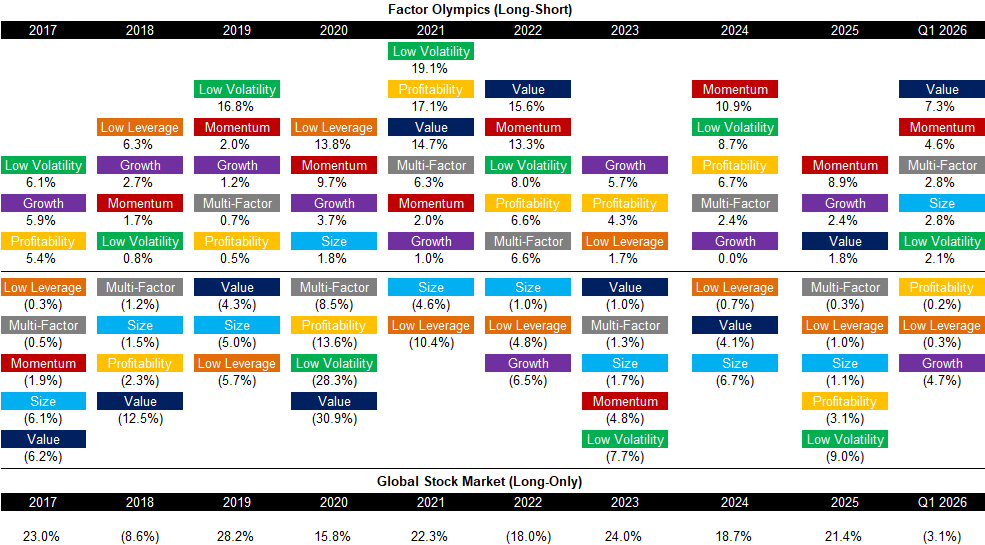
The table below ranks long-short factor performance for the first quarter of 2026 and over the past 10 years. Beyond showing performance, it illustrates the sharp year-to-year rotations in factor profitability, underscoring the value of diversifying across multiple factors.
Value was the top-performing factor in the first quarter, while growth ranked last. An equal-weighted portfolio of all factors, excluding growth, which is not supported by academic research, would have returned 2.8% before management fees.
Source: Finominal
TRENDS IN FACTOR PERFORMANCE
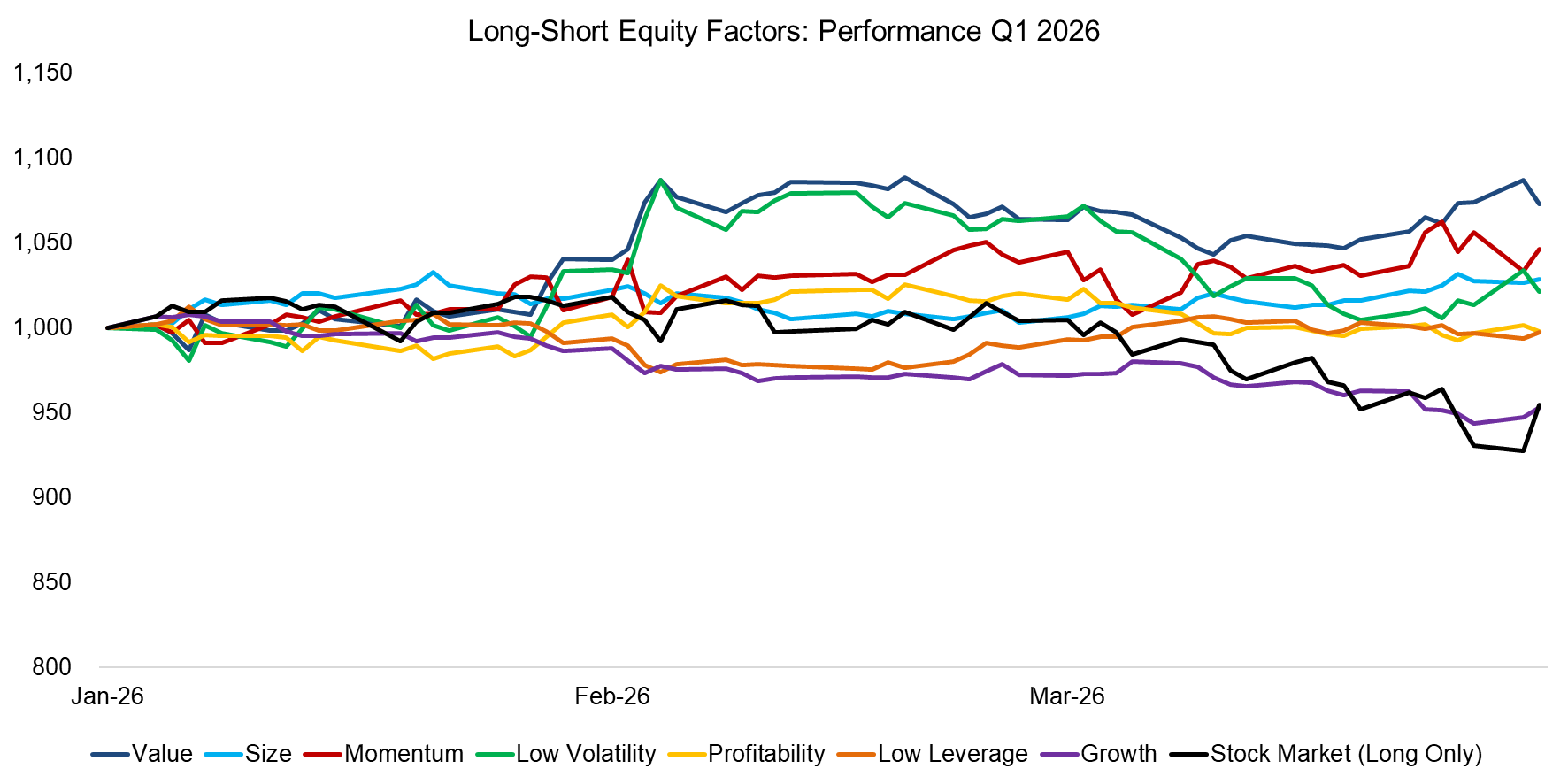
We observe two notable factor rotations during the period. In early February, markets began pricing in the likelihood that AI models – such as ChatGPT and Claude – would prove disruptive to traditional software companies, driving a rotation into value and low-volatility stocks while growth sold off sharply. A second dislocation is visible at the end of March, when the war between the U.S., Israel, and Iran triggered a sharp rise in commodity prices.
Source: Finominal
PERFORMANCE OF LONG-SHORT MULTI-FACTOR PRODUCTS
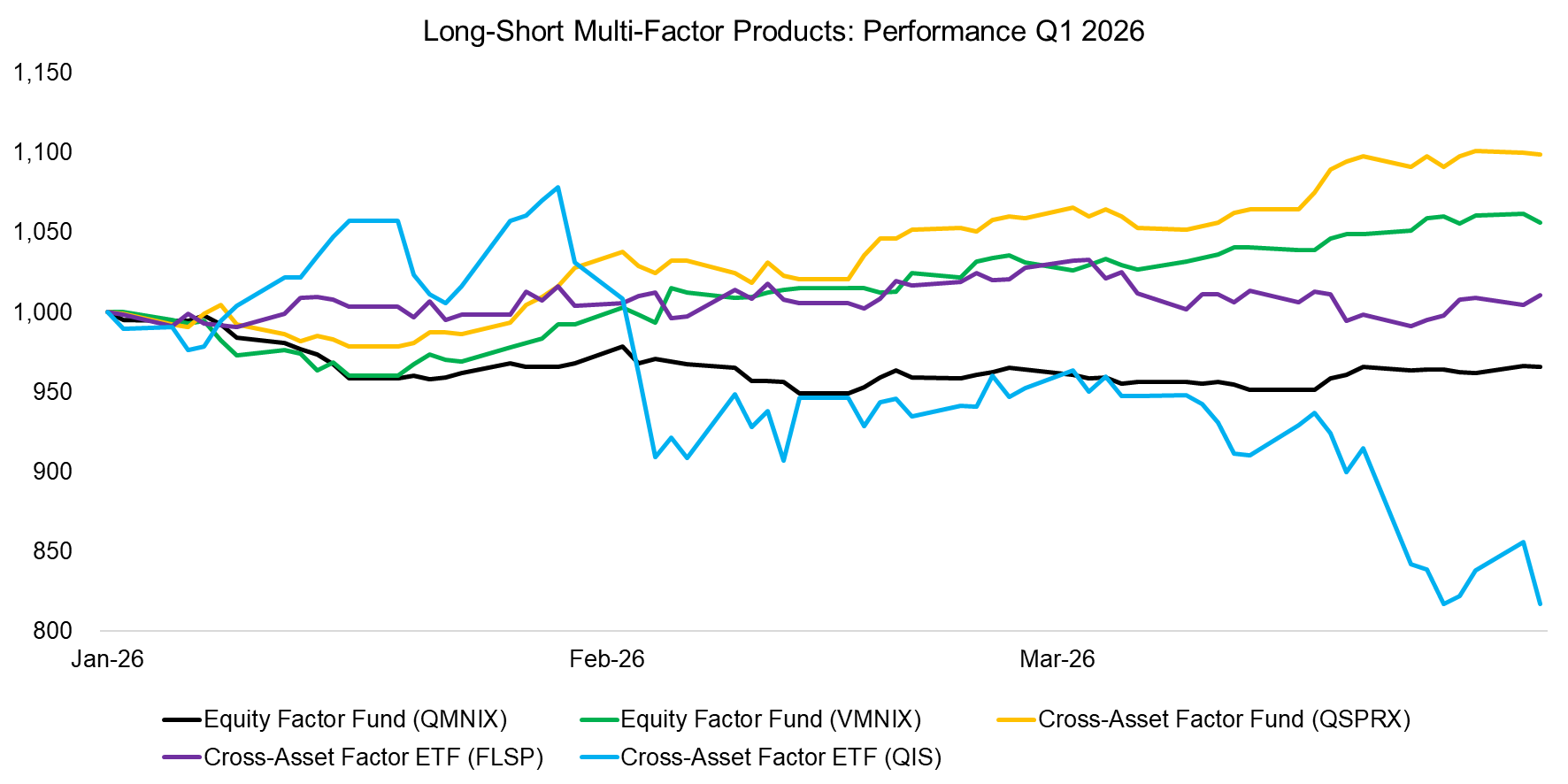
Only a handful of liquid alternative mutual funds and ETFs offer pure long-short factor exposure, as seen in academic research. Despite numerous fund liquidations over the past decade, Simplify Asset Management introduced two new products in 2023: the Simplify Market Neutral Equity Long/Short ETF (EQLS) and the Simplify Multi-QIS Alternative ETF (QIS), both designed to provide exposure to equity and cross-asset factors. EQLS was liquidated in 2025, and QIS is likely to be liquidated soon, given exceptionally poor performance.
We observe an interesting dichotomy in the first quarter of 2026: AQR’s Equity Market Neutral Fund (QMNIX) is slightly down, while AQR’s Style Premia Alternative Fund (QSPRX) posted strong returns. However, the largest allocation of QSPRX is to equity market neutral factors, i.e., QMNIX, which implies that factor investing in commodities, fixed income, and currencies generated all the returns, as equities contributed little.
Source: Finominal
SMART BETA EXCESS RETURNS
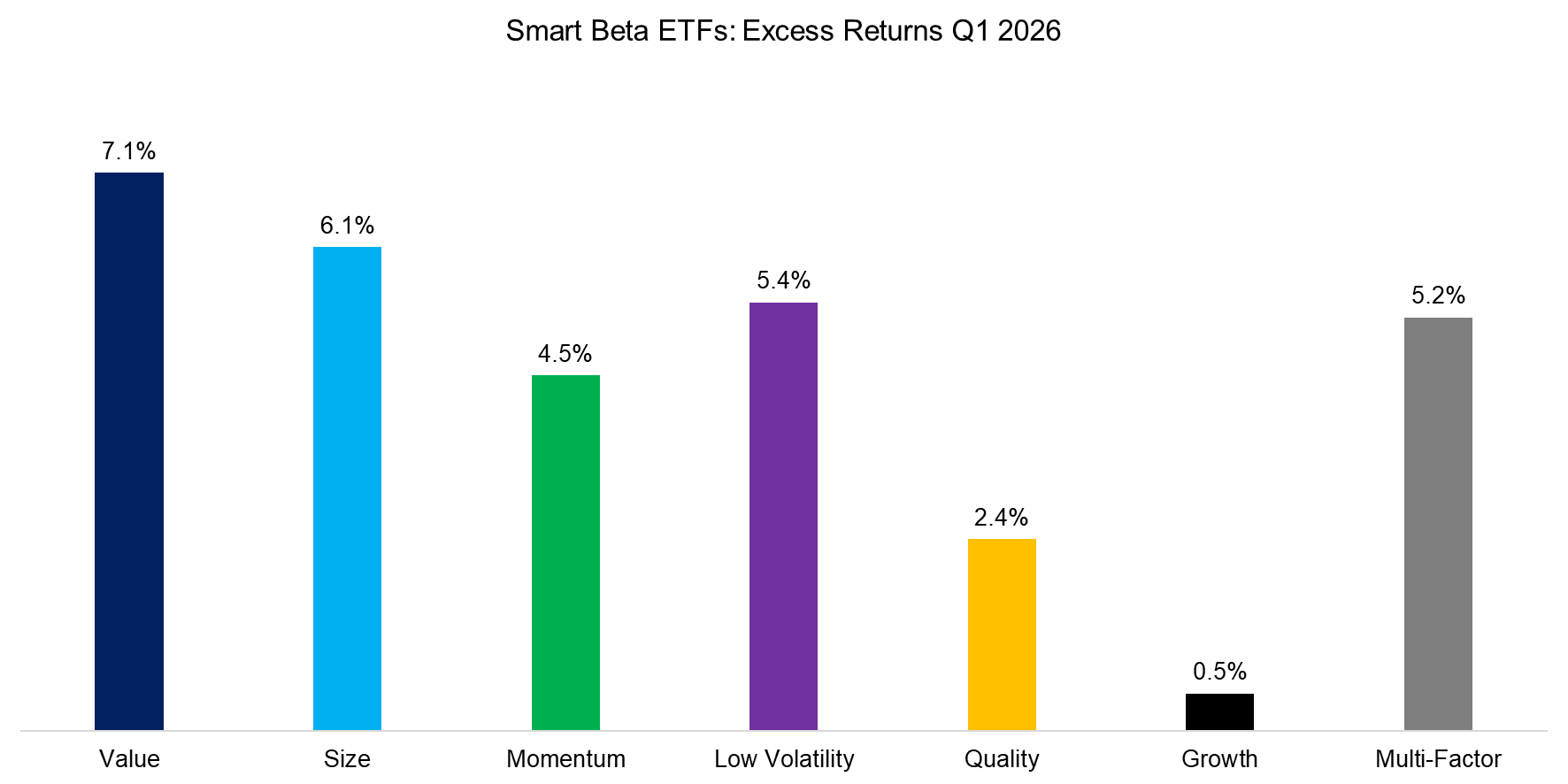
Although investors should allocate to factors constructed as long-short portfolios given that these offer high diversification benefits, most invest via long-only smart beta ETFs (read Smart Beta vs Alpha + Beta). Following the money, we highlight the excess returns generated from investing in smart beta ETFs in the US, which represents a universe of 160+ products and approximately $800 billion of assets under management. We also show the performance of the growth factor, which is popular with investors but is not associated with positive excess returns over time (read What Are Growth Stocks?).
We observe a strong overlap between long-short and long-only factor investing in the first quarter of 2026, as return directions were broadly aligned: value, size, low volatility, and momentum delivered positive performance in both approaches. The main divergence is in the growth factor, which was slightly positive in smart beta ETFs but negative in the long-short implementation.
Source: Finominal
FACTOR CORRELATIONS
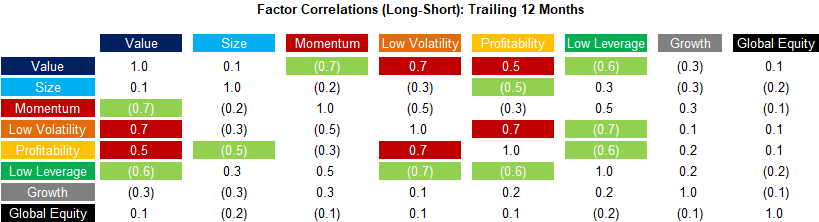
The 12-month correlation analysis reveals several strong positive relationships, including value & low volatility, profitability & low volatility. It also highlights notable negative correlations, such as value & momentum, value & low leverage, and size & profitability. Many of these relationships are structural rather than temporal – for example, cheap stocks often underperform and are frequently associated with high leverage.
Investors can naturally exploit advantageous correlations, e.g., buying cheap, low-volatility, but highly profitable companies, seems like a sensible investing strategy.
Source: Finominal
FURTHER THOUGHTS
In recent years, there was a pronounced divergence between long-short and long-only (smart beta) factor investing, with long-short strategies delivering strong excess returns while long-only approaches underperformed. The fact that both strategies generated attractive returns in 2026 marks a notable shift and may offer welcome relief to investors frustrated by the weak performance of smart beta products.
Market-Neutral versus Smart Beta Factor Investing
Factor Optimization via ETFs
Smart Beta ETF vs Customized Factor Portfolios
Factor Exposure Analysis 114: Factor Offsetting
Improving Smart Beta Attribution Analysis II
Quality in Small versus Large-Cap Stocks
The Illusion of the Small-Cap Premium
Shorting Lousy Stocks = Lousy Returns?
Higher Volatility, Higher Alpha?
Outperformance Ain’t Alpha
Improving the Odds of Value Investing
The Value Factor’s Pain: Are Intangibles to Blame?
Smart Beta vs Alpha + Beta
How Painful Can Factor Investing Get?
GARP Investing: Golden or Garbage? II
Are Low-Risk Stocks Really Low-Risk?
ABOUT THE AUTHOR
Nicolas Rabener is the CEO & Founder of Finominal, which empowers professional investors with data, technology, and research insights to improve their investment outcomes. Previously he created Jackdaw Capital, an award-winning quantitative hedge fund. Before that Nicolas worked at GIC and Citigroup in London and New York. Nicolas holds a Master of Finance from HHL Leipzig Graduate School of Management, is a CAIA charter holder, and enjoys endurance sports (Ironman & 100km Ultramarathon).
Connect with me on LinkedIn or X.