
Intended vs Unintended Effects of Equal-Weighting Stocks
Betting against momentum?
April 2026. Reading Time: 10 Minutes. Author: Nicolas Rabener.
SUMMARY
- Equal-weighting beats market cap-weighting over the long term
- However, there is no performance consistency
- Comes with strong sector and factor biases
INTRODUCTION
In a previous research article, we showed that an equal-weighted portfolio of U.S. stocks would have outperformed its market-cap-weighted counterpart in eight of the ten decades since 1926 (read Equal versus Market Cap-Weighted Stock Market Indices). Yet despite this historical edge, market-cap-weighted products continue to dominate in assets under management.
For instance, Invesco’s S&P 500 Equal Weight ETF (RSP), the largest product in the equal-weighted space, manages $82 billion – far below the $700 billion held by State Street’s SPDR S&P 500 ETF Trust (SPY).
In this article, we examine the intended and unintended bets investors make when allocating to an equal-weighted stock market index.
PERFORMANCE OF MARKET CAP VS EQUAL-WEIGHTED S&P 500
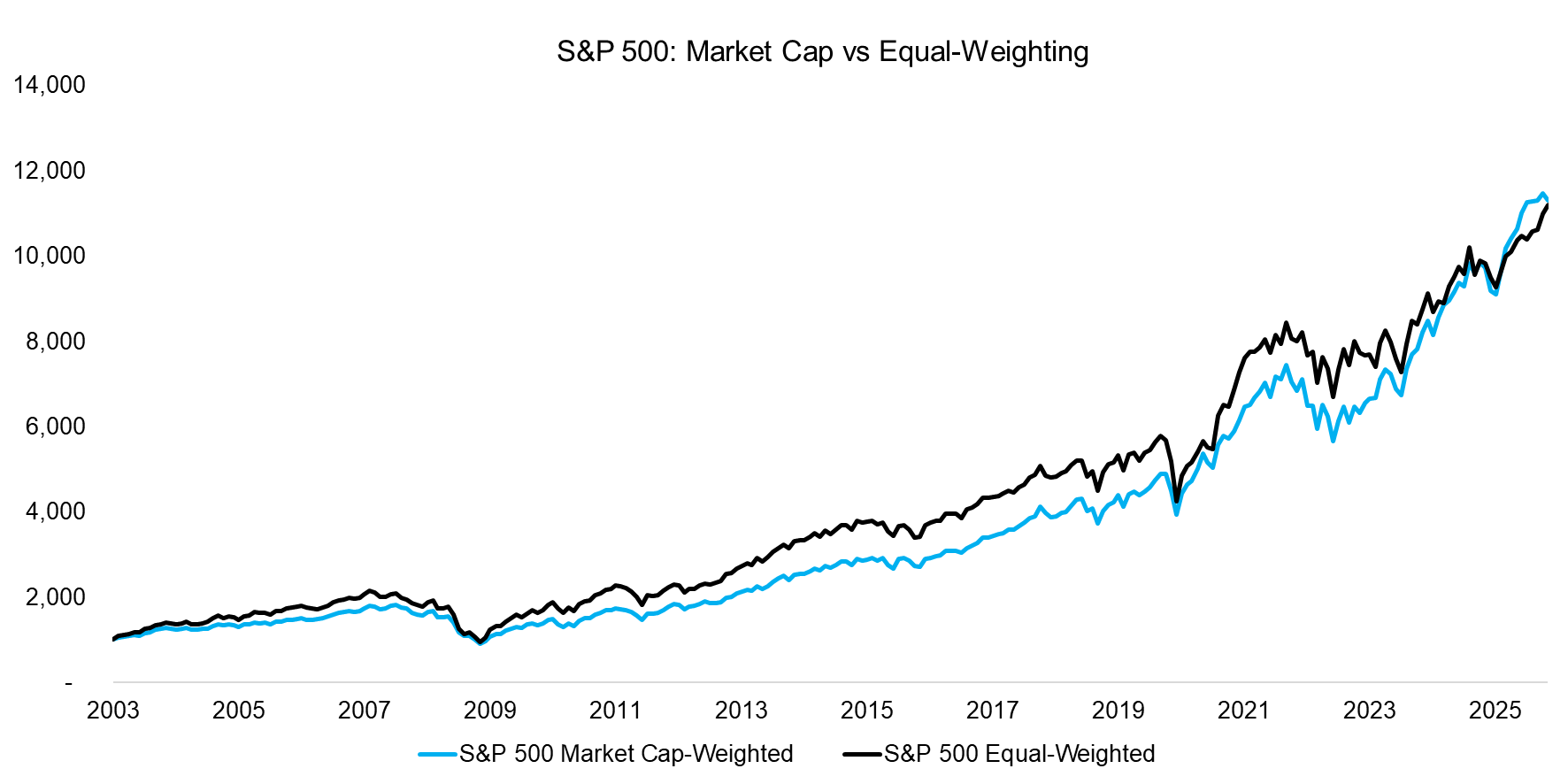
RSP, the equal-weighted S&P 500 ETF, was launched in 2003 and outperformed SPY, its market-cap-weighted counterpart, for nearly two decades. Only in the past few years, as a handful of stocks began to dominate the U.S. equity market, has SPY pulled ahead.
Source: Finominal
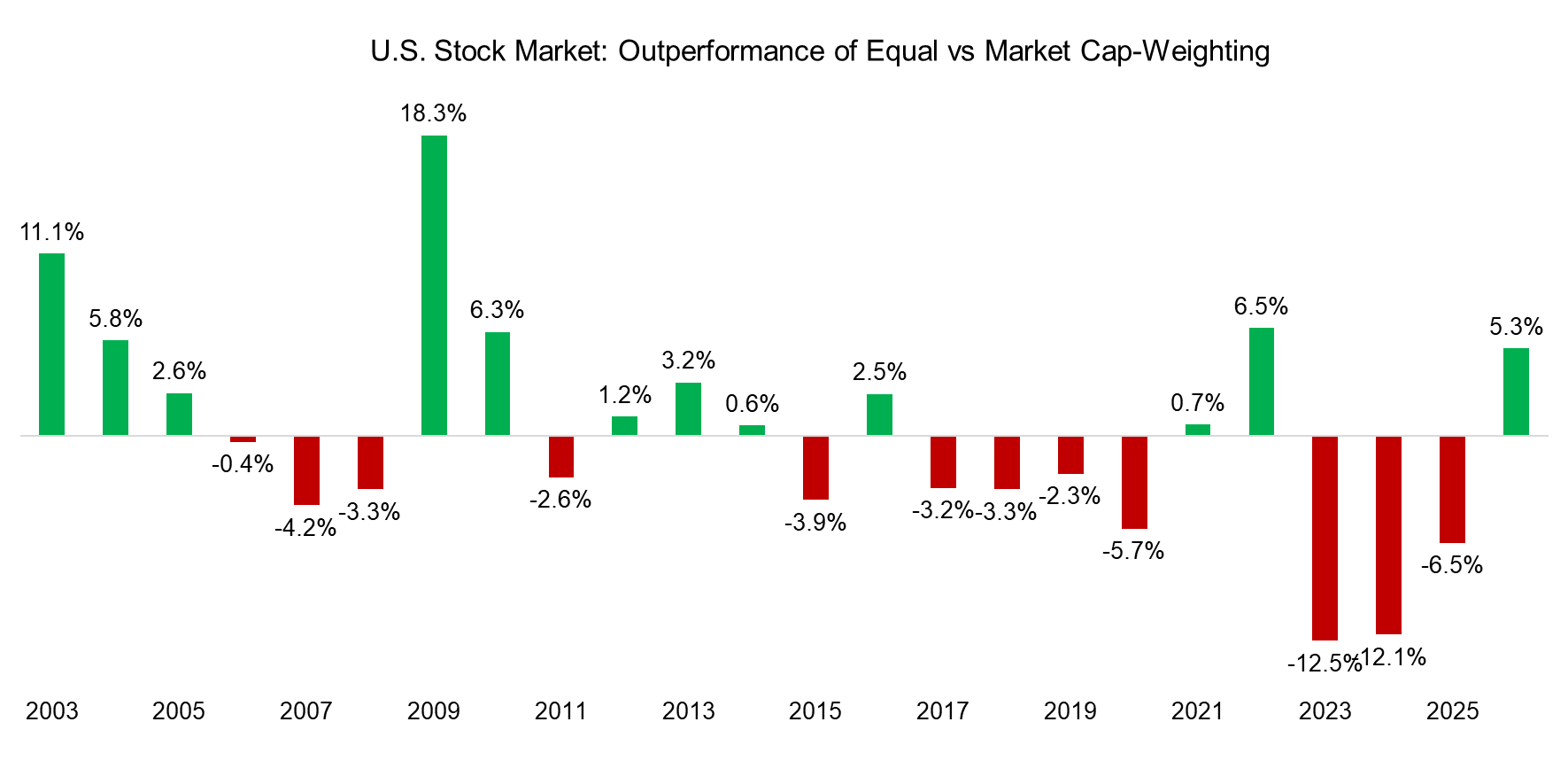
Although RSP has delivered strong cumulative performance over the 23-year period, it outperformed SPY in only about half of those years. Examining the annual results shows that a few years – such as 2003 and 2009 – contributed disproportionately to its total outperformance.
Source: Finominal
FUNDAMENTALS OF EQUAL VS MARKET CAP-WEIGHTED INDICES
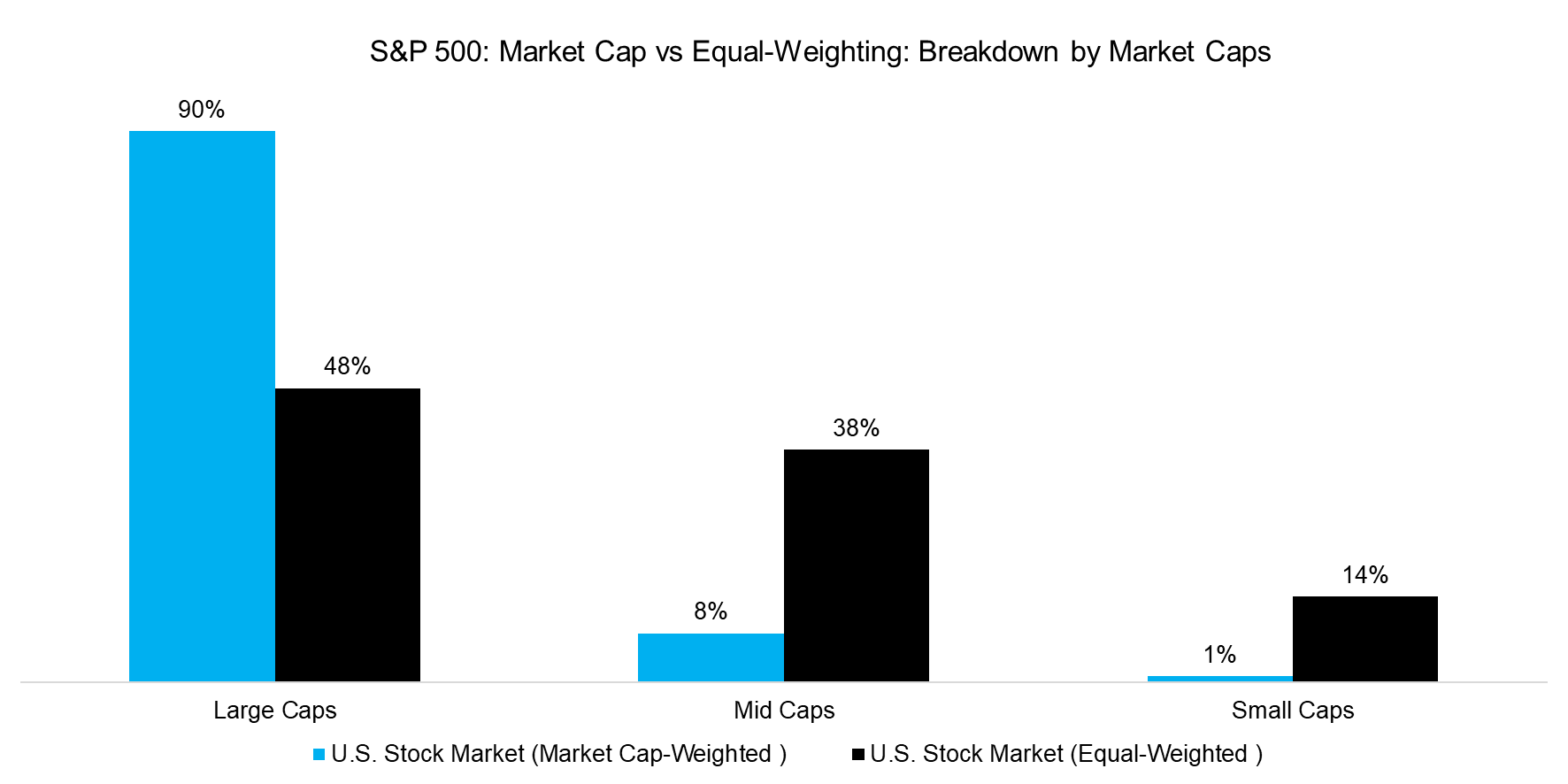
Next, we compare the fundamentals of equal-weighted and market-cap-weighted indices. As expected, the equal-weighted index has a significantly lower exposure to large-cap stocks, which account for only 48% of the index, with a greater allocation to mid-cap stocks. This difference is also reflected in valuations: the equal-weighted index has a median P/E ratio of 26.2x, compared with 33.2x for the market cap-weighted index.
Source: Finominal
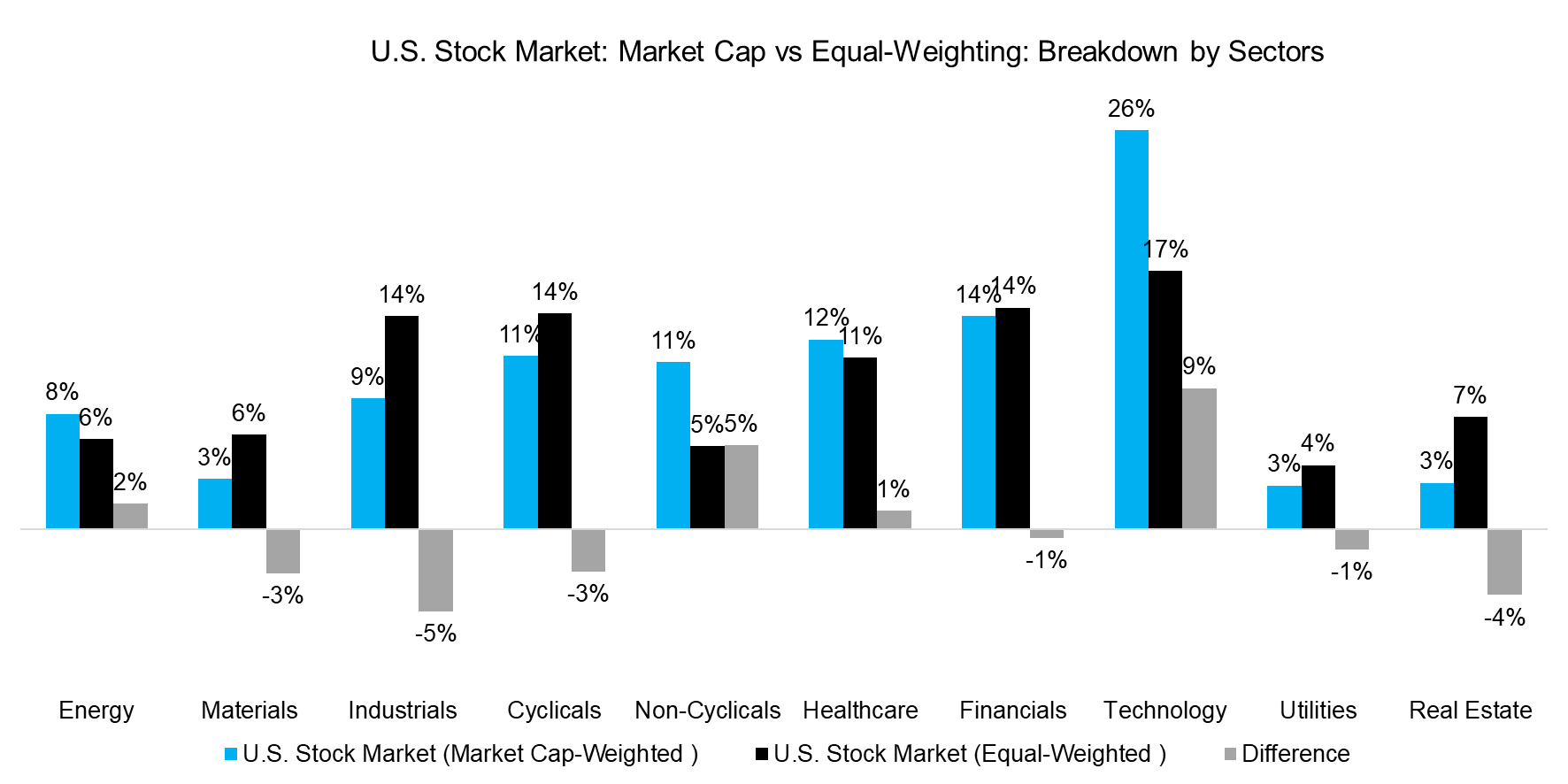
The lower median valuation of the equal-weighted stock market is also evident in its long-term average sector exposures, with notable underweights in non-cyclical and technology sectors, and overweights in industrial and real estate stocks. This suggests that an equal-weighted index may provide a more balanced representation of the U.S. economy.
Source: Finominal
FACTOR EXPOSURE ANALYSIS
S&P Global recently offered an interesting perspective on equal-weighted indices in their article “Big Tech, Breadth, and Balance,” noting that the equal-weighted index tends to outperform when momentum is lagging, and vice versa. This implies that equal-weighting exhibits a negative beta to the momentum factor.
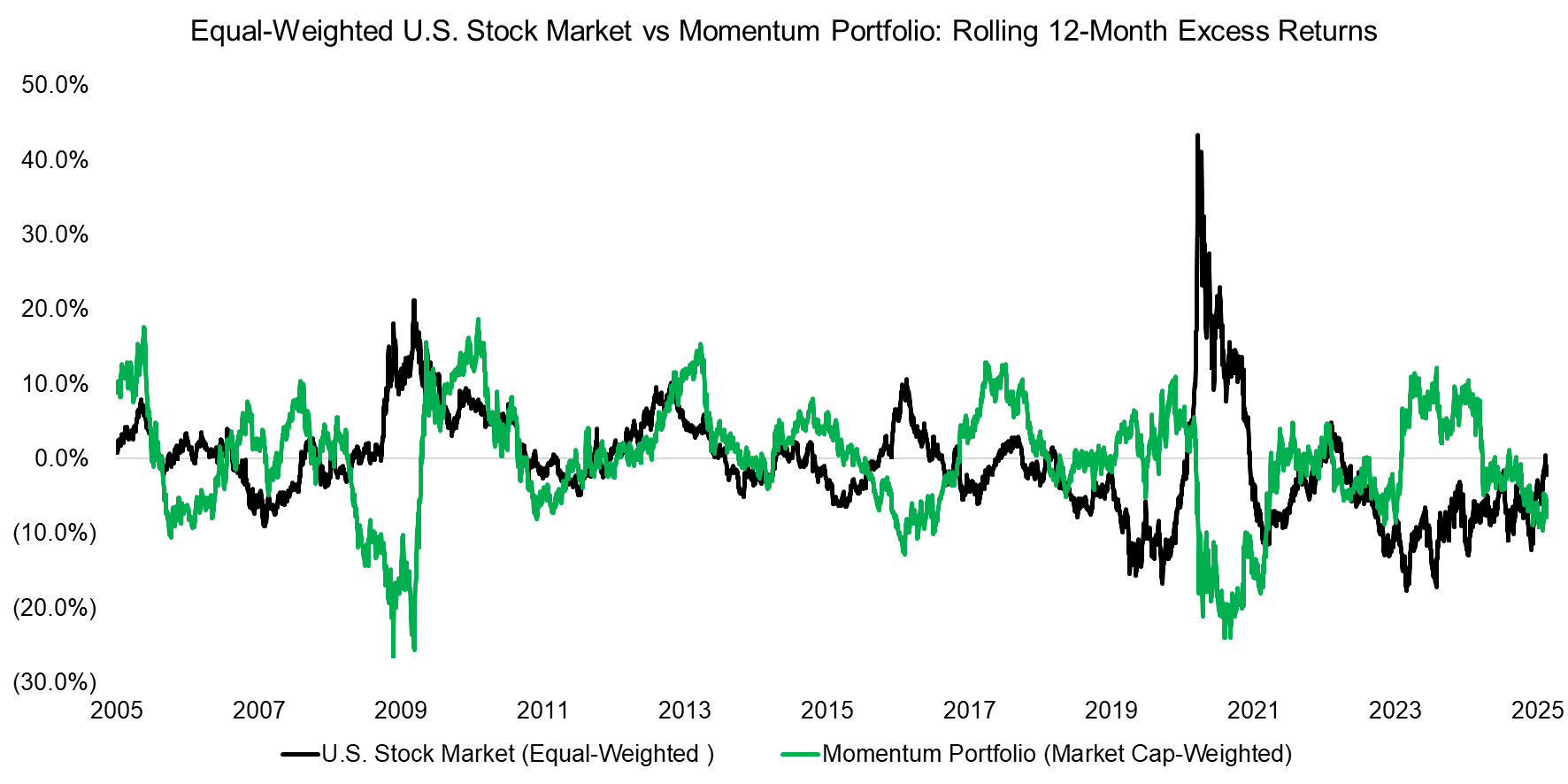
Source: Finominal
A returns-based factor exposure analysis of the equal-weighted U.S. equity market reveals several factor biases over the period from 2004 to 2026. In particular, the index exhibits positive exposure to the size and value factors, alongside negative exposure to momentum and quality. This outcome is intuitive, as many of the strongest performers in recent years, such as the Magnificent 7, have been highly profitable companies, but have lower weights in the equal-weighted index. Exposure to the low-volatility factor has been close to zero.
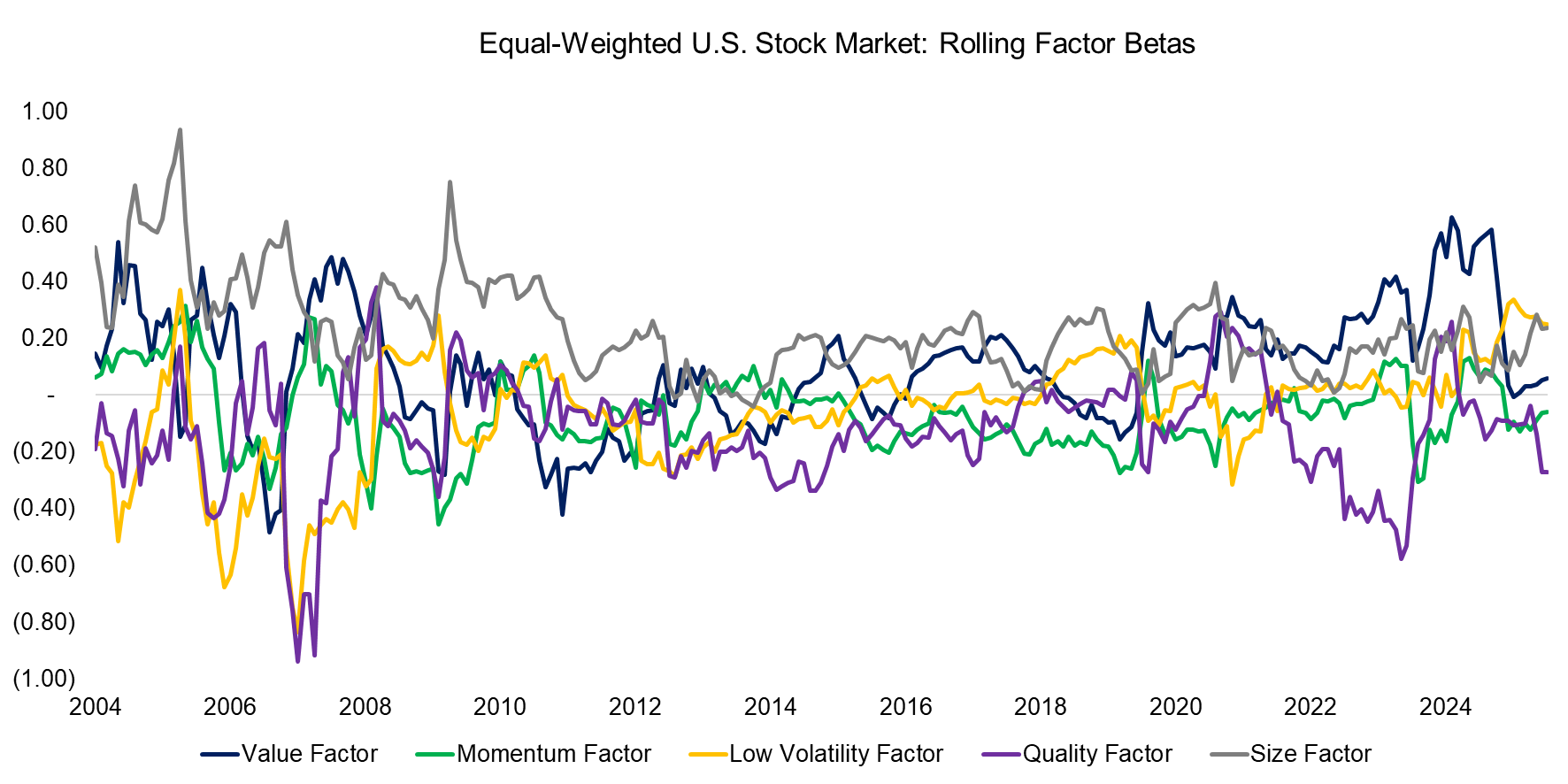
Source: Finominal
FURTHER THOUGHTS
Most investors assume that the market cap-weighted stock market exhibits strong momentum characteristics, but this is not the case, at least when measured by the academic momentum factor. This may seem counterintuitive, as investors often group growth, momentum, and large-cap stocks into a single category (read Cap-Weighted Benchmarks: Good Momentum Bets?).
As the outperformance of the equal-weighted stock market discussed in this article illustrates, it is possible to outperform even with negative momentum exposure.
RELATED RESEARCH
Equal versus Market Cap-Weighted Stock Market Indices
Cap-Weighted Benchmarks: Good Momentum Bets?
Equal vs Market Cap-Weighted Portfolios in Stock Market Crashes
The Juggernaut Index
The Fallacy of Betting on the Best Stock Market
Stock Selection versus Asset Allocation
What´s Better than the S&P 500?
Outperformance via Leverage
ABOUT THE AUTHOR
Nicolas Rabener is the CEO & Founder of Finominal, which empowers professional investors with data, technology, and research insights to improve their investment outcomes. Previously he created Jackdaw Capital, an award-winning quantitative hedge fund. Before that Nicolas worked at GIC and Citigroup in London and New York. Nicolas holds a Master of Finance from HHL Leipzig Graduate School of Management, is a CAIA charter holder, and enjoys endurance sports (Ironman & 100km Ultramarathon).
Connect with me on LinkedIn or X.