
Managed Futures vs Factor Investing: A 100-Year Perspective
Rethinking traditional asset allocation
June 2026. Reading Time: 10 Minutes. Author: Nicolas Rabener.
SUMMARY
- Managed futures generated higher returns than a simple market-neutral multi-factor portfolio
- Naturally, the factor selection matters
- Combining both generated the largest diversification benefits
INTRODUCTION
In our recent research report, Bonds vs. Managed Futures: A 100-Year Perspective, we showed that managed futures delivered significantly higher returns and lower drawdowns than U.S. government bonds over the past century. The contrast was particularly striking in real terms, where bonds suffered a 61% drawdown. These findings stand in sharp contrast to conventional asset allocation frameworks, in which bonds occupy a central role while managed futures remain largely absent.
The limited adoption of managed futures is especially puzzling given the extensive body of academic research supporting the strategy. A similar pattern can be observed in factor investing: investors frequently rely on evidence derived from long-short factor research, yet allocate predominantly to long-only implementations.
In this report, we examine the long-term performance of managed futures and market-neutral multi-factor investing over the past century.
PERFORMANCE OF MANAGED FUTURES VS MARKET-NEUTRAL MULTI-FACTOR INVESTING
To compare the long-term performance of managed futures and market-neutral multi-factor investing, we use a backtested managed futures index developed by AQR, which provides nearly 100 years of data. As the AQR index is available only through 2020, we extend the series using realized returns from the AQR Managed Futures Strategy Fund (AQMIX) thereafter.
For market-neutral multi-factor investing, we construct an equal-weighted portfolio of the long-short size, value, and momentum factors, rebalanced annually using data from the Kenneth R. French Data Library. Both indices are based on backtests that exclude transaction costs and therefore likely overstate realized returns.
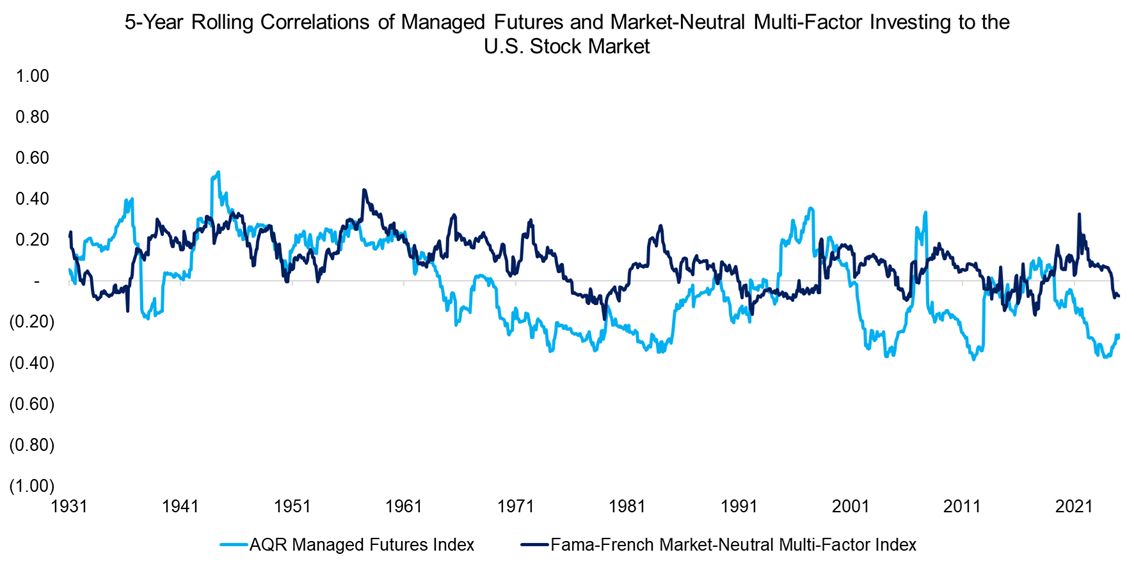
We begin by examining the correlations of both indices with the U.S. equity market. Managed futures exhibit a correlation close to zero, while the multi-factor portfolio shows a modest correlation of 0.17, underscoring their potential as effective diversifiers within equity portfolios. Importantly, the two strategies do not exhibit similar performance patterns, which further enhances their appeal when combined within an alternatives allocation (read Trend Following & Factor Investing – Unexpected Cousins?).
Source: AQR, Kenneth R. French Data Library, Finominal
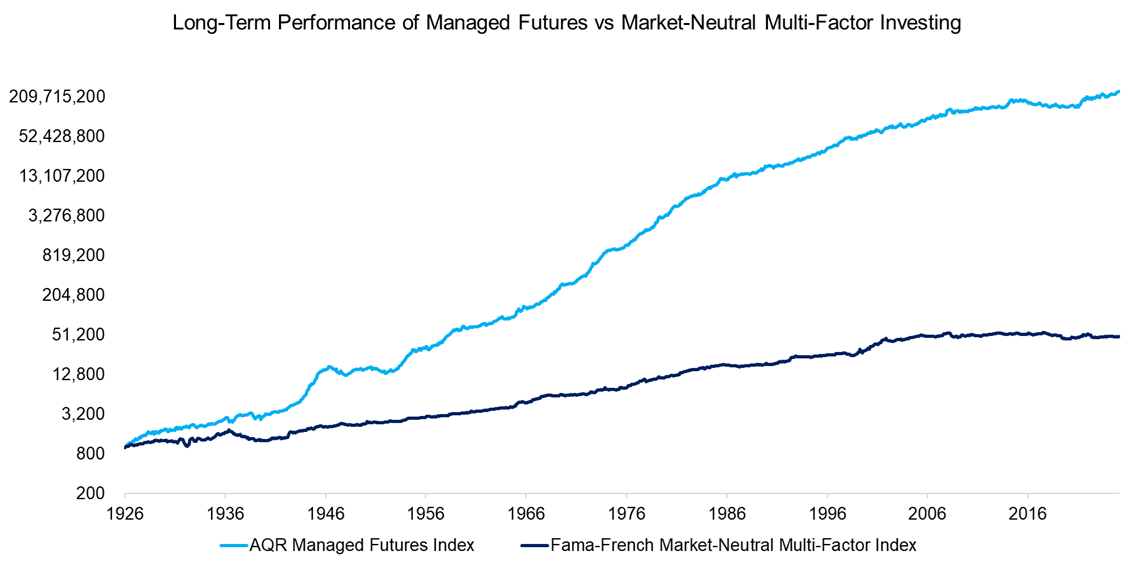
Next, we compare the performance of both strategies from 1926 to 2026. Managed futures delivered substantially higher returns than the multi-factor index, generating a CAGR of 13.2% versus 4.0% for the latter. While both strategies produced relatively consistent returns over time, managed futures achieved a significantly superior risk-adjusted profile, with a Sharpe ratio of 1.3 compared to 0.6 for factor investing.
Source: AQR, Kenneth R. French Data Library, Finominal
NOMINAL VS REAL RETURNS
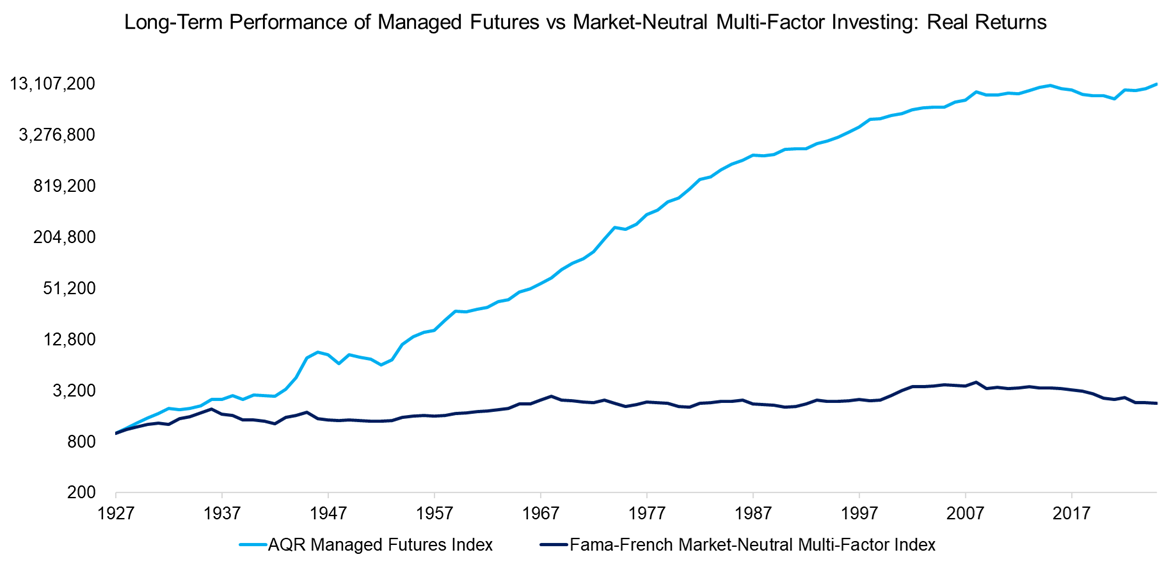
An annual return of 4.0% for the market-neutral multi-factor index may appear attractive in nominal terms, but historical periods of elevated inflation materially eroded those gains. For example, annualized inflation in the U.S. exceeded 10% during the 1970s. When adjusting both strategies for inflation, the performance of the multi-factor index effectively flatlines in real terms.
Source: AQR, Kenneth R. French Data Library, Finominal
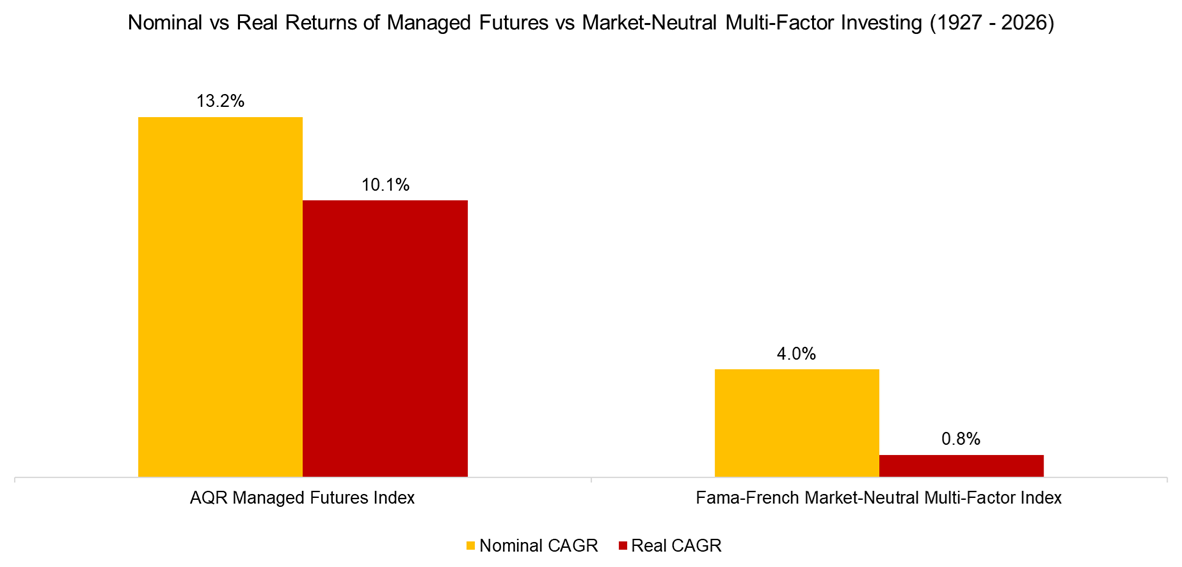
Inflation in the U.S. averaged approximately 3% between 1927 and 2026, reducing the CAGR of the managed futures index from 13.2% in nominal terms to 10.1% in real terms. In contrast, the return of the multi-factor index declines from 4.0% to just 0.8% after adjusting for inflation – and this is before accounting for transaction costs, market impact, and management fees. After incorporating these additional costs, the strategy’s real return would have been negative.
Source: AQR, Kenneth R. French Data Library, Finominal
ACTUAL VS BACKTESTED RETURNS
The 100-year return profile of the market-neutral multi-factor index – constructed from size, value, and momentum – has been poor. This outcome is largely driven by the size factor, which delivered a modest CAGR of 0.6% since 1926, compared to 3.5% for value and 6.0% for momentum. These three factors were selected primarily because they offer the longest available historical data, though extending the framework to include additional factors such as quality or low volatility – both of which have exhibited meaningfully higher historical returns – would present a more favorable view of factor investing (read Factor Investing Is Dead, Long Live Factor Investing!).
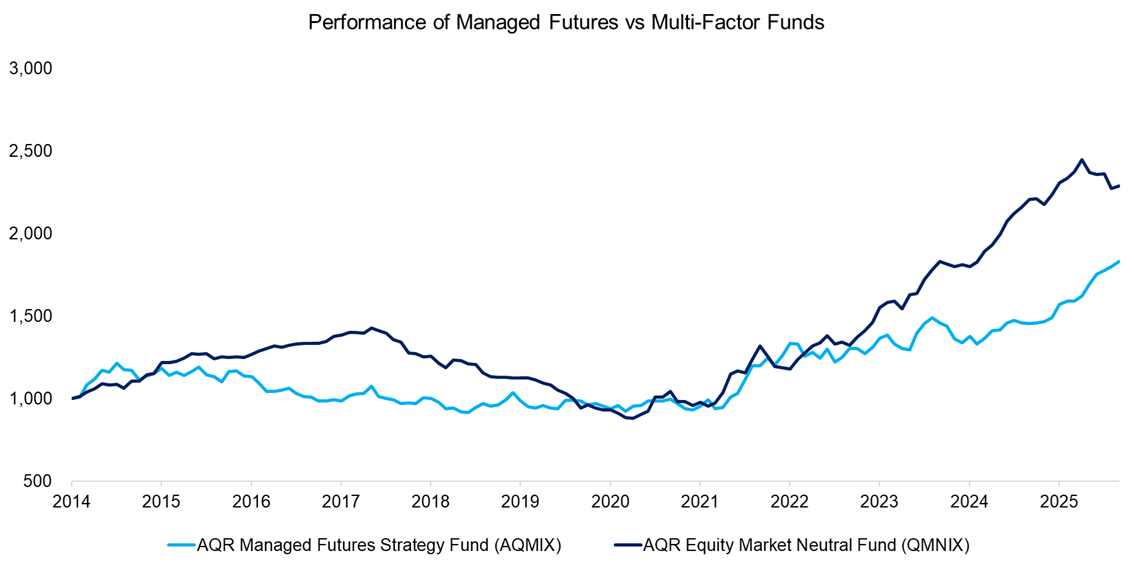
To move beyond long-term backtests and closer to implementable reality, we also compare live fund implementations. In particular, we contrast the AQR Managed Futures Strategy Fund (AQMIX) with the AQR Equity Market Neutral Fund (QMNIX), both of which are designed to closely reflect academically motivated investment strategies.
Over the period since 2014, the market-neutral multi-factor fund has delivered higher returns than the managed futures fund, in contrast with the 100-year horizon (read Managed Futures versus Market-Neutral Multi-Factor Investing).
Source: Finominal
QUANTIFYING DIVERSIFICATION BENEFITS
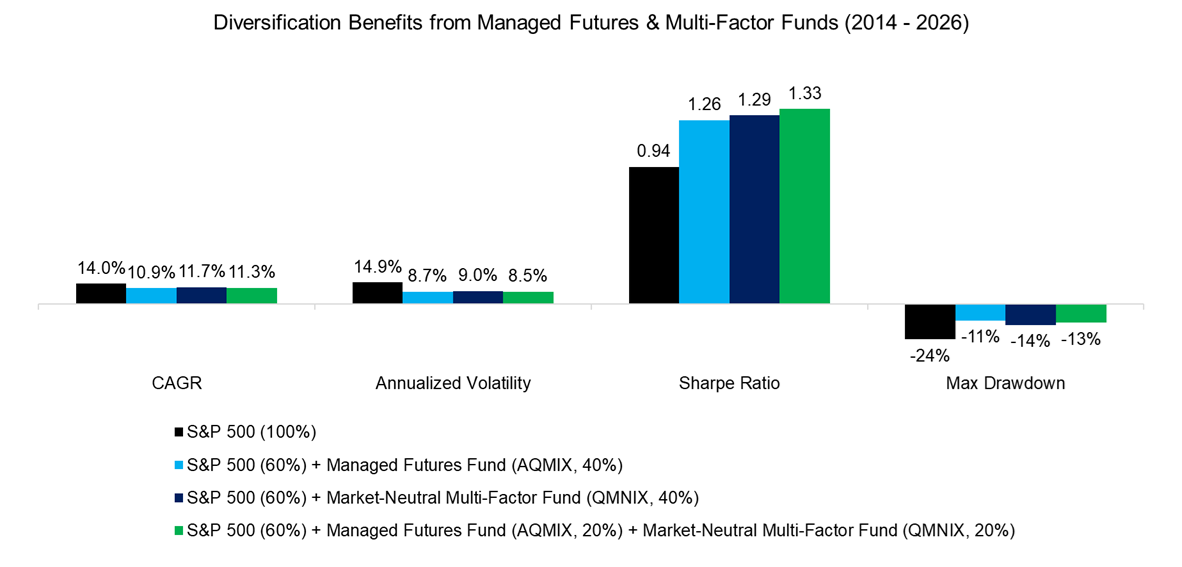
Investors may view the performance of the AQR managed futures and market-neutral multi-factor funds with mixed feelings over the 2014–2020 period, given the relatively weak absolute returns. However, because both strategies exhibit low correlation to equities, they still provide meaningful diversification benefits when combined with traditional portfolios.
While the combined allocation would have slightly reduced overall CAGR, the impact on volatility and maximum drawdowns would have been more pronounced, leading to materially improved Sharpe ratios. Importantly, the low correlation between managed futures and market-neutral factor strategies also means that diversification benefits are not redundant: the greatest improvement in portfolio efficiency is achieved when both strategies are held together, rather than in isolation.
Source: AQR, Kenneth R. French Data Library, Finominal
FURTHER THOUGHTS
The irony of academic research is that quant researchers work incredibly hard to identify strategies that generate alpha or diversification benefits, only to have them ultimately ignored by investors, as truly unique strategies often feel too alien to be implemented at scale.
Take momentum, for example, which can be implemented either as long-short trend following across asset classes or within equities. There is academic research spanning well beyond the 100 years covered by this article, yet total assets under management in managed futures funds are only about $350 billion and have barely changed over the past decade, according to data from BarclayHedge. Even more surprisingly, there is not a single fund that provides pure exposure to the long-short momentum factor.
It might be incredibly difficult to create value through stock selection, but not nearly as difficult with asset allocation.
RELATED RESEARCH
Bonds vs. Managed Futures: A 100-Year Perspective
Trend Following & Factor Investing – Unexpected Cousins?
Managed Futures versus Market-Neutral Multi-Factor Investing
Factor Investing Is Dead, Long Live Factor Investing!
60/40 Portfolios Without Bonds
Bonds versus CTAs for Diversification
How Much Should You Allocate to Managed Futures?
Combining Risk-Managed Equities and Managed Futures – II
Combining Risk-Managed Equities and Managed Futures
CTAs: With or Without Trend Following in Equities?
Carry versus Trend Following
Trend Following in Equities
Trend Following in Bear Markets
Replicating a CTA via Factor Exposures
Creating a CTA from Scratch – II
CTAs vs Global Macro Hedge Funds
Managed Futures: The Empire Strikes Back
Managed Futures: Fast & Furious vs Slow & Steady
Hedging via Managed Futures Liquid Alts
ABOUT THE AUTHOR
Nicolas Rabener is the CEO & Founder of Finominal, which empowers professional investors with data, technology, and research insights to improve their investment outcomes. Previously he created Jackdaw Capital, an award-winning quantitative hedge fund. Before that Nicolas worked at GIC and Citigroup in London and New York. Nicolas holds a Master of Finance from HHL Leipzig Graduate School of Management, is a CAIA charter holder, and enjoys endurance sports (Ironman & 100km Ultramarathon).
Connect with me on LinkedIn or X.