Quantifying Survivorship Bias in Hedge Fund Indices
How large is it?
June 2026. Reading Time: 10 Minutes. Author: Nicolas Rabener.
SUMMARY
- The survivorship bias of liquid alts is approximately 1% pa
- However, this ranges dramatically across hedge fund strategies
- It rises up to 4% for offshore hedge funds
INTRODUCTION
Equity market neutral funds are supposed to provide uncorrelated returns and diversification benefits to traditional portfolios. However, HedgeIndex’s Equity Market Neutral Index fell by 40% in November 2008 during the global financial crisis – exactly when investors needed diversification the most.
Such a decline is highly unusual for an index, as these are typically composed of multiple funds which themselves represent diversified portfolios. In this case, the index weights constituents by assets under management, and the largest equity market neutral fund at the time was Madoff’s fund, which was liquidated after his Ponzi scheme collapsed.
Should HedgeIndex have removed the fund given its fraudulent nature? Some might argue yes, but the reality is that investors lost billions of dollars – the losses were real. Although the episode portrays equity market neutral funds in a poor light, HedgeIndex’s methodology ensures survivorship bias is minimized. Eurekahedge, another index provider, by contrast, adjusts historical index values when new funds are added. Since only funds with strong performance seek inclusion in a hedge fund index, this directly introduces backfill bias. In practice, allocators should treat Eurekahedge’s indices with caution, as they overstate returns and understate risks.
In this article, we quantify the survivorship bias across hedge fund indices.
LIVE VS DELISTED HEDGE FUNDS
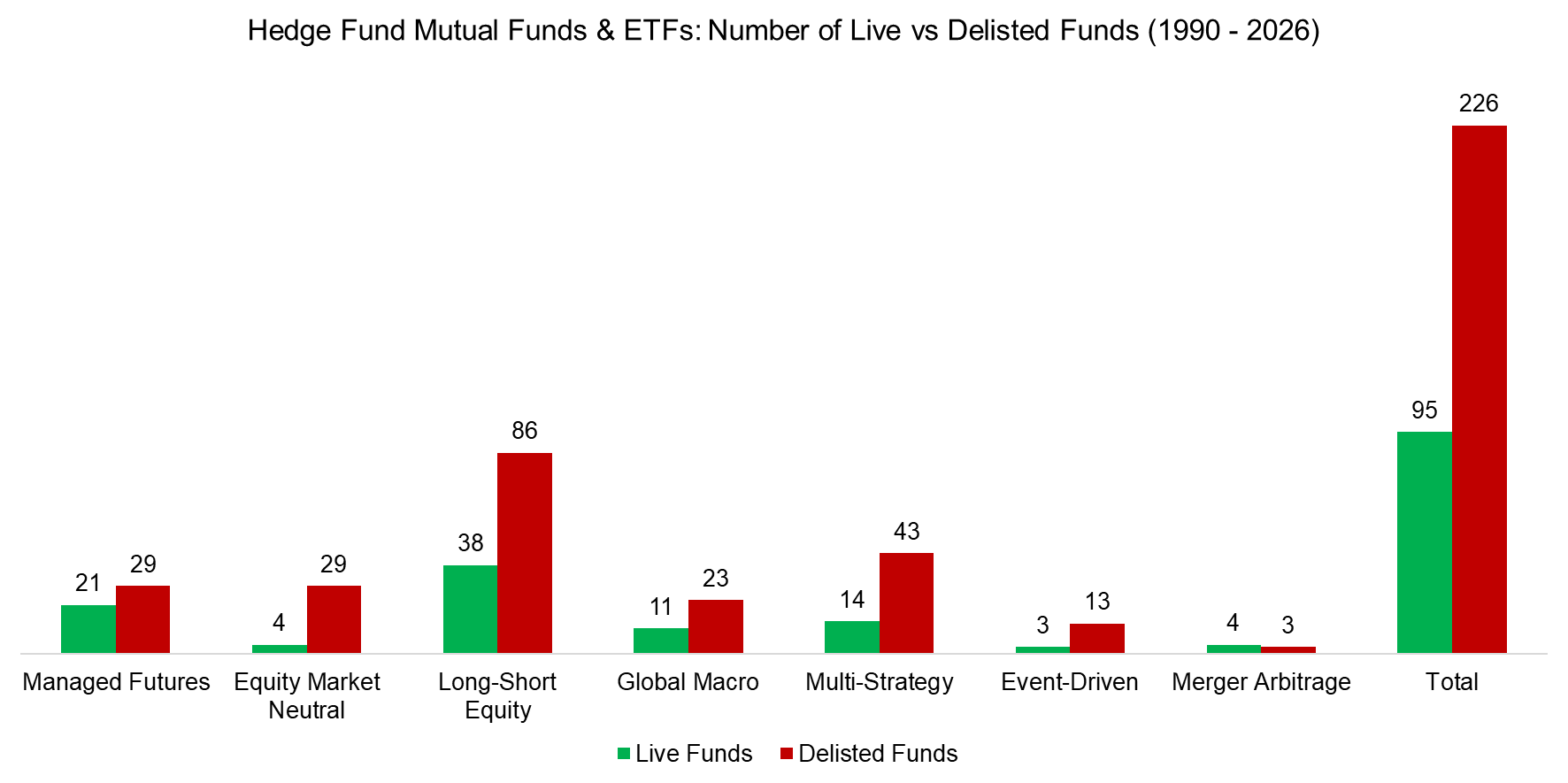
We focus on publicly traded hedge funds trading as mutual funds or ETFs in the U.S. market across the following strategies: managed futures, equity market neutral, long-short equity, global macro, multi-strategy, event driven, and merger arbitrage. After removing duplicate share classes, the universe contains 321 funds from 1990 to 2026. Of these, only 95 remain active today – meaning 70% have been liquidated, highlighting the challenges of running a hedge fund business.
CORRELATION ANALYSIS
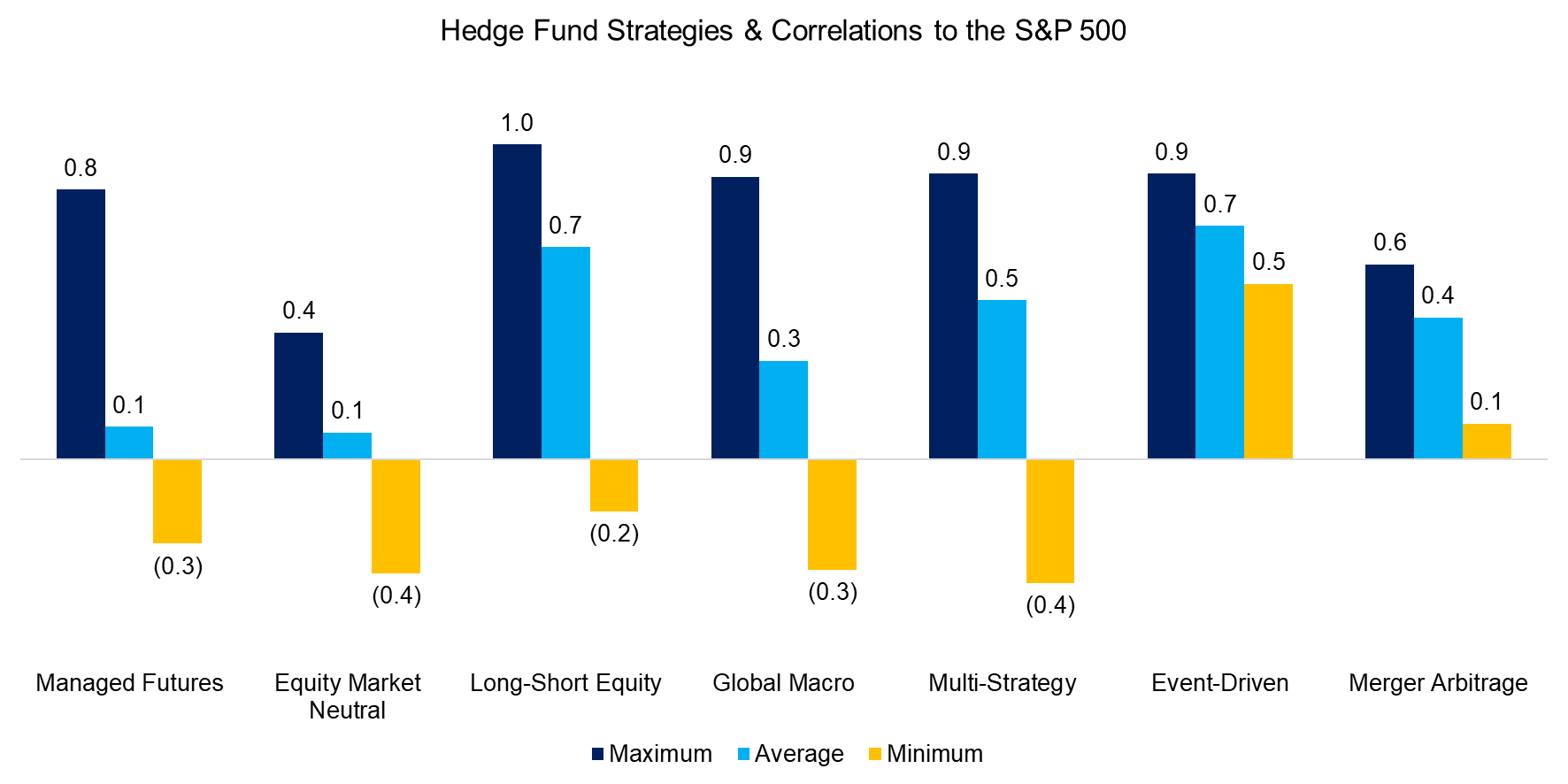
We compute correlations to the S&P 500 and observe large ranges between the maximum and minimum correlations within each strategy. Furthermore, long-short equity, multi-strategy, and event-driven funds feature average correlations above 0.5, indicating limited hedging and diversification benefits. Managed futures and equity market neutral funds feature the lowest correlations, as expected given their mandates.
QUANTIFYING THE SURVIVORSHIP BIAS
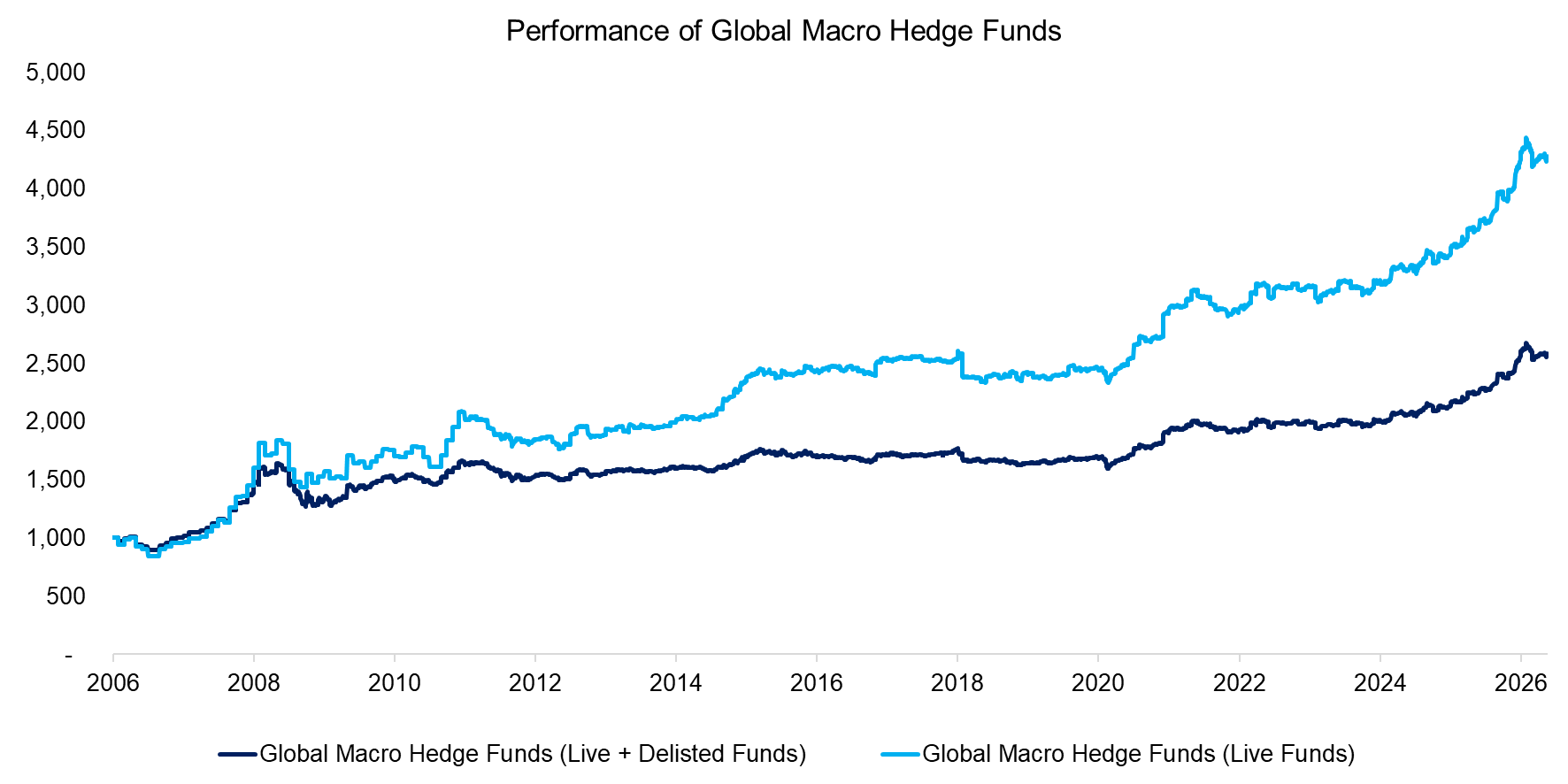
We construct two indices for each hedge fund strategy: one comprised of live, currently trading funds, and another including both live and delisted funds. Funds are equally weighted within each index.
Taking global macro hedge funds as an example, we observe a significant performance discrepancy between the two indices. The first fund liquidations occurred in 2008, after which the index comprising surviving funds shows relatively consistent returns, while the index including delisted funds shows considerably less attractive performance – illustrating the impact of survivorship bias in practice.
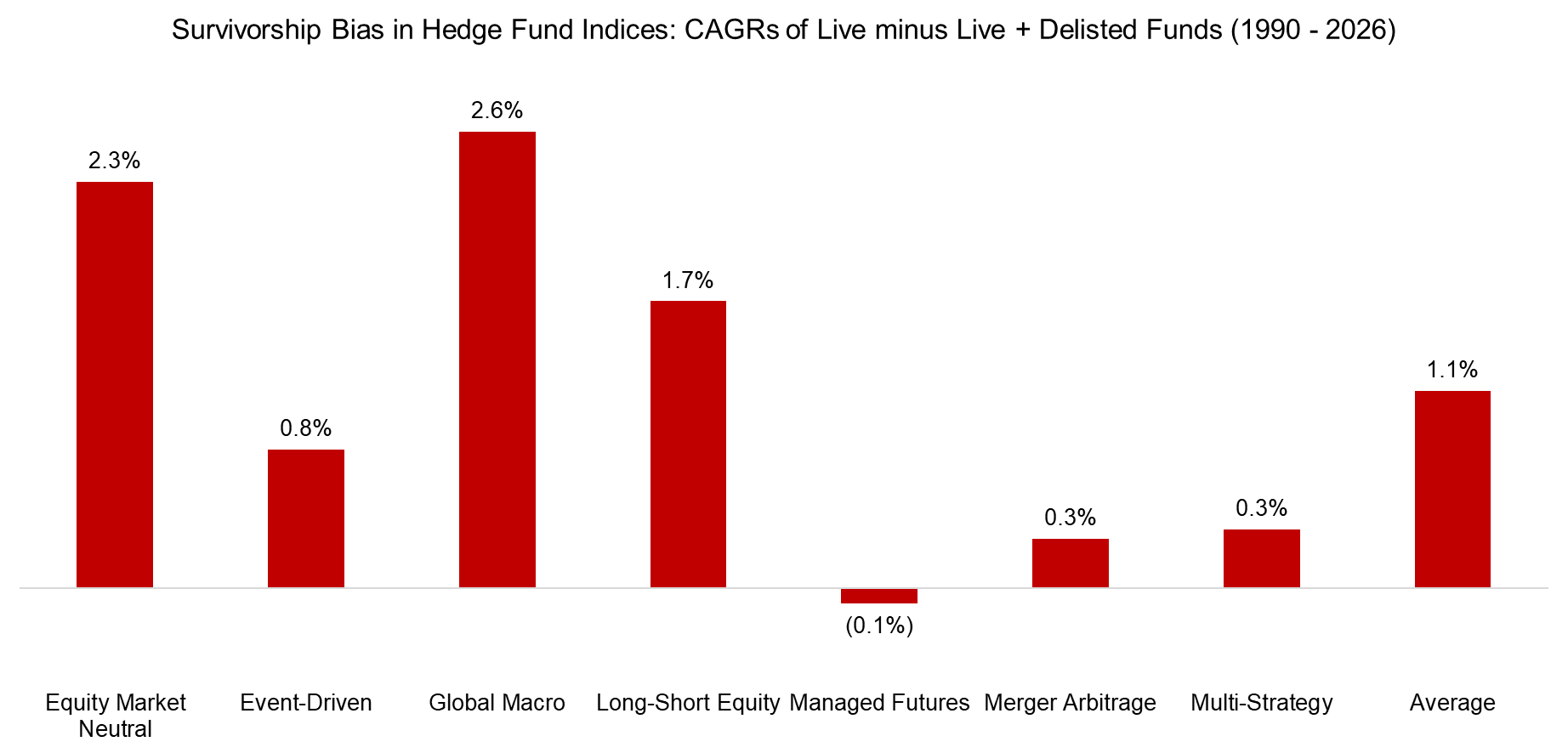
Finally, we compute the difference in CAGRs between the live and live-plus-delisted indices, which represents the survivorship bias embedded in each strategy. On average, this amounts to 1.1%, ranging from -0.1% for managed futures to 2.6% for global macro funds. The variation across strategies can be attributed to differences in heterogeneity – strategies such as global macro and equity market neutral tend to be more diverse in their approaches, leading to greater return dispersion and a higher rate of fund liquidations.
FURTHER THOUGHTS
Existing research on survivorship bias in hedge fund indices – including Ackermann, McEnally & Ravenscraft (1999), Liang (2000), Fung & Hsieh (2000), and Brown, Goetzmann & Ibbotson (1999) – has quantified it at between 2% and 3% per annum. More recent research by Malkiel & Saha (2005) estimates it at 4.4% per annum, which is significantly higher than our findings. However, most of these studies focus on offshore hedge funds, which tend to be riskier and more heterogeneous than mutual funds, likely explaining the higher estimates.
Either way, investors should treat hedge fund indices with caution. No database provider can compel fund managers to report returns, which means all hedge fund indices are subject to some degree of survivorship bias – and by extension, tend to overstate the return potential of these.
RELATED RESEARCH
Quant Strategies: Theory vs Reality
Managed Futures vs Factor Investing: A 100-Year Perspective
Bonds vs. Managed Futures: A 100-Year Perspective
Return vs Diversification: What Matters More?
Alts: Volatility Is Not Your Enemy
60/40 vs Leveraged Diversified Portfolio
How to Combine Alternative Strategies
Are Liquid Alts more than Diluted Equity Funds?
Myth Busting: Alts’ Uncorrelated Returns Diversify Portfolios
Are Alternative ETFs Good Diversifiers?
Market Neutral Hedge Funds: Diversification or Overpriced Beta?
Market Neutral Hedge Funds: Powered by Beta?
Multi-Strategy Hedge Funds & Replication ETFs
Multi-Strategy Hedge Funds: Jack of All Trades?
Multi-Strategy Hedge Funds: Equity in a Different Shade?
Global Macro: Masters of the Universe?
Merger Arbitrage: Arbitraged Away?
Hedge Fund ETFs
Replicating Famous Hedge Funds
A Horse Race of Liquid Alternatives
Liquid Alternatives: Alternative Enough?
Hedging Bear Markets & Crashes with Tail Risk ETFs
Tail Risk Hedge Funds
ABOUT THE AUTHOR
Nicolas Rabener is the CEO & Founder of Finominal, which empowers professional investors with data, technology, and research insights to improve their investment outcomes. Previously he created Jackdaw Capital, an award-winning quantitative hedge fund. Before that Nicolas worked at GIC and Citigroup in London and New York. Nicolas holds a Master of Finance from HHL Leipzig Graduate School of Management, is a CAIA charter holder, and enjoys endurance sports (Ironman & 100km Ultramarathon).
Connect with me on LinkedIn or X.