
Return vs Diversification: What Matters More?
The more diversified, the lower the return expectation
May 2026. Reading Time: 10 Minutes. Author: Nicolas Rabener.
SUMMARY
- Diversifying strategies do not need to feature high returns
- Lower correlations are more valuable than higher returns
- Low correlations are preferable to negative correlations
INTRODUCTION
Almost every investor desires higher returns and is willing to bet on active fund managers to achieve these. However, most fund managers fail to beat their benchmarks, making this an expensive fool’s game for most investors. If the returns of the S&P 500 are not high enough, why not simply buy a leveraged version of it?
The ProShares Ultra S&P 500 (SSO) aims to deliver 2x the returns of the S&P 500, but investors have entrusted it with only $7bn in assets. In contrast, the State Street SPDR S&P 500 ETF Trust (SPY) manages $700bn. Given all the performance chasing, the total assets in leveraged ETFs in the U.S. are estimated to be less than 1% of the entire stock market, which is surprisingly low (read Outperformance via Leverage).
Naturally leveraged ETFs have inherent weaknesses, such as high fees and negative compounding due to daily resets. However, SSO has generated a CAGR of 15.3% vs 11.2% for SPY over the last 20 years. Using leverage also implies that there is more capital available for diversifying strategies, as the equity allocation can be reduced (read 60/40 vs Leveraged Diversified Portfolio).
One question that frequently arises is how high the return expectations for the diversifying strategies should be, which we explore in this article.
LIMITED VS HIGHLY DIVERSIFYING STRATEGIES
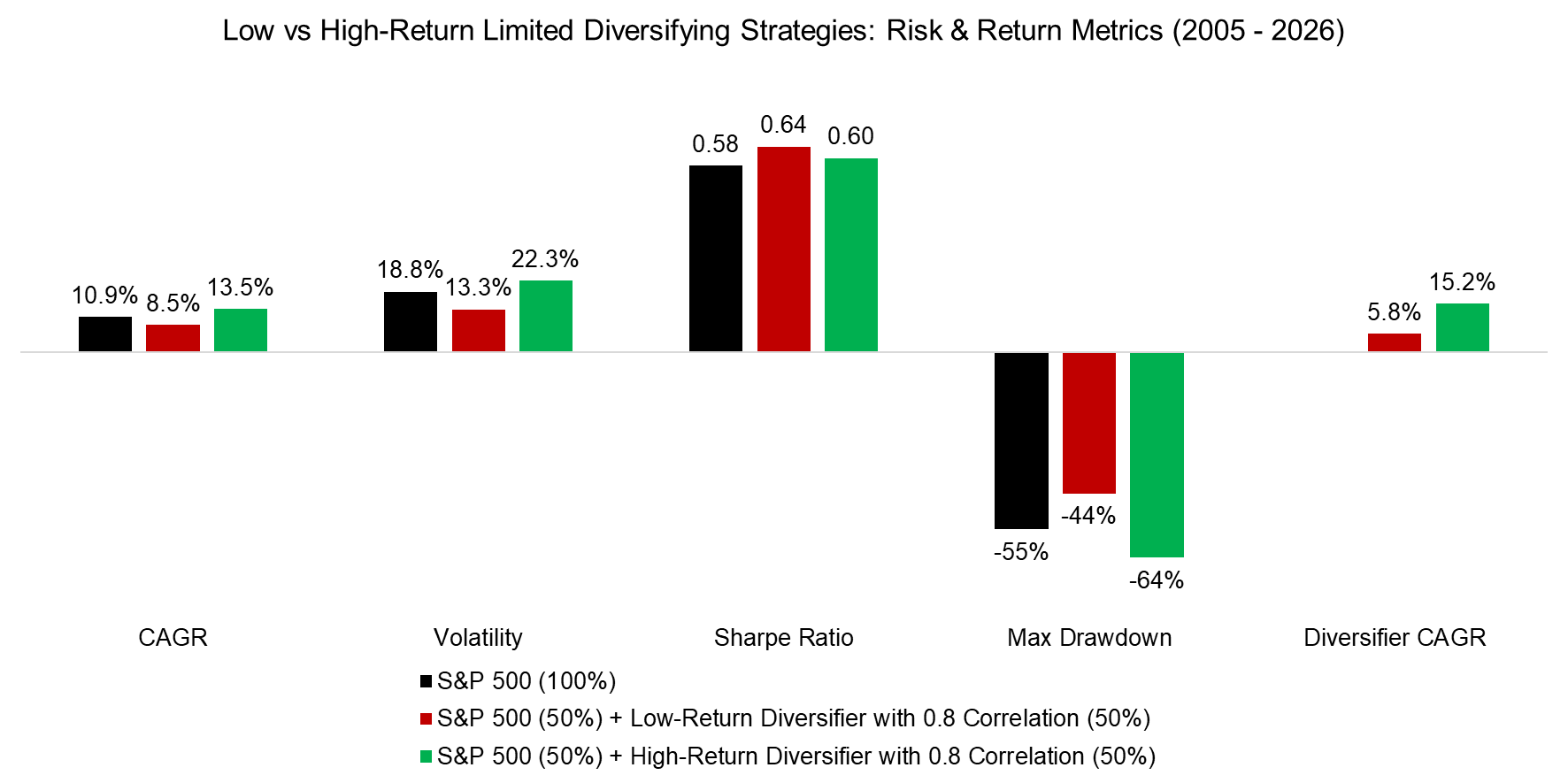
We use the S&P 500 index as the core portfolio over the period from 2005 to 2026. We first simulate adding a 50% allocation to a diversifying strategy with a 0.8 correlation to the S&P 500, considering two variations: a high-return and a low-return diversifier. We find that the low-return diversifier would have reduced returns, volatility, and maximum drawdown, as expected by construction, while the high-return diversifier would have increased all three. Both strategies would have improved the Sharpe ratio, though the improvement would have been more pronounced for the low-return diversifier.
Source: Finominal
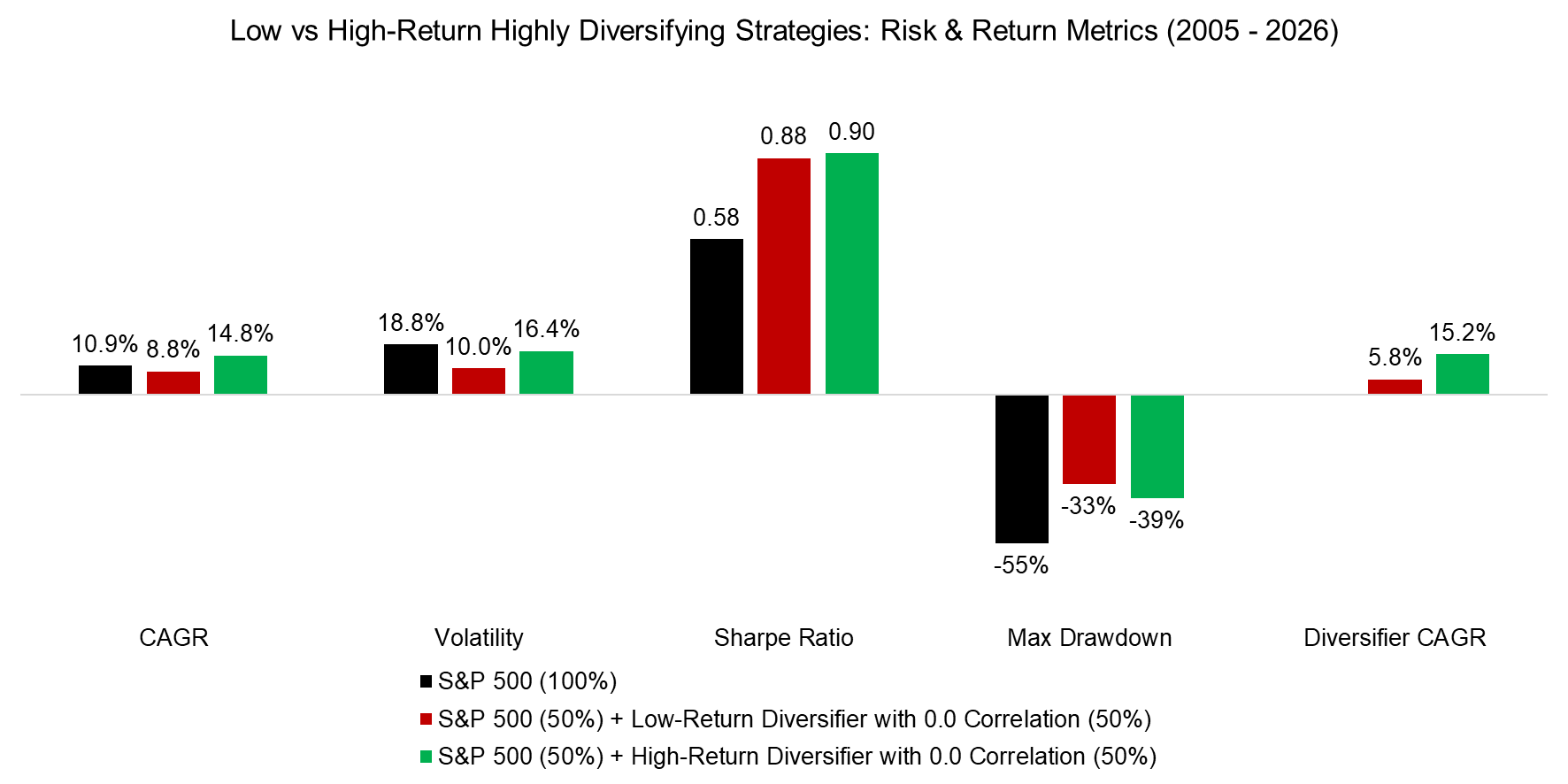
Next, we move from a limited to a highly diversifying strategy, where the correlation to the S&P 500 is 0 rather than 0.8. The CAGR of the high- and low-return strategies remains the same, at 15.2% and 5.8%, respectively. Adding these strategies increases returns slightly compared to the limited diversification case, but it significantly reduces volatility. This results in a substantial increase in Sharpe ratios.
However, there is no meaningful difference in risk-adjusted returns of the combined portfolios between the two diversifying strategies. This is interesting, as it shows that low-return strategies can achieve similar Sharpe ratio improvements to high-return ones, provided their correlation with equities is sufficiently low.
Source: Finominal
RETURNS VS CORRELATIONS
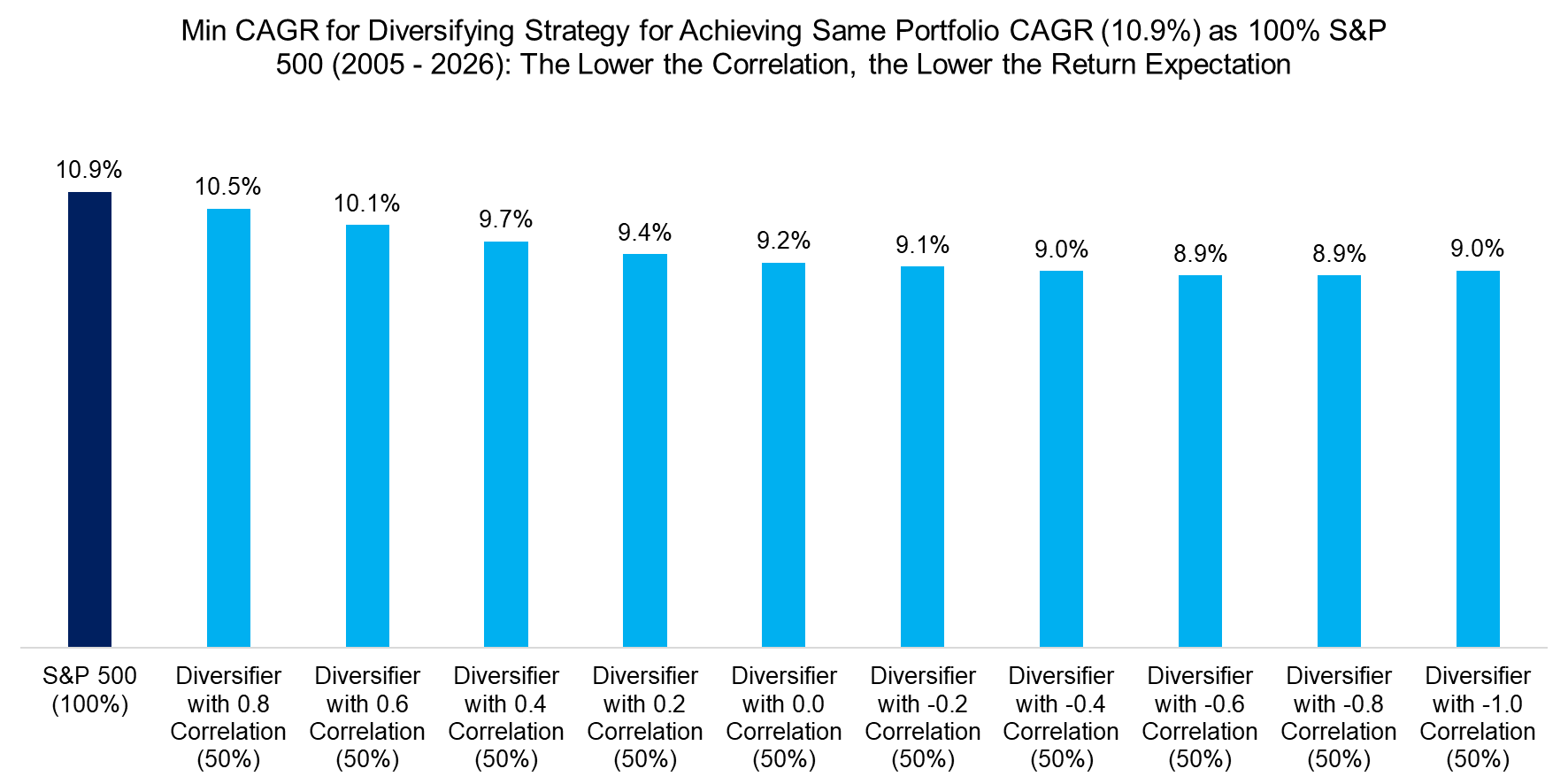
We can simulate the relationship between returns and the correlation of diversifying strategies. We construct 10 strategies with correlations ranging from 0.8 to -1.0 relative to the S&P 500. The U.S. stock market generated a CAGR of 10.9% between 2005 and 2026, and we calculate the required returns for each diversifying strategy so that the combined portfolio also achieves a 10.9% CAGR.
We observe a decline from 10.5% for a strategy with 0.8 correlation to approximately 9% when the correlation reaches zero. Beyond this point, the required return does not continue to decline, as increasingly negative correlations lead to more pronounced return offsetting between the diversifying strategy and equities rather than additional diversification benefits.
Source: Finominal
We aim to achieve the same return as the S&P 500 when adding diversifying strategies with steadily decreasing correlations. As shown, the lower the correlation, the lower the return required from the diversifying strategy to maintain the same overall portfolio return.
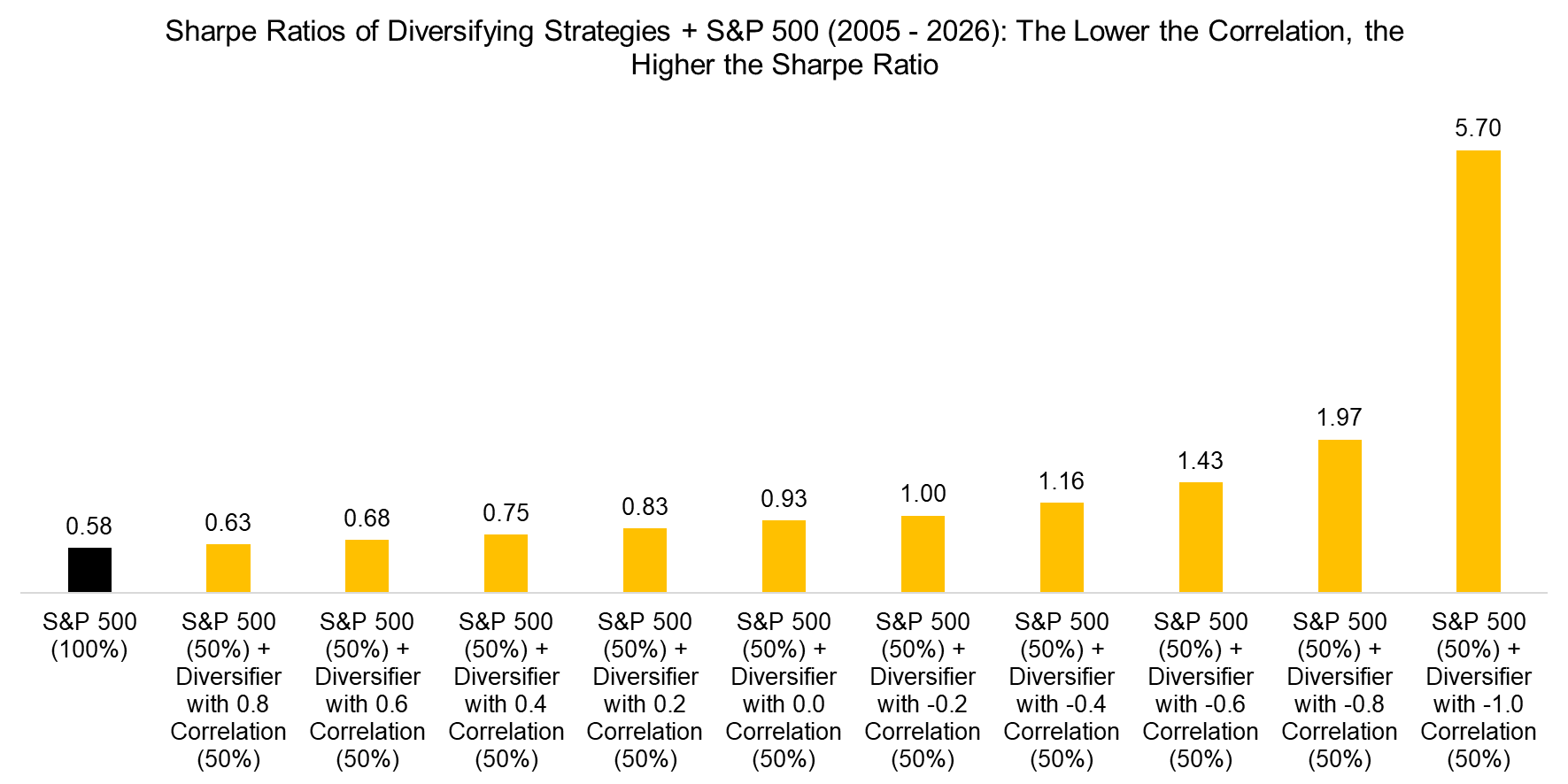
However, the more meaningful effect emerges when looking at risk-adjusted returns, which increase almost linearly from 0.58 for the equity-only portfolio over 2005 to 2026 to an unusually high 5.7 in the most diversified case.
Source: Finominal
FURTHER THOUGHTS
Although there are strategies that are close to perfectly negatively correlated with equities, i.e. tail risk strategies, these are generally not desirable on a standalone basis. The global stock market has increased steadily over centuries, and structurally betting against this long-term trend has been a losing proposition. Tail risk strategies may only add value in the narrow context of anticipating market crashes, but reliable market timing is extremely difficult in practice (read Tail Risk Hedge Funds).
In contrast, allocating to strategies with low correlation to equities can be highly beneficial. As this analysis shows, the required return expectations for such allocations can be quite modest while still delivering meaningful diversification benefits.
RELATED RESEARCH
Outperformance via Leverage
Tail Risk Hedge Funds
Alts: Volatility Is Not Your Enemy
60/40 vs Leveraged Diversified Portfolio
Diversification versus Hedging II
Diversification versus Hedging
Finding Funds with Diversification Potential
Downside Betas vs Downside Correlations
ABOUT THE AUTHOR
Nicolas Rabener is the CEO & Founder of Finominal, which empowers professional investors with data, technology, and research insights to improve their investment outcomes. Previously he created Jackdaw Capital, an award-winning quantitative hedge fund. Before that Nicolas worked at GIC and Citigroup in London and New York. Nicolas holds a Master of Finance from HHL Leipzig Graduate School of Management, is a CAIA charter holder, and enjoys endurance sports (Ironman & 100km Ultramarathon).
Connect with me on LinkedIn or X.