
Risk-Managed Equity Exposure IV
Reduced drawdowns vs lower returns
April 2026. Reading Time: 10 Minutes. Author: Nicolas Rabener.
SUMMARY
- Simple risk-on / risk-off rules have been effective for reducing risk
- However, the most recent decade was the worst environment for such strategies
- Few investors have the stamina to stick to these
INTRODUCTION
The 250-day moving average is arguably the most widely used technical rule for rotating among asset classes. Its implementation can be as simple as switching between risk-on and risk-off instruments – such as the S&P 500 and Treasury bills – or as complex as creating a diversified portfolio of long and short positions across hundreds of assets, as seen in managed futures strategies (please read Combining Risk-Managed Equities and Managed Futures – II).
Deploying a simple risk-on / risk-off framework requires little infrastructure or technical sophistication. Most investors do not need a fund manager to implement their strategy, yet a fund may offer tax advantages.
Interestingly, given the popularity of this rule, relatively little capital is invested in these strategies. The largest fund in this category, the Pacer Trendpilot US Large Cap ETF (PTLC), manages only about $3 billion in assets. In total, tactical asset allocation ETFs in the U.S. hold less than $10 billion – minuscule compared to the roughly $70 trillion U.S. equity market (please read Risk-Managed Equity Exposure III).
If these strategies are so effective, why hasn’t more capital flowed into them? This article explores the possible reasons.
PERFORMANCE OF RISK-MANAGED EQUITIES IN THE U.S.
First, we simulate the performance of a simple risk-on / risk-off strategy using the U.S. stock market and U.S. Treasury bills. The data is sourced from the Kenneth R. French Data Library. The approach switches from equities to T-bills whenever the 250-day moving average turns negative. Signals are implemented with a one-day delay, transaction costs are ignored, and the portfolio is rebalanced quarterly.
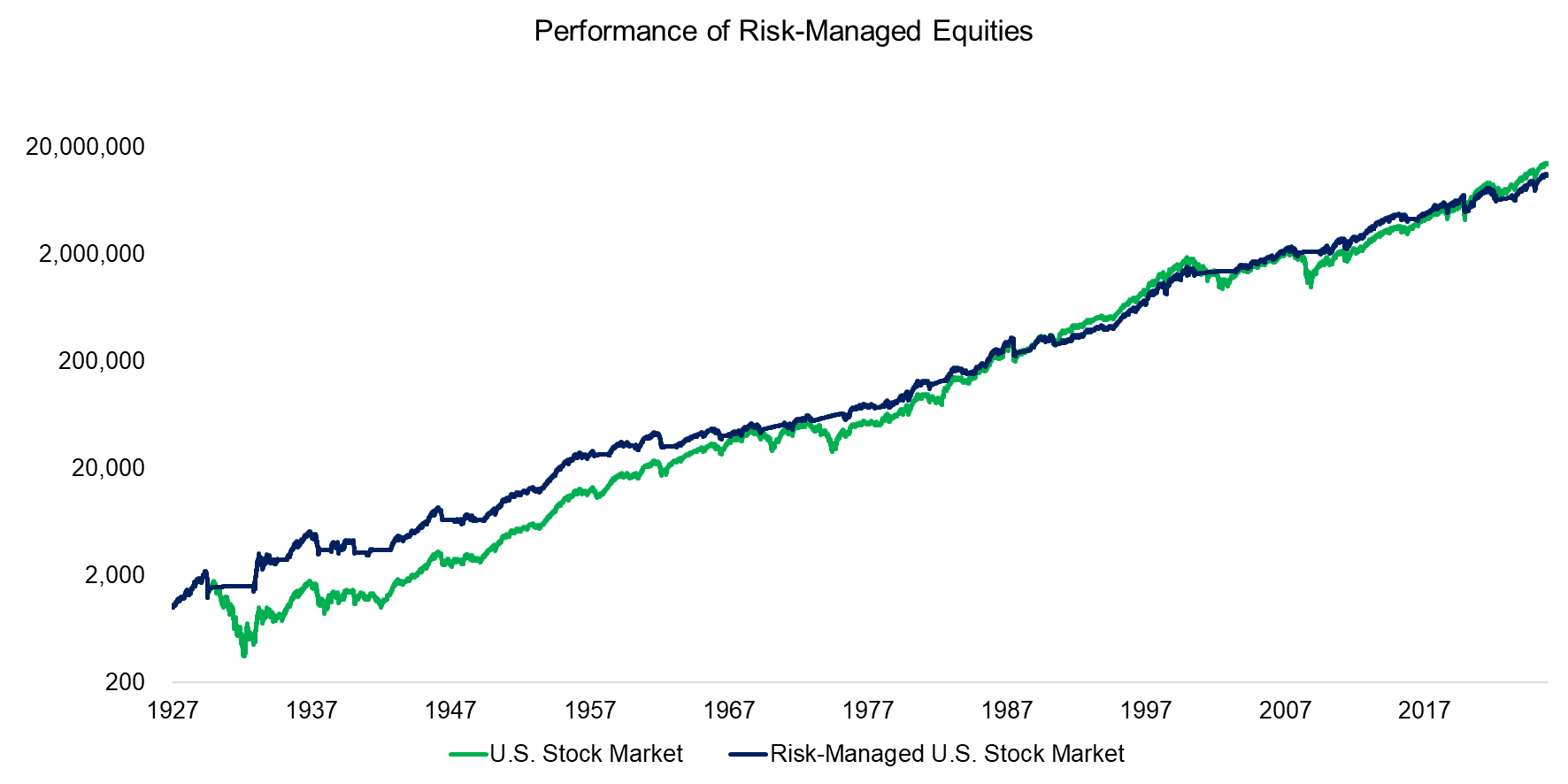
Looking at the past century (1927 – 2026), the risk-managed strategy delivers a total return broadly comparable to that of the U.S. equity market (9.9% vs. 10.1%). However, it does so with meaningfully lower volatility – 13% compared to 17.1% – and a significantly smaller maximum drawdown of -44% versus -84% for equities.
Source: Kenneth R. French Data Library, Finominal
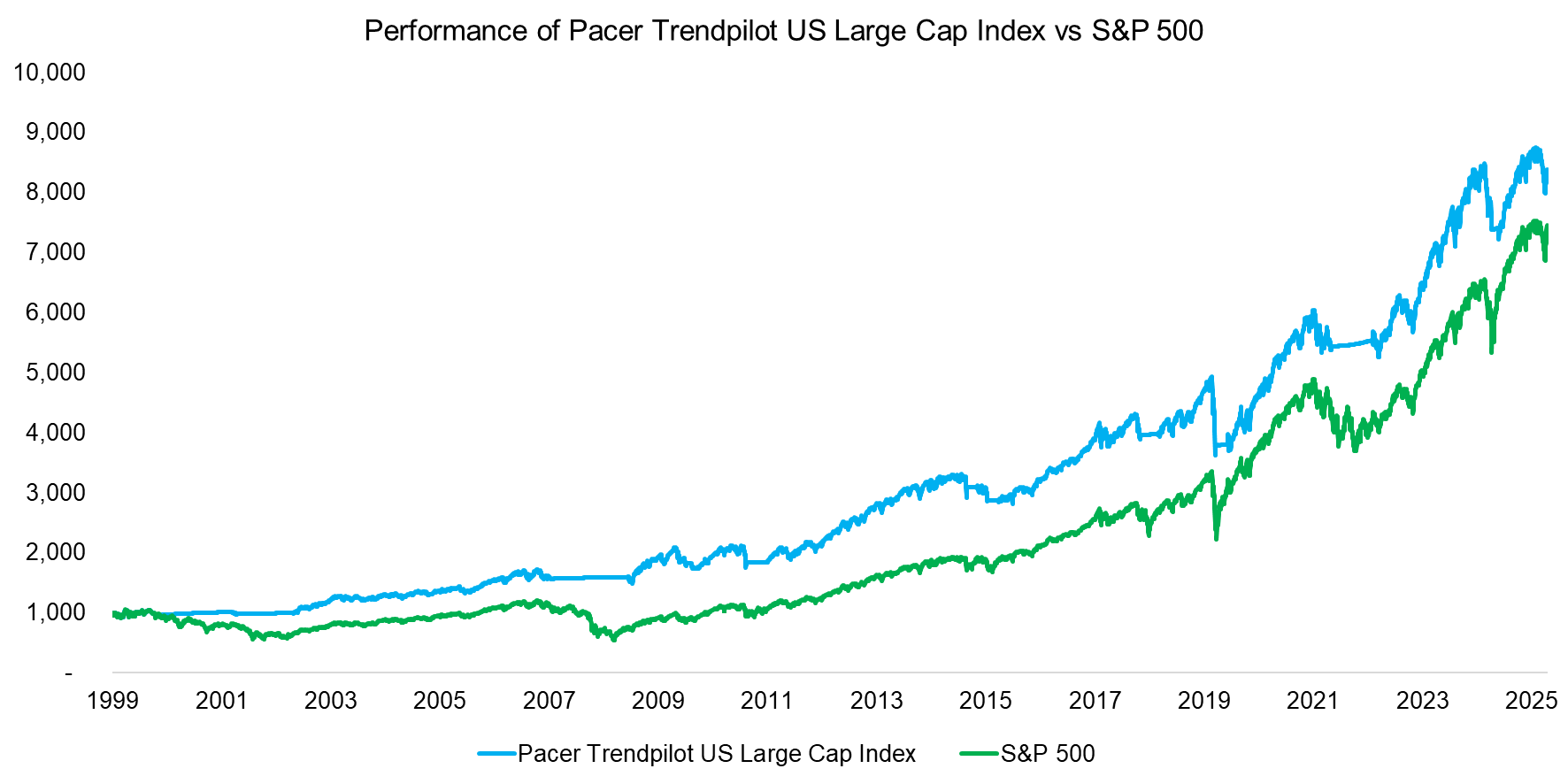
Pacer’s PTLC was only launched in 2015, but the underlying index has been backtested to 1999. The ETF follows a rules-based trend strategy that adjusts its exposure to U.S. equities based on the S&P 500’s 200-day moving average. When the market is in an uptrend, the fund is fully invested in equities; in weaker conditions, it splits exposure between stocks and Treasury bills; and during downtrends, it shifts fully into Treasury bills.
The fund charges a 0.60% annual management fee, which is expensive given the simplicity of the underlying strategy. However, the corresponding index has outperformed the S&P 500 since 1999, both on an absolute basis (8.4% vs. 7.9%) and on a risk-adjusted basis (0.68 vs. 0.41). Notably, the strategy largely sidestepped the major drawdowns of the early 2000s tech bubble collapse and the 2007–2008 global financial crisis. Over the full period, it experienced a maximum drawdown of -26%, compared to -55% for the S&P 500.
Source: Finominal
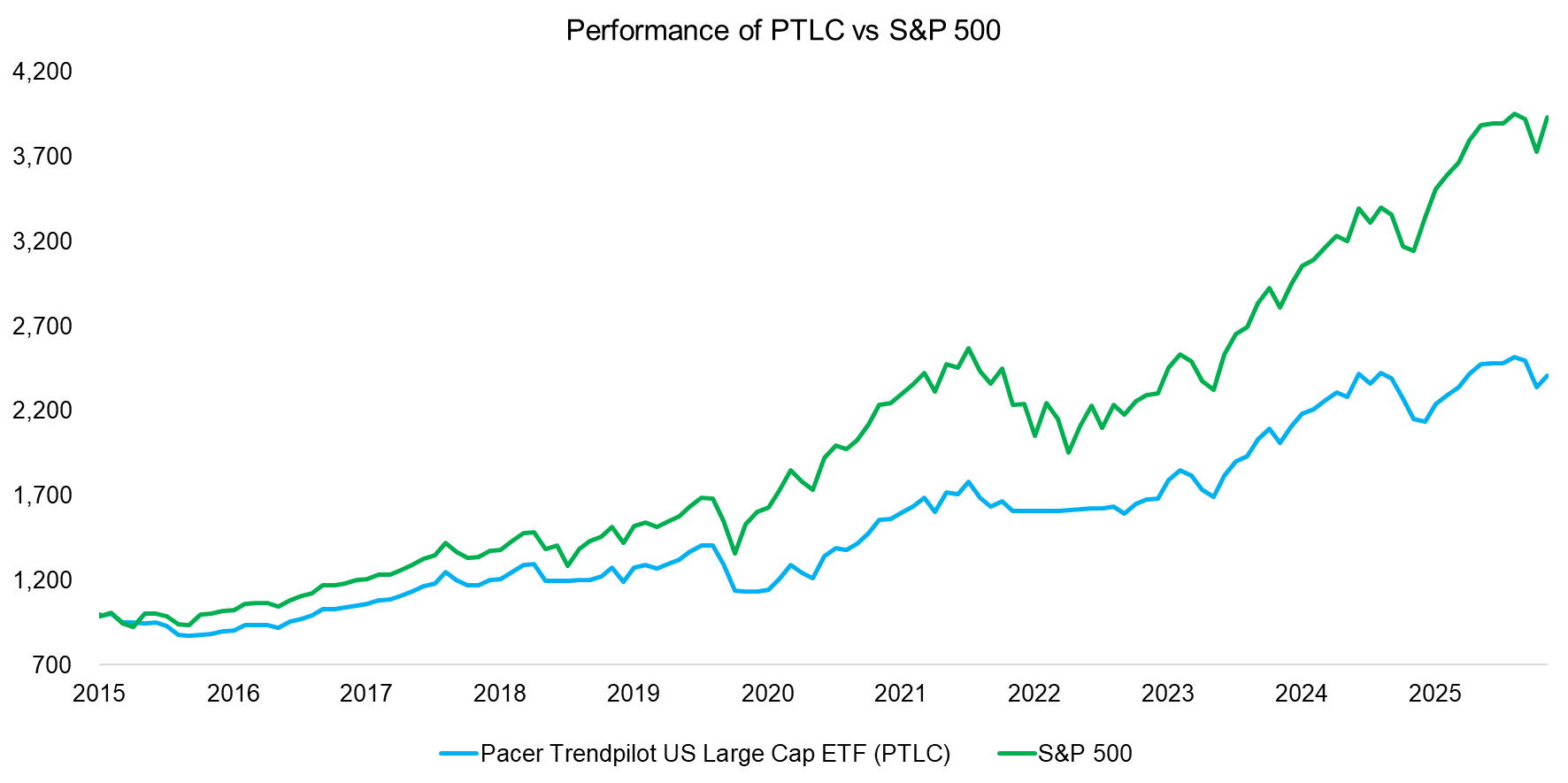
Although the long-term performance of the index tracked by PTLC appears attractive, the ETF itself has delivered weaker results in recent years, with a CAGR of 8.4% versus 13.5% for the S&P 500 between 2015 and 2026. Risk-adjusted performance has also lagged, with a Sharpe ratio of 0.71 compared to 0.89 for the S&P 500, and there has been no meaningful improvement in maximum drawdowns.
The past decade underscores the challenges of such tactical strategies. While they can help mitigate prolonged, grinding bear markets, they are far less effective at avoiding sharp, abrupt selloffs such as the COVID-19 crash in 2020. Adding to this, markets repeatedly snapped back on policy intervention over the last decade, leaving tactical rules to rotate into defensive assets at precisely the point when they should have stayed invested.
Source: Finominal
THE CHALLENGES OF TACTICAL ASSET ALLOCATION
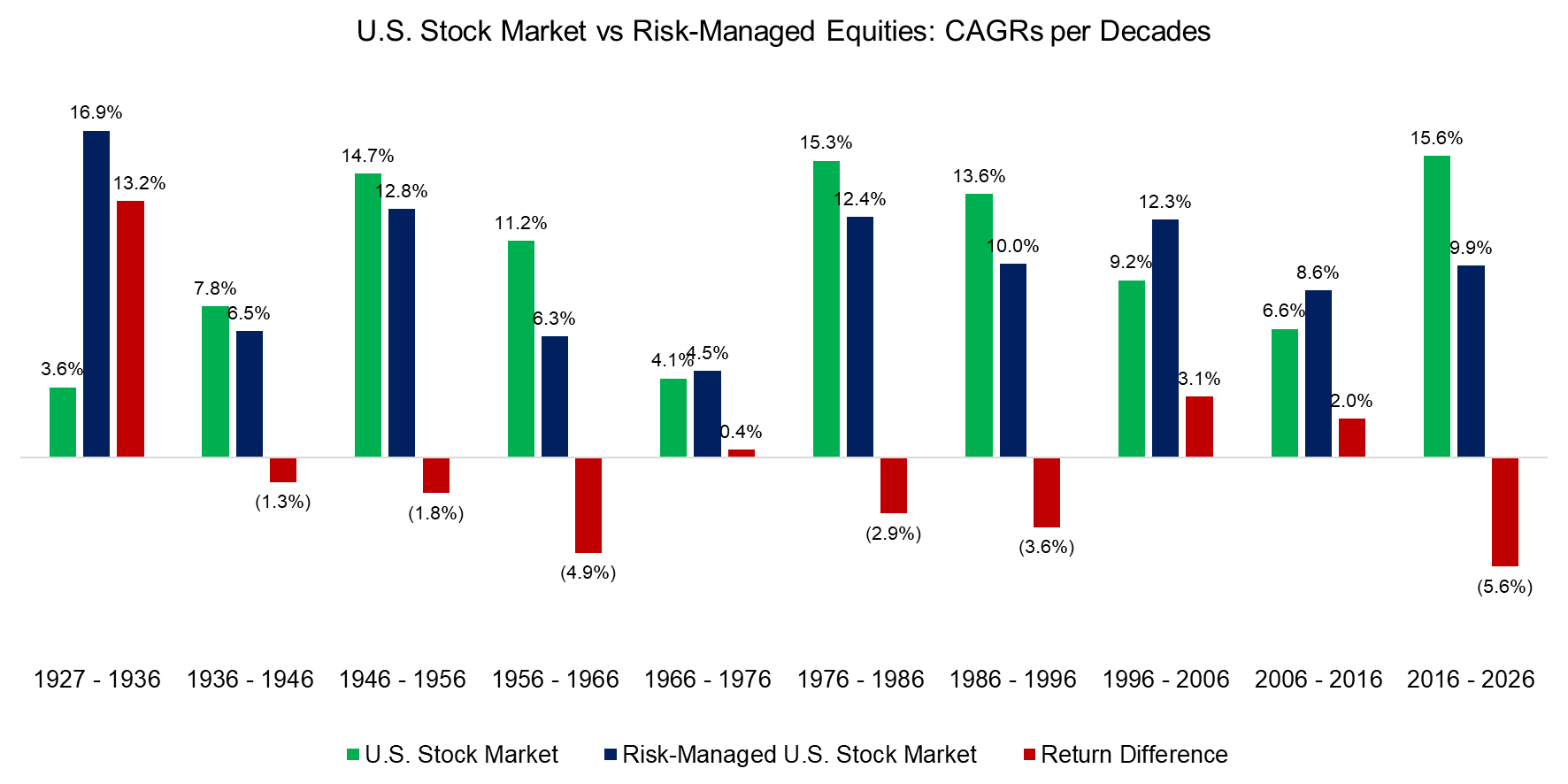
We can use the 100-year backtest to quantify how difficult it would have been for investors to stay committed to the tactical strategy. In only three out of ten decades did the risk-managed approach meaningfully improve returns. The strongest relative performance occurred during the Great Depression era (1927–1936), while the weakest results were seen in the most recent decade. For most investors, it is challenging to persist with a strategy that underperforms by -5.6% per year, regardless of how compelling the backtest may appear.
Source: Finominal
PERFORMANCE OF RISK-MANAGED EQUITIES IN JAPAN
The objective of risk management is to improve risk-adjusted returns, not necessarily to maximize absolute returns. Over the past century, the U.S. stock market has been among the best-performing equity markets globally – if not the strongest – with the most recent decade being particularly robust.
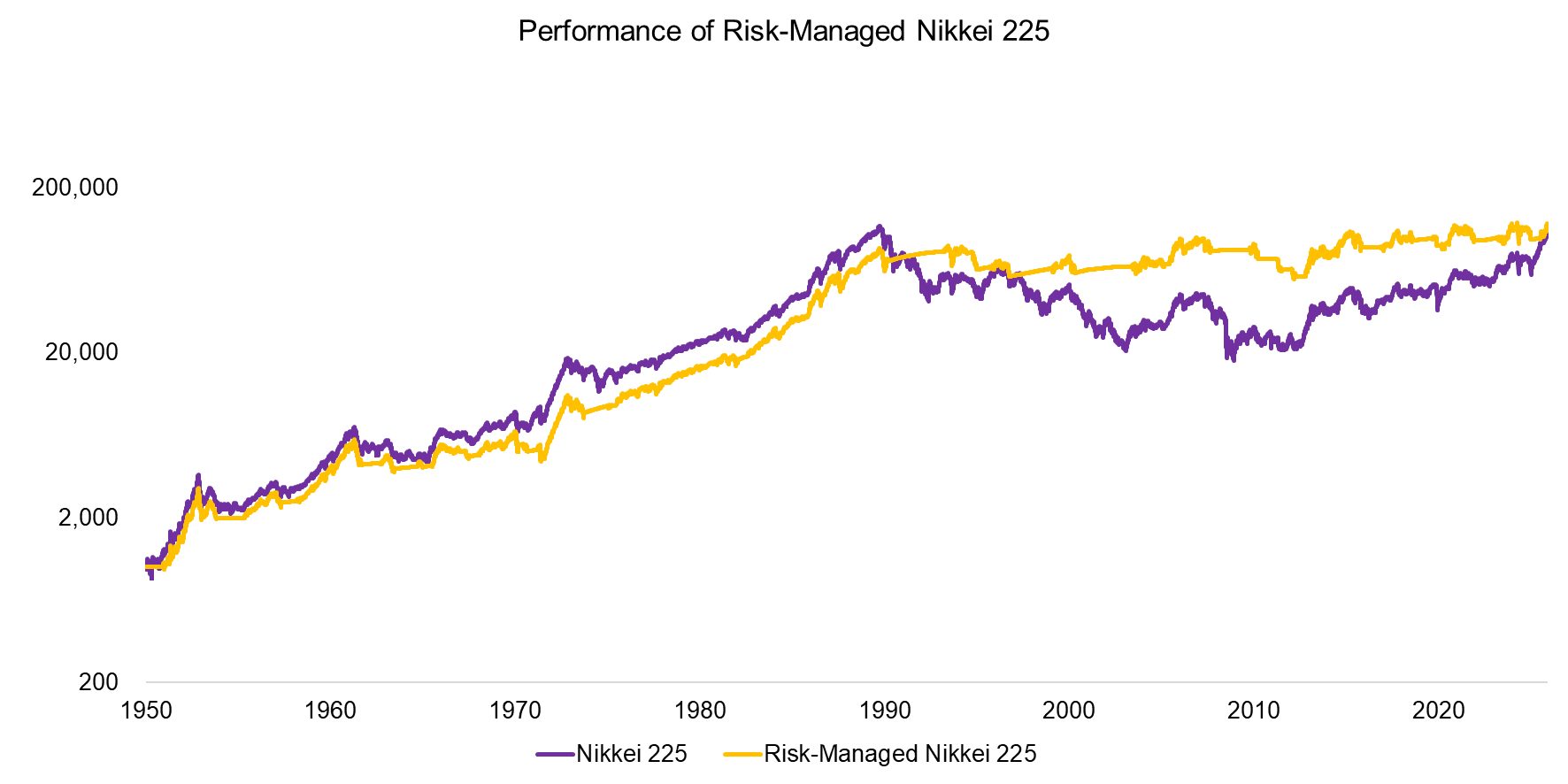
It is therefore useful to evaluate the tactical asset allocation strategy under different market environments. As a second case study, we consider Japan, which experienced a strong bull market from the post-World War II period through around 1990, followed by two decades of prolonged stagnation and then a more recent recovery. In this context, the risk-managed approach to the Nikkei 225 captured much of the postwar bull run while also largely avoiding the severe drawdown and extended stagnation following the collapse of the late-1980s bubble. The tactical strategy generated a Sharpe ratio of 0.48, compared to 0.33 for the buy-and-hold strategy.
Source: Finominal
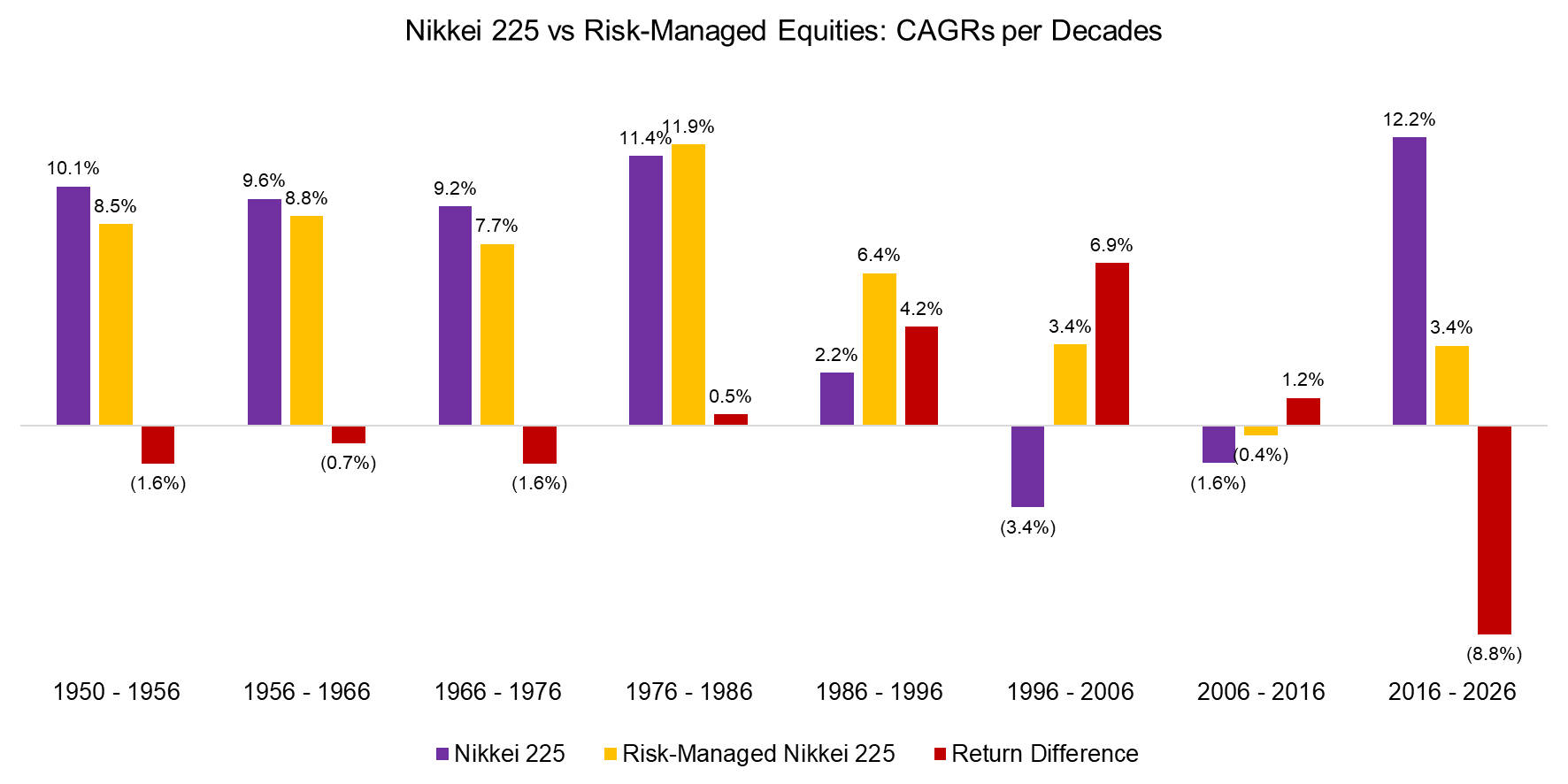
We again compute the decade-level CAGRs for the Nikkei 225 and its risk-managed counterpart. The tactical strategy only slightly lagged during the strong bull market from 1950 to 1990, while it significantly outperformed in the subsequent decades. However, between 2016 and 2026 – a period of strong performance for the Nikkei 225 – the risk-managed version underperformed by 8.8% per year, a worse shortfall than its U.S. equivalent.
Source: Finominal
FURTHER THOUGHTS
The simple risk-on / risk-off strategy has added value for investors over time, but it is difficult to implement in practice due to extended periods of significant underperformance. As with maintaining a healthy diet and exercising regularly, there is a substantial gap between knowing what to do and consistently executing it over time.
RELATED RESEARCH
Risk-Managed Equity Exposure III
Risk-Managed Equity Exposure II
Risk-Managed Equity Exposure
Combining Risk-Managed Equities and Managed Futures – II
Combining Risk-Managed Equities and Managed Futures
Defining Tactical Asset Allocation
Revisiting the Performance of TAA ETFs
Tactical ETFs: Tactfully No, Thank You?
Risk versus Momentum-based Equity Allocations
Market Timing vs Risk Management
Market Timing with Multiples, Momentum, and Volatility
Stock Selection versus Asset Allocation
The Fallacy of Betting on the Best Stock Market
What´s Better than the S&P 500?
Outperformance via Leverage
ABOUT THE AUTHOR
Nicolas Rabener is the CEO & Founder of Finominal, which empowers professional investors with data, technology, and research insights to improve their investment outcomes. Previously he created Jackdaw Capital, an award-winning quantitative hedge fund. Before that Nicolas worked at GIC and Citigroup in London and New York. Nicolas holds a Master of Finance from HHL Leipzig Graduate School of Management, is a CAIA charter holder, and enjoys endurance sports (Ironman & 100km Ultramarathon).
Connect with me on LinkedIn or X.