
Trend Following in Equities II
As good as in other asset classes?
July 2026. Reading Time: 10 Minutes. Author: Nicolas Rabener.
SUMMARY
- It is debatable whether CTAs should trade equities
- Trend following in equities performed poorly since the GFC
- However, diversification benefits were generated
INTRODUCTION
One of the most debated questions in the managed futures industry is whether to include equities. Originally, these managers focused on exploiting commodity trends – hence their other name, commodity trading advisors (CTAs). As exchanges like the CME and CBOT introduced futures on other asset classes, including currencies and fixed income, the same trend-following approach was applied to these markets. The S&P 500 futures contract was launched in 1982, and other major equity index futures followed.
Although the CTA industry originated in the United States, European managers such as Winton were particularly aggressive in expanding their programs into new markets. The rationale is straightforward: more tradable markets mean more trading opportunities and greater risk diversification.
However, some managed futures managers continue to argue for excluding equities on two grounds. First, most investors already hold the majority of their assets in equities – additional equity exposure through CTAs is therefore redundant, and short equity positions can inadvertently reduce an investor’s overall equity allocation at precisely the wrong moment. Second, equity markets tend to feature prolonged bull markets punctuated by sharp but short-lived bear markets, making it structurally difficult to exploit them systematically through trend following.
In previous research, we examined CTAs with and without equity markets and concluded that equities were not needed for generating diversification benefits (read CTAs: With or Without Trend Following in Equities?).
In this article, we evaluate trend following in equities on a standalone basis.
TREND FOLLOWING IN THE U.S. STOCK MARKET
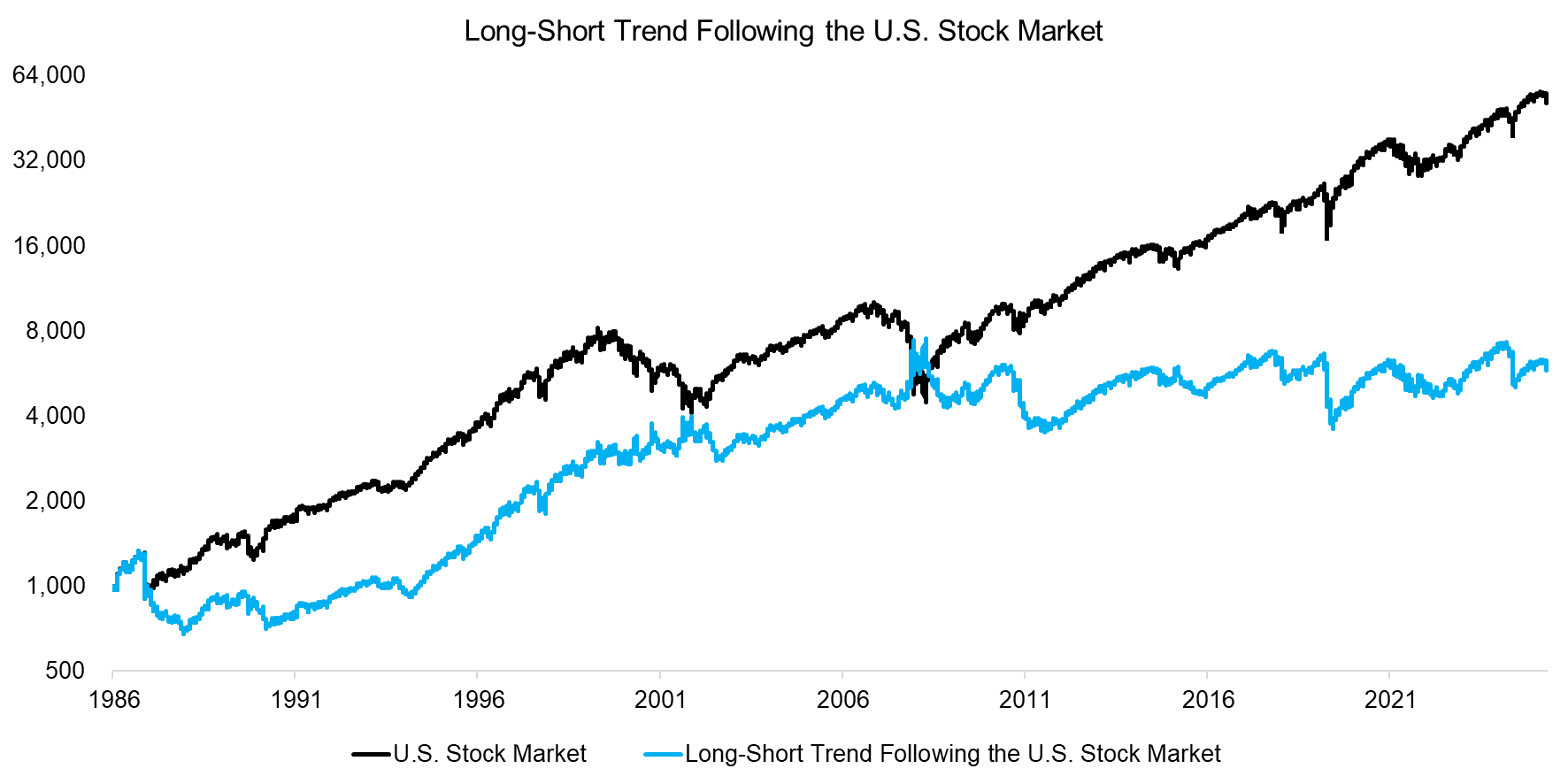
The basic trend-following strategy is to go long an asset class when the trend is positive and short when it is negative. We simulate this using the U.S. stock market, determining the trend via the 250-day moving average, rebalancing monthly, and assuming transaction costs of 0.2%. We use stock market data from AQR’s data library.
The backtest begins in 1987 and almost immediately encounters its first major challenge: the strategy switched from long to short following the October 1987 crash, only for the market to recover quickly, producing a significant drawdown before the position could be reversed. This episode foreshadows a recurring weakness that becomes more pronounced later in the analysis.
From that point through to the Global Financial Crisis, the strategy performed relatively well. It preserved capital during the technology bubble implosion between 2001 and 2003 and again during the GFC in 2008 and 2009 – both episodes where sustained downtrends gave trend-following strategies the time they need to work.
However, the strategy generated no meaningful excess returns in the period thereafter. This can be attributed to a series of sharp market declines that were swiftly reversed by central bank and government intervention – the same dynamic that undermined the strategy in October 1987. Trend following is structurally ill-suited to environments where drawdowns are short-lived and recoveries are rapid.
Source: Finominal
TREND FOLLOWING ACROSS STOCK MARKETS
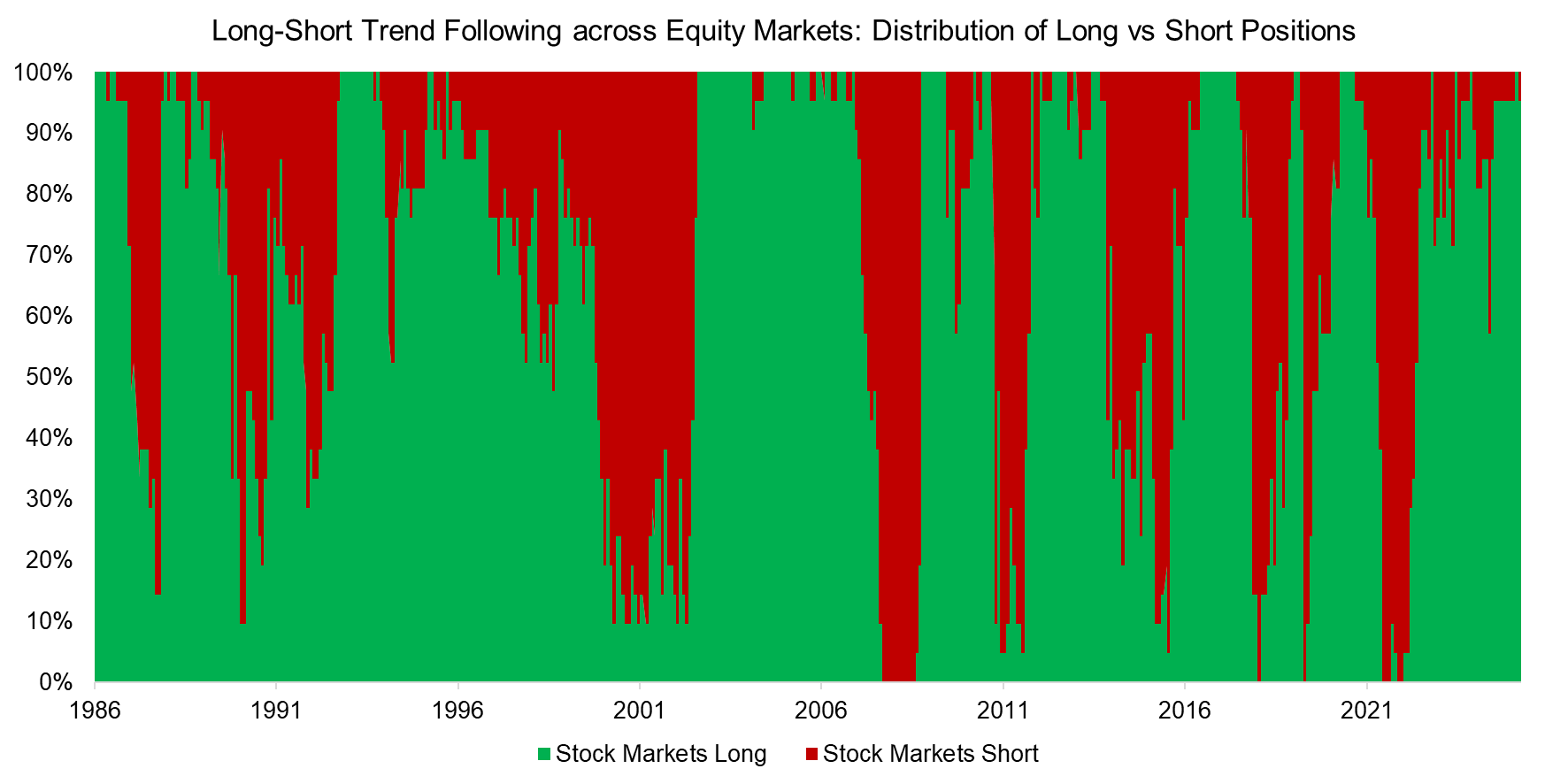
We next expand the universe to 21 developed stock markets, applying the same trend-following methodology across all of them and using equal allocations. Computing the distribution of long versus short positions reveals a 70/30 split – intuitive given that global equity markets have been in a broad bull market for most of the period since 1986. There were only four instances where the entire portfolio moved to a net short position, and these were mostly brief episodes – with the notable exception of the GFC, where the short positioning was sustained for a meaningful period.
Source: Finominal
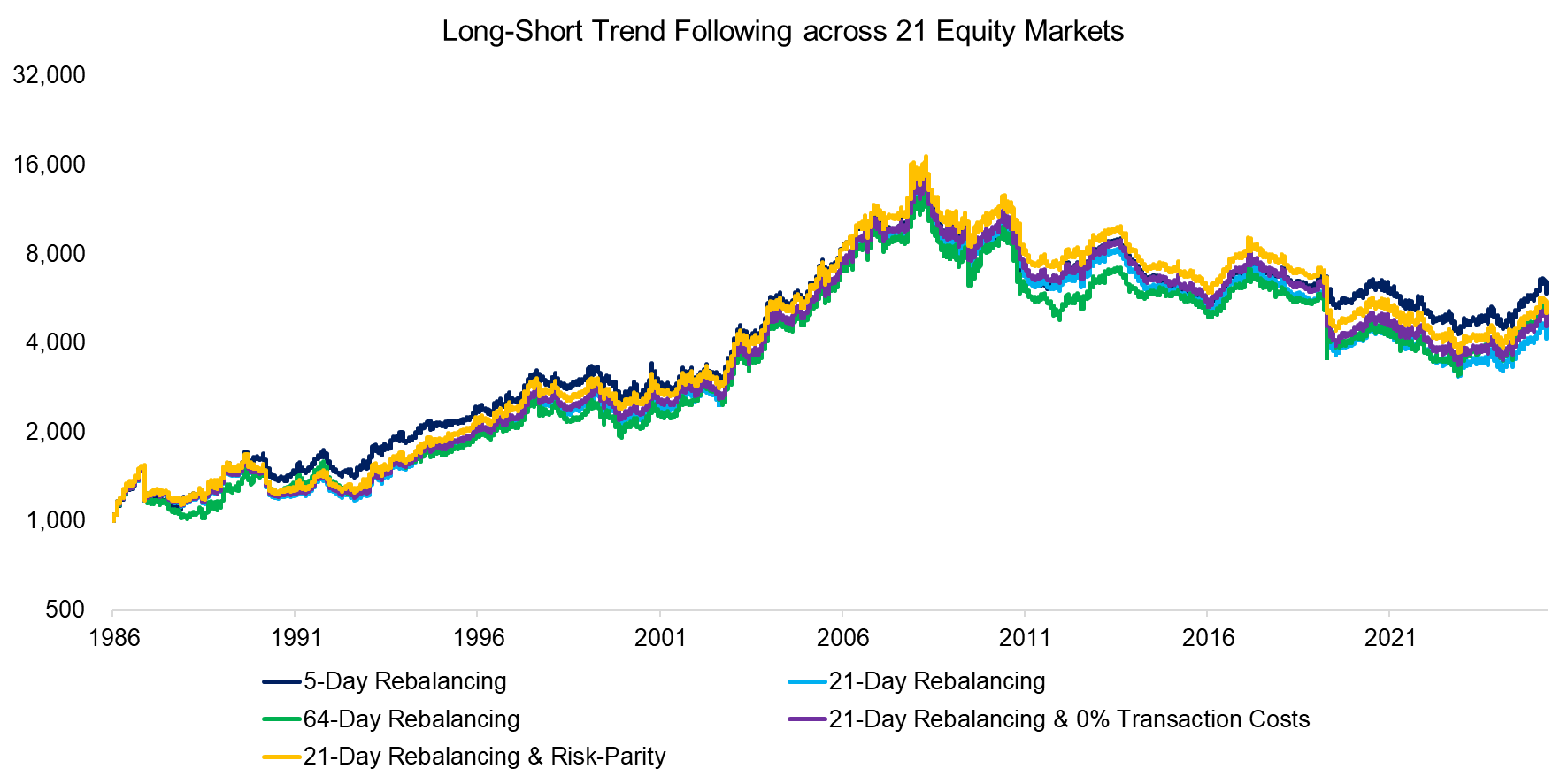
Plotting the performance of the long-short trend-following strategy in equities reveals a clear structural break: relatively consistent positive returns from 1986 to 2009, followed by consistent losses thereafter. As discussed, the poor post-GFC performance can largely be attributed to a market regime characterized by sharp drawdowns and swift reversals – an environment where trend-following is structurally disadvantaged.
We also tested the robustness of the results by varying the rebalancing frequency from monthly to weekly and quarterly, adjusting transaction costs from 0.20% to 0%, and changing the weighting scheme from equal-weight to risk parity. None of these modifications had a meaningful impact on the risk-return profile of the strategy – suggesting the results reflect a genuine feature of the return environment rather than a sensitivity to modeling choices.
Source: Finominal
LONG-SHORT TREND FOLLOWING IN EQUITIES VS ACROSS ASSET CLASSES
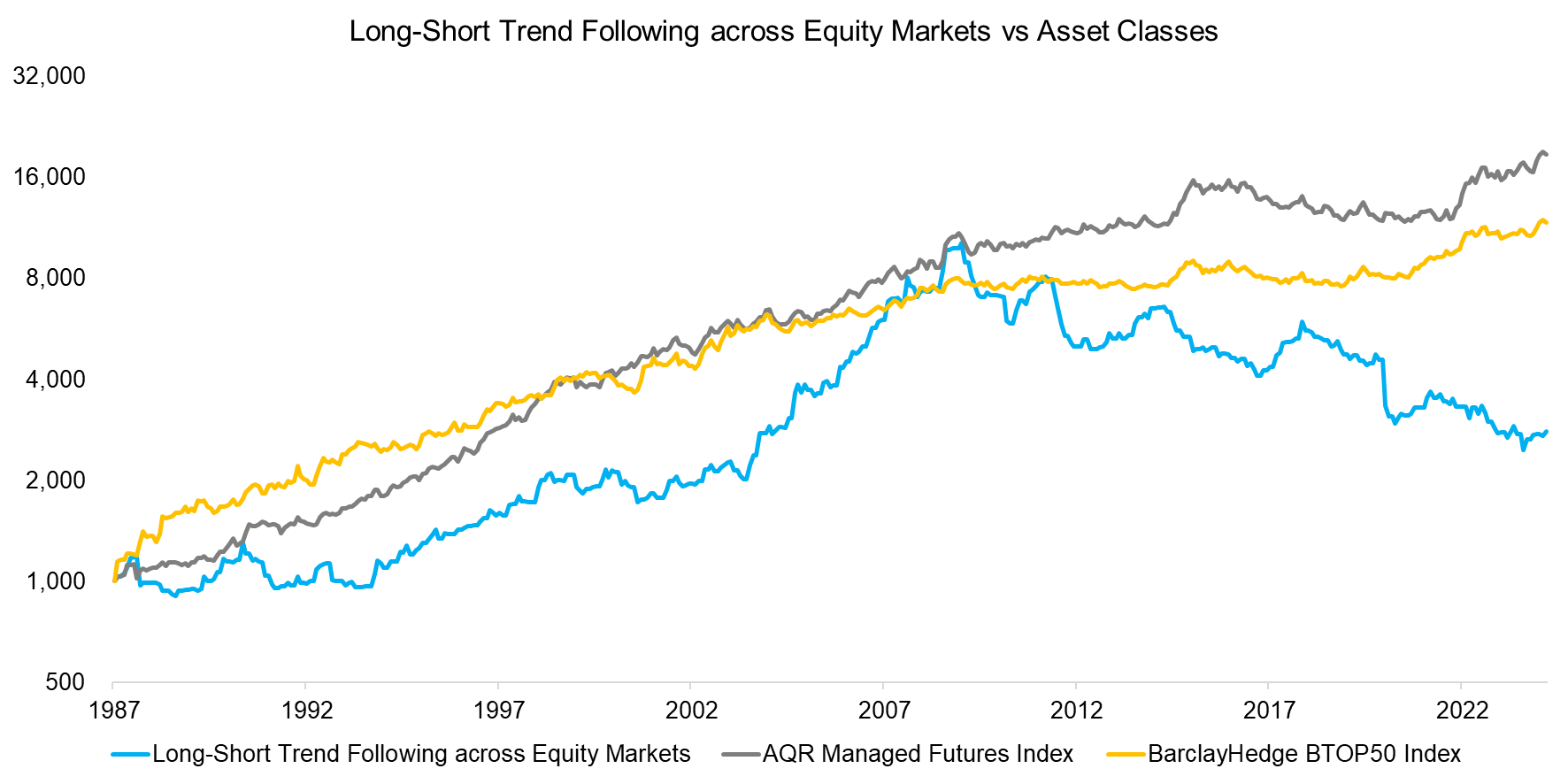
We can further contextualize the equity trend-following results by comparing them to trend-following across all asset classes. Using managed futures indices from AQR and BarclayHedge – which exhibit broadly similar patterns over the past 40 years – we find that although neither index is highly correlated with the equity-only strategy, the same structural pattern emerges: trend following was meaningfully more profitable before the GFC than after.
Source: Finominal
QUANTIFYING DIVERSIFICATION BENEFITS
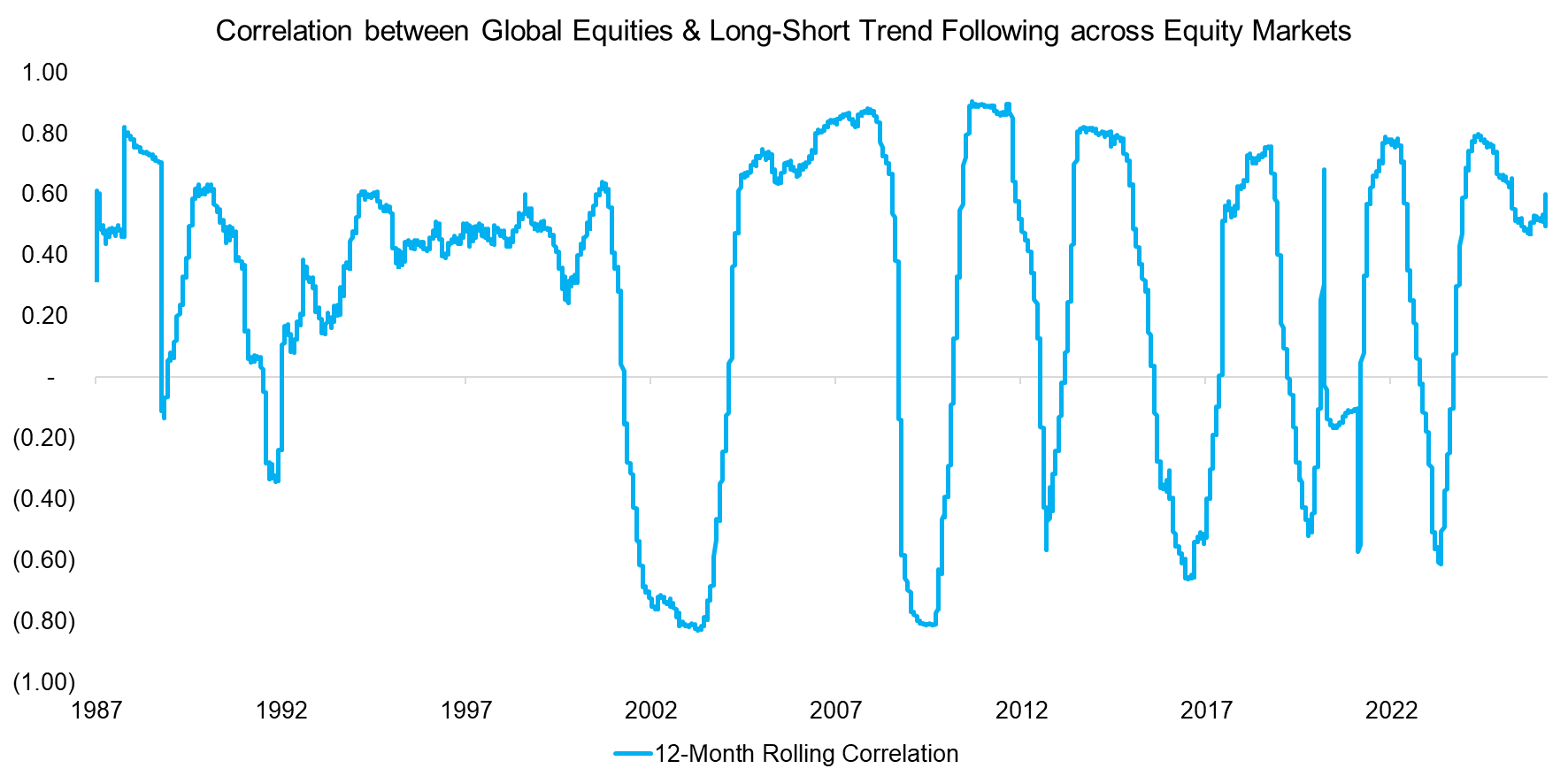
The average correlation between the trend-following strategy and global equities was just 0.13 over the full period from 1986 to 2026, suggesting meaningful diversification potential. However, this masks dramatic variation: rolling correlations ranged from a maximum of 0.90 to a minimum of -0.83. This confirms that the strategy carries a real risk of doubling up on equity exposure ahead of a market decline, or conversely, of reducing equity exposure through a short position precisely when markets are recovering.
Source: Finominal
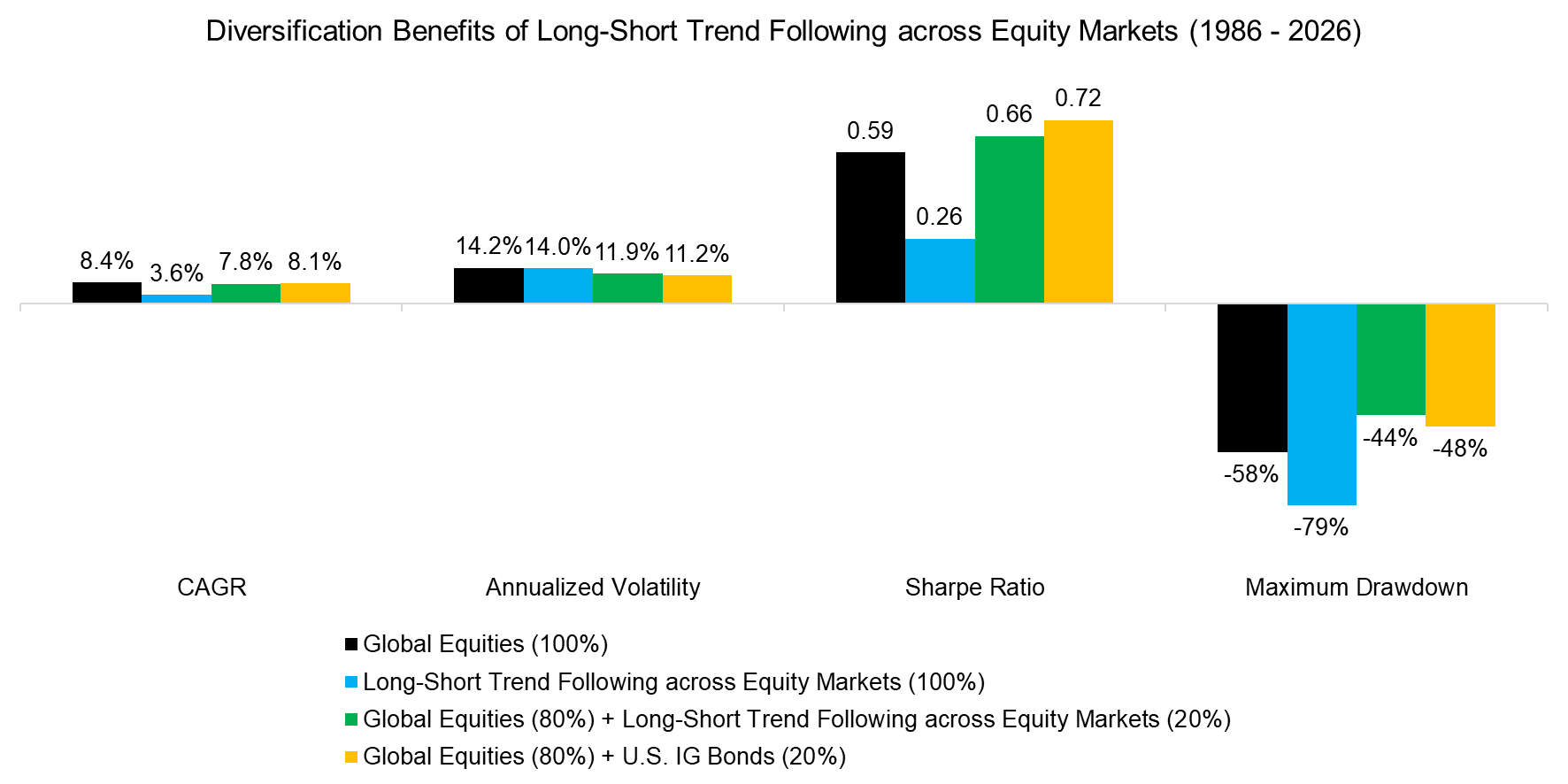
Finally, we simulate adding a 20% allocation to the trend-following strategy to a portfolio of global equities, rebalanced quarterly. The result is a reduction in CAGR and volatility, a shallower maximum drawdown, and a modest improvement in the Sharpe ratio – confirming diversification benefits. However, a 20% allocation to U.S. investment-grade bonds would have been more accretive over the same period, yielding a meaningfully higher Sharpe ratio of 0.72 versus 0.66 for the trend-following equity strategy.
Source: Finominal
FURTHER THOUGHTS
Including equities in a managed futures strategy has been accretive over the past few decades, supported by the broad upward trend in global stock markets. However, the failure to exploit trends since the GFC – and the resulting consistent losses – is concerning. There is little indication that central banks and governments will intervene less in markets going forward, which suggests the structural headwind facing equity trend-following strategies is unlikely to abate.
RELATED RESEARCH
Trend Following in Equities
Trend Following in Bear Markets
CTAs: With or Without Trend Following in Equities?
Managed Futures vs Factor Investing: A 100-Year Perspective
Bonds vs. Managed Futures: A 100-Year Perspective
Trend Following & Factor Investing – Unexpected Cousins?
Managed Futures versus Market-Neutral Multi-Factor Investing
60/40 Portfolios Without Bonds
Bonds versus CTAs for Diversification
How Much Should You Allocate to Managed Futures?
Combining Risk-Managed Equities and Managed Futures – II
Combining Risk-Managed Equities and Managed Futures
Carry versus Trend Following
Replicating a CTA via Factor Exposures
Creating a CTA from Scratch – II
CTAs vs Global Macro Hedge Funds
Managed Futures: The Empire Strikes Back
Managed Futures: Fast & Furious vs Slow & Steady
Hedging via Managed Futures Liquid Alts
ABOUT THE AUTHOR
Nicolas Rabener is the CEO & Founder of Finominal, which empowers professional investors with data, technology, and research insights to improve their investment outcomes. Previously he created Jackdaw Capital, an award-winning quantitative hedge fund. Before that Nicolas worked at GIC and Citigroup in London and New York. Nicolas holds a Master of Finance from HHL Leipzig Graduate School of Management, is a CAIA charter holder, and enjoys endurance sports (Ironman & 100km Ultramarathon).
Connect with me on LinkedIn or X.